
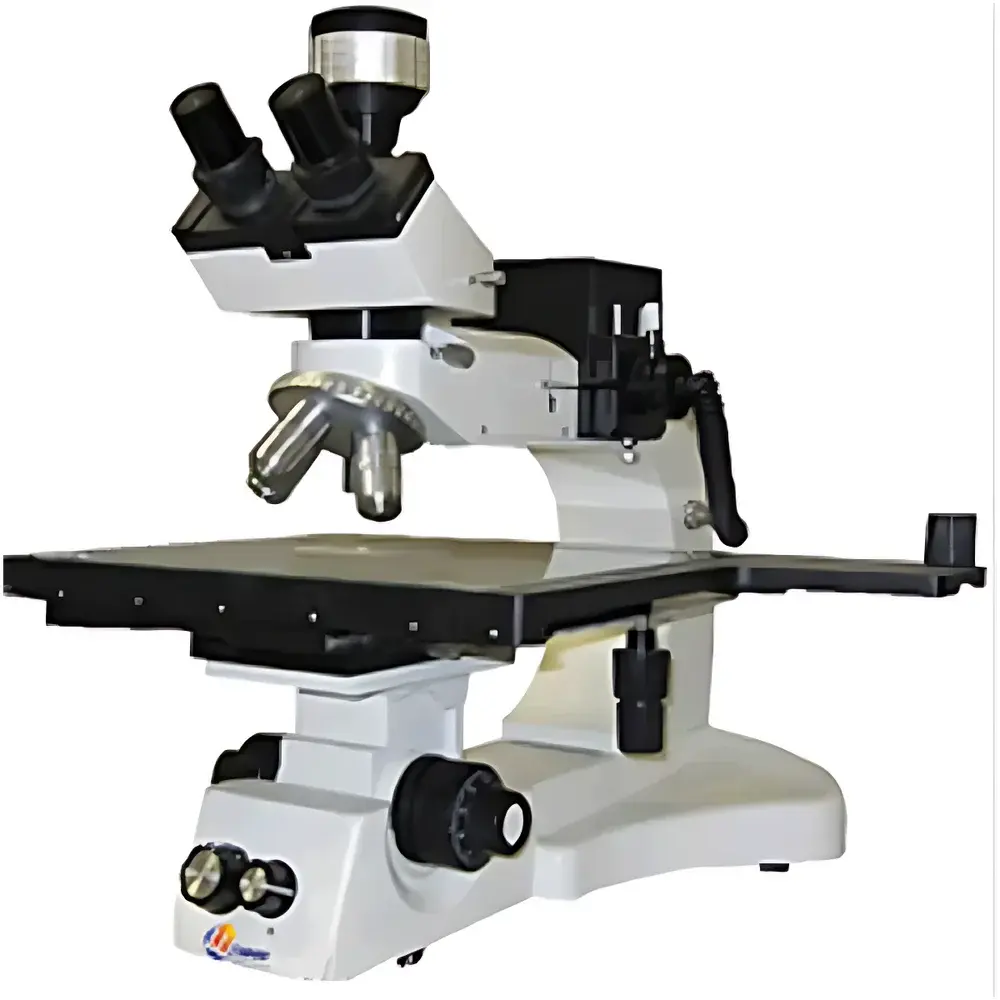
YANRUN 7XB-PC Large-Platform Integrated Circuit Inspection Metallurgical Microscope
| Brand | YANRUN |
|---|---|
| Origin | Shanghai, China |
| Manufacturer Type | Direct Manufacturer |
| Product Type | Inverted Metallurgical Microscope |
| Total Magnification Range | 40×–400× |
| Eyepieces | 10× (Field Number 18) |
| Objective Lenses | 4×, 10×, 20×, 40× (Dry, Finite Conjugate) |
| Numerical Apertures | 0.10, 0.25, 0.40, 0.65 |
| Working Distances | 17.91 mm, 6.54 mm, 1.05 mm, 0.736 mm |
| Stage Dimensions | 350 mm × 255 mm |
| Stage Travel Range | 200 mm × 200 mm |
| Coarse/Fine Focus Travel | 25 mm total |
| Fine Focus Graduation | 2 µm per division, 0.2 mm per revolution |
| Illumination | 6 V / 20 W Halogen Lamp with Built-in Continuous Intensity Control |
| Nosepiece | Quadruple Revolving Turret |
| Tube | Trinocular (Photo Port Enabled) |
Overview
The YANRUN 7XB-PC is an inverted metallurgical microscope engineered for high-precision inspection of integrated circuits (ICs), semiconductor wafers, printed circuit boards (PCBs), and other planar microelectronic components. Its inverted optical configuration places the objective lenses beneath the specimen stage—enabling unobstructed access to large, heavy, or topographically complex samples mounted on standard wafer carriers or custom fixtures. The system operates on brightfield illumination with finite-conjugate, dry objective optics optimized for surface morphology analysis, defect identification (e.g., scratches, voids, delamination, solder joint integrity), and metallurgical phase evaluation in package-level assemblies. Designed for laboratory and production QA/QC environments, the 7XB-PC delivers consistent resolution across its 40×–400× magnification range while maintaining mechanical stability during extended manual or semi-automated inspection workflows.
Key Features
- Inverted optical architecture with fixed-stage design—ideal for oversized, rigid, or vertically constrained specimens such as full-size IC substrates, lead frames, and power modules.
- Extra-large mechanical stage (350 mm × 255 mm) with 200 mm × 200 mm travel range, enabling seamless navigation across multi-die wafers or panel-level PCBs without repositioning.
- Precision coaxial coarse/fine focusing mechanism: 25 mm total vertical travel; fine focus calibrated to 2 µm per graduation mark and 0.2 mm per full revolution—ensuring repeatable Z-axis positioning for comparative layer analysis.
- Quadruple revolving nosepiece accommodating four parfocal, color-corrected dry objectives (4×, 10×, 20×, 40×) with specified numerical apertures (0.10–0.65) and working distances (0.736–17.91 mm) to balance resolution, depth of field, and clearance for probe stations or thermal stages.
- Trinocular observation tube with dedicated photo port—compatible with optional C-mount adapters (0.5× standard included) for integration with industrial cameras up to 12 MP resolution.
- Stable 6 V / 20 W halogen illumination system with built-in continuous intensity control, delivering uniform Köhler illumination across the entire field of view at all magnifications.
Sample Compatibility & Compliance
The 7XB-PC accommodates specimens up to 50 mm in height and 5 kg in mass, supporting industry-standard carriers including 8-inch and 12-inch wafer chucks, ceramic substrate trays, and metal heat sinks. Its open-bottom design permits direct mounting of electrostatic discharge (ESD)-safe stages and in-situ thermal platforms. While the base configuration does not include image analysis software, the trinocular port meets ISO 8578:2021 mechanical interface specifications for auxiliary imaging devices. All optical components comply with ISO 10110-7 for surface quality and ISO 9022-3 for environmental robustness under controlled lab conditions (20–25°C, <60% RH). The instrument is suitable for use in GLP-compliant laboratories when paired with validated digital capture hardware and documented calibration procedures.
Software & Data Management
The 7XB-PC operates as a standalone optical platform; no proprietary software is bundled. However, its C-mount photo port supports third-party machine vision systems compliant with USB3 Vision or GigE Vision standards. Optional accessories include research-grade image analysis software packages validated per ASTM E1558–22 for quantitative grain size measurement, inclusion counting, and line-profile intensity analysis. When integrated with FDA 21 CFR Part 11–compliant data acquisition systems, audit trails, electronic signatures, and version-controlled report generation can be implemented for regulated semiconductor manufacturing environments.
Applications
- Failure analysis of bond wires, solder bumps, and copper pillars in flip-chip and 2.5D/3D packaging.
- Visual verification of lithographic alignment marks, etch uniformity, and resist residue on post-processing wafers.
- Metallurgical assessment of plating thickness, intermetallic compound (IMC) formation, and recrystallization in lead-free solder joints.
- Non-destructive inspection of die attach voiding, mold compound delamination, and wire sweep in encapsulated ICs.
- Quality gate screening for automotive AEC-Q200 qualified components requiring visual evidence of structural integrity per IATF 16949 clause 8.5.1.2.
FAQ
Is the 7XB-PC compatible with automated stage controllers or motorized focus units?
Yes—its stage and focus mechanisms feature standardized M4 and M6 threaded mounting interfaces, allowing integration with third-party motorized translation stages and piezoelectric Z-drives using OEM adapter plates.
Can oil-immersion objectives be used with this system?
No—the 7XB-PC is configured exclusively for dry objectives; oil-immersion optics are incompatible due to mechanical constraints of the inverted design and lack of immersion fluid management pathways.
What calibration documentation is provided with shipment?
Each unit ships with a factory calibration certificate verifying stage travel linearity (±0.02 mm over full range), focus scale accuracy (±1 µm per division), and illumination uniformity (>90% across FOV at 10× magnification).
Are replacement halogen lamps RoHS-compliant?
Yes—all supplied 6 V / 20 W halogen lamps meet EU Directive 2011/65/EU (RoHS 2) and carry CE marking for electromagnetic compatibility and safety.
Does the trinocular tube support beam-splitting for simultaneous eyepiece viewing and camera capture?
Yes—the standard trinocular head provides a fixed 20:80 beam splitter ratio (20% to eyepieces, 80% to photo port), ensuring optimal brightness for both real-time observation and high-fidelity digital capture.






