
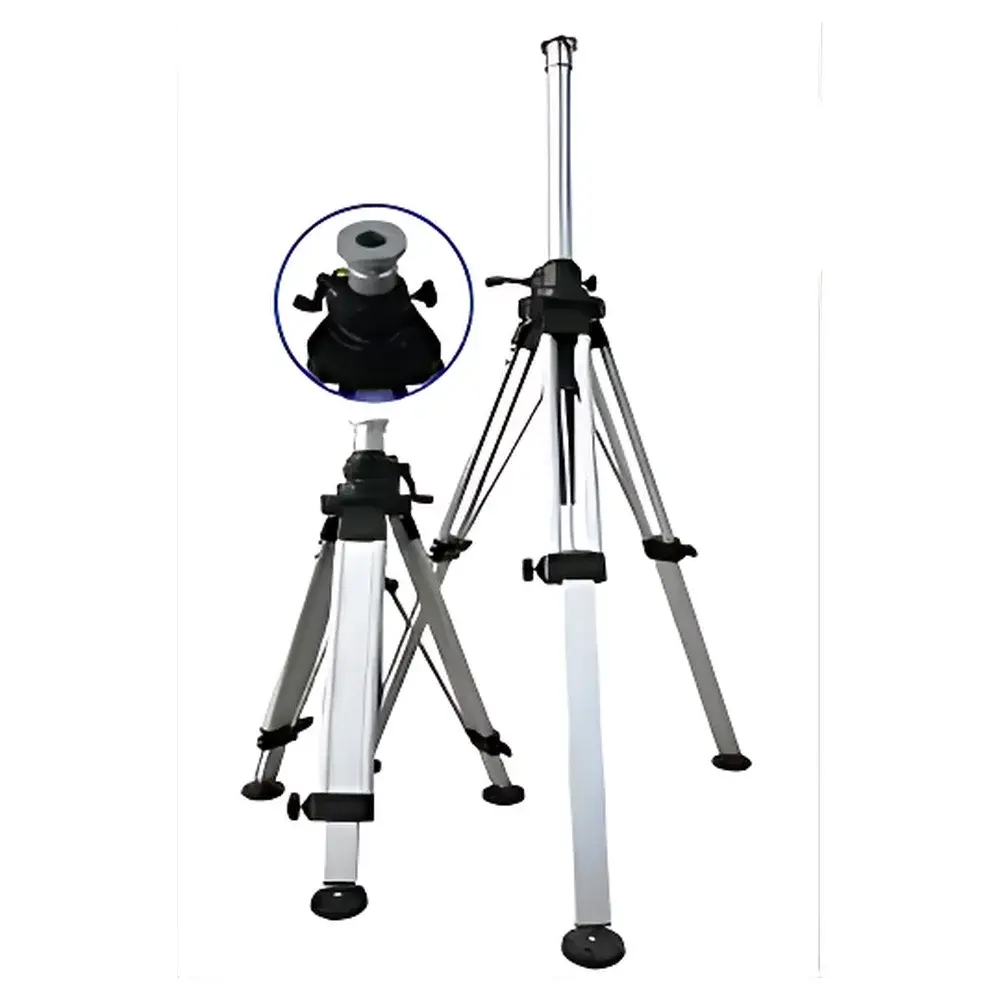
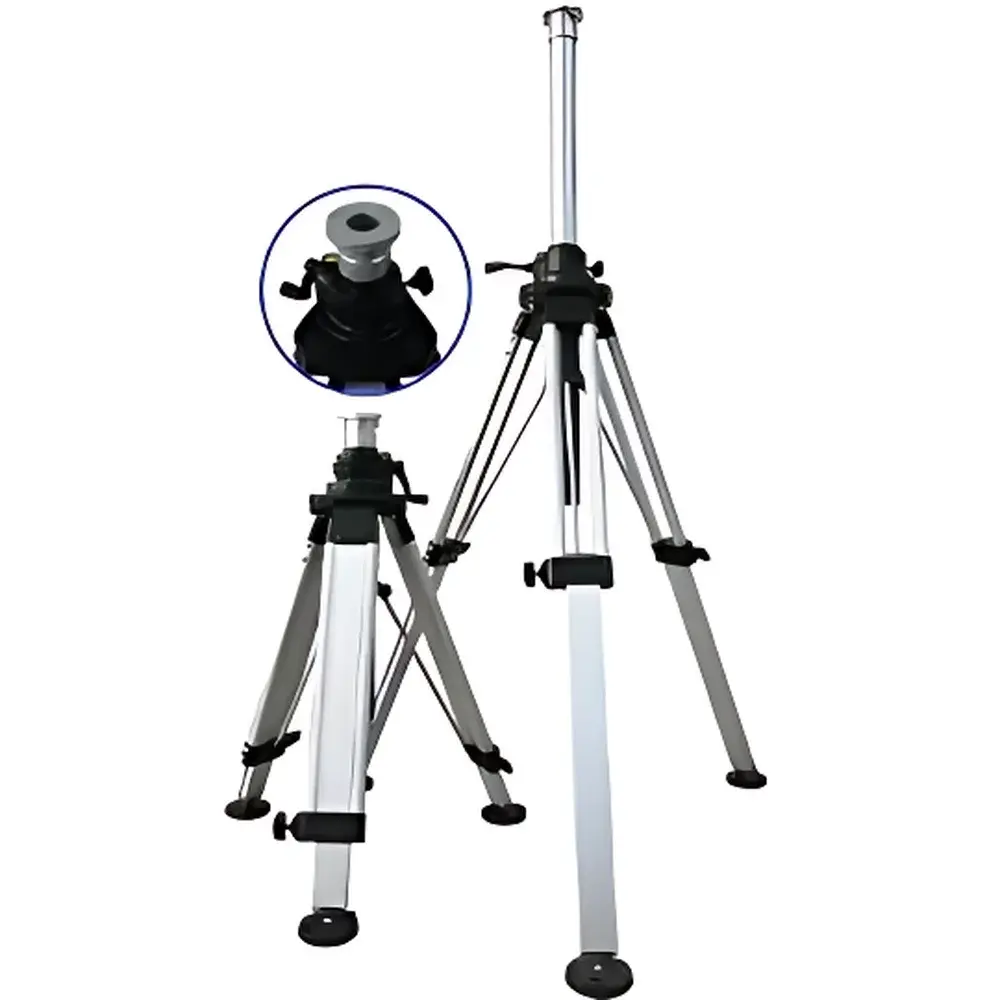
YANRUN LP-1 Adjustable Tripod Stand (750–1550 mm)
| Brand | YANRUN |
|---|---|
| Origin | Shanghai, China |
| Manufacturer Type | Direct Manufacturer |
| Country of Origin | China |
| Model | LP-1 |
| Component Category | Optical Support Hardware |
| Height Adjustment Range | 750–1550 mm |
Overview
The YANRUN LP-1 Adjustable Tripod Stand is a precision-engineered optical support platform designed for stable, vibration-dampened positioning of optical instruments—including autocollimators, collimators, alignment telescopes, and interferometric sensors—in metrology laboratories, calibration facilities, and optical assembly lines. Its core function is mechanical stabilization and fine vertical positioning: the tripod employs a three-point kinematic base with individually lockable leg extensions and a centrally threaded vertical column enabling smooth, backlash-free height adjustment across a 800 mm working range (750–1550 mm). Constructed from high-rigidity aluminum alloy with anodized surface treatment, the LP-1 minimizes thermal drift and maintains geometric integrity under sustained load—critical when supporting instruments requiring sub-arcsecond angular stability during long-duration measurements.
Key Features
- Continuous height adjustment from 750 mm to 1550 mm via precision-machined central lead screw with dual-locking mechanism (coarse + fine thread engagement)
- Three independently adjustable, non-slip rubber-tipped legs with graduated scale markings for repeatable leveling and repositioning
- Top mounting plate features standardized M6 threaded holes in 25 mm grid pattern (ISO 2093 compliant), compatible with industry-standard optical breadboards, kinematic mounts, and instrument adapters
- Integrated bubble level embedded in the top plate for rapid coarse leveling prior to fine adjustment
- Load capacity rated at 15 kg static (centered), validated per ISO 10360-2 mechanical stability criteria for optical support structures
- No-tool assembly/disassembly design with captive fasteners and corrosion-resistant hardware
Sample Compatibility & Compliance
The LP-1 is engineered to serve as a universal mechanical interface for optical instruments requiring stable elevation and minimal parasitic motion. It supports devices weighing ≤15 kg with center-of-gravity within ±25 mm of the central axis—ensuring tip/tilt deviation remains below 1.2 arcseconds over full height range (per ASTM E1317-22 test protocol for optical support rigidity). The stand complies with ISO 7000-0425 (graphical symbols for equipment adjustment) and meets mechanical safety requirements outlined in EN 10219-1 for cold-formed structural hollow sections used in support frames. While not an active measurement device, its dimensional repeatability (±0.15 mm height reproducibility after 1000 adjustment cycles) supports GLP-aligned calibration workflows where mechanical setup consistency is traceable.
Software & Data Management
As a passive mechanical component, the LP-1 requires no embedded firmware or software integration. However, it is fully interoperable with industry-standard optical metrology software platforms—including Metrology Studio, QED MetroPro, and Zygo Metrology Suite—when used in conjunction with compatible instruments such as dual-axis autocollimators (e.g., TriOptics OptiCentric series) or laser tracker systems. Its consistent height positioning enables automated measurement sequences where Z-axis coordinate referencing is synchronized via external encoders or digital calipers interfaced through USB/RS-232. Audit trails for mechanical setup parameters (e.g., final height setting, leveling status) can be manually logged or captured via connected vision systems adhering to FDA 21 CFR Part 11 electronic record requirements.
Applications
- Stabilized mounting of dual-axis autocollimators for angular error mapping of precision machine tool spindles (per ISO 230-1 Annex D)
- Elevation control of laser interferometers during straightness and flatness verification of granite surface plates (ASTM E1155)
- Height-adjustable platform for collimator alignment in optical telescope collimation rigs and satellite payload ground test setups
- Modular support in multi-instrument optical benches where differential height compensation between beam paths is required
- Calibration station base for angle encoders and rotary tables, providing repeatable Z-reference for multi-axis error separation
FAQ
Is the LP-1 compatible with vacuum or cleanroom environments?
Yes—the anodized aluminum construction and absence of lubricants or outgassing polymers meet ISO 14644-1 Class 5 particulate limits; however, optional stainless-steel fastener kits are recommended for Class 4 or higher environments.
Can the tripod be anchored to an optical table?
Yes—four M6 threaded holes (12 mm depth) on the underside of the base plate allow direct bolting to standard 12 mm or 25 mm pitch optical table tapped holes.
Does YANRUN provide calibration documentation for mechanical repeatability?
A factory-verified mechanical repeatability report (±0.15 mm over 1000 cycles) is included with each unit; NIST-traceable calibration certificates are available upon request with additional lead time.
What is the maximum allowable off-center load?
For loads exceeding 5 kg applied >25 mm from center axis, use of counterbalance weights or auxiliary lateral bracing is advised to maintain angular stability within ±2 arcseconds.



