
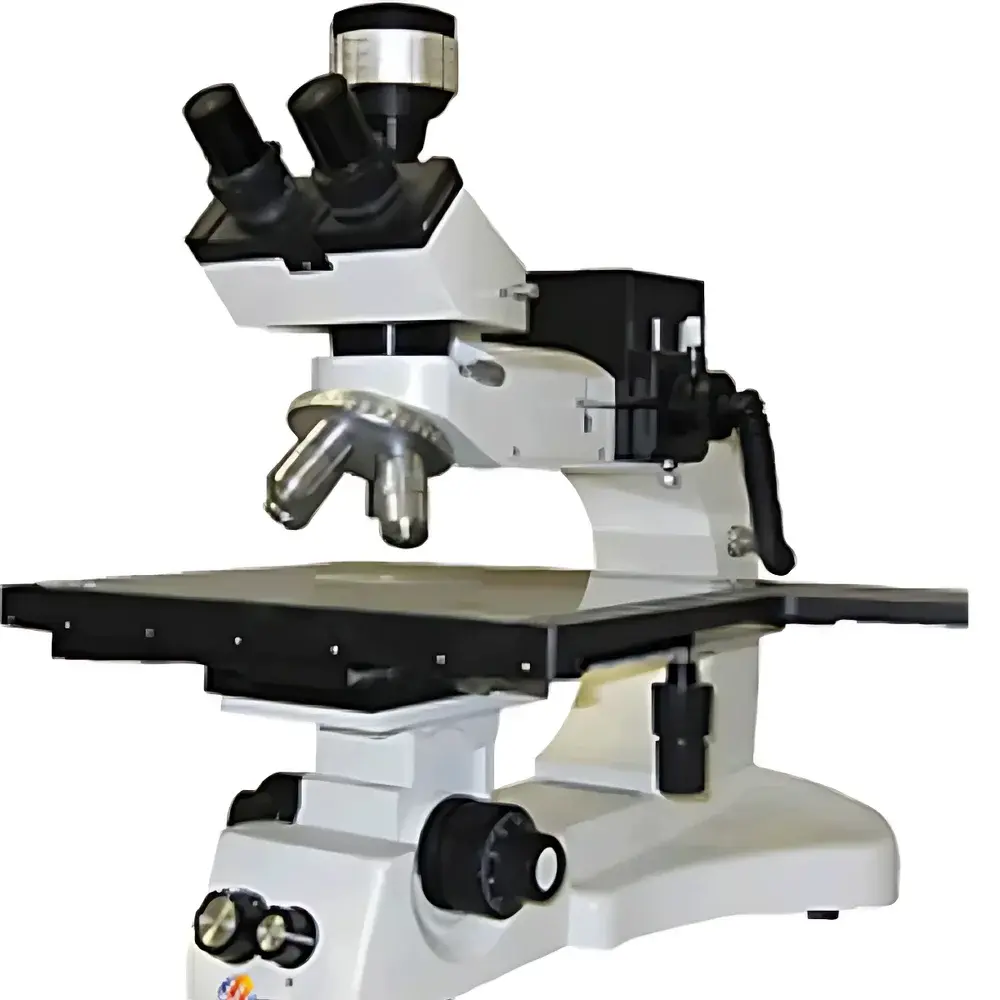
YANRUN 7XB Large-Platform Integrated Circuit Inspection Metallurgical Microscope
| Brand | YANRUN |
|---|---|
| Origin | Shanghai, China |
| Manufacturer Type | Direct Manufacturer |
| Product Type | Upright |
| Total Magnification Range | 40×–400× |
| Eyepieces | 10× (Field Number 18) |
| Objective Lenses | 4× (NA 0.10, WD 17.91 mm), 10× (NA 0.25, WD 6.54 mm), 20× (NA 0.40, WD 1.05 mm), 40× (NA 0.65, WD 0.736 mm) |
| Nosepiece | Quadruple Revolving |
| Stage Dimensions | 350 mm × 255 mm, Travel Range: 200 mm × 200 mm |
| Focusing Mechanism | Coarse/Fine Combined, 25 mm Vertical Travel, Fine Focus Graduation: 2 µm per division, 0.2 mm per revolution |
| Illumination | 6 V / 20 W Halogen Lamp with Built-in Continuous Intensity Control |
| Mounting Medium | Dry |
| Optional Accessories | Long Working Distance Objectives (50×, 80×, 100×), Digital Camera Adapters, 12.5× or Reticle Eyepieces |
Overview
The YANRUN 7XB Large-Platform Integrated Circuit Inspection Metallurgical Microscope is an upright, high-stability optical instrument engineered for precision microstructural analysis of metallurgical specimens, semiconductor wafers, and packaged ICs. Designed specifically for failure analysis, defect mapping, and process validation in microelectronics manufacturing and quality control laboratories, the system employs transmitted and reflected light illumination pathways—optimized for brightfield, darkfield, and polarized contrast modes—enabling comprehensive surface and subsurface characterization of conductive, opaque, and polished samples. Its rigid mechanical architecture minimizes vibration-induced drift during extended imaging sessions, while the large-format mechanical stage ensures stable positioning of oversized substrates, including full 300 mm wafers and multi-die PCB assemblies.
Key Features
- Upright configuration with quadruple revolving nosepiece for rapid, repeatable objective switching between 4×, 10×, 20×, and 40× dry objectives—each calibrated to ISO 10934-1 standards for magnification accuracy and parfocality.
- Large motorized-grade mechanical stage (350 mm × 255 mm) with 200 mm × 200 mm travel range and vernier-scaled X/Y controls—designed to accommodate full-sized IC test boards, wafer carriers, and cross-sectioned packages without repositioning.
- Dual-focus coaxial control: coarse focusing over 25 mm total range; fine focus with 2 µm graduation and 0.2 mm linear displacement per full rotation—enabling precise Z-axis navigation across multi-layer metallization stacks and bond interface planes.
- 6 V / 20 W halogen illumination system with integrated continuous dimming circuitry—providing stable color temperature (~3200 K) and uniform Köhler illumination across all magnifications, critical for quantitative reflectance assessment and grain boundary delineation.
- Standard 10× wide-field eyepieces (FN 18) deliver ergonomic viewing with ample eye relief; optional reticle or 12.5× eyepieces support manual measurement and alignment tasks compliant with ASTM E112 and ISO 643 grain size evaluation protocols.
Sample Compatibility & Compliance
The 7XB accommodates a broad spectrum of metallurgical and microelectronic specimens—including polished metallographic mounts, sputtered thin films, solder joint cross-sections, wire-bond interfaces, and die-attached substrates—without requiring immersion media. Its dry-objective design eliminates refractive index mismatch issues common in high-NA oil-immersion systems, ensuring consistent resolution on both conductive and dielectric surfaces. The microscope conforms to IEC 61000-6-3 (EMC emissions) and IEC 61000-6-2 (immunity) for laboratory integration. While not inherently GLP/GMP-certified, its mechanical repeatability, traceable calibration paths (via NIST-traceable stage micrometers and stage rulers), and stable illumination output support audit-ready documentation workflows aligned with ISO/IEC 17025 requirements.
Software & Data Management
Although the base configuration does not include bundled image analysis software, the optical train is fully compatible with third-party machine vision platforms—including Olympus Stream, Image-Pro Premier, and open-source Fiji/ImageJ—via standard C-mount adapter (C-Mount, 1× relay lens optional). Digital camera integration preserves native resolution up to 400× total magnification when paired with ≥5 MP sensors. All hardware interfaces (e.g., stage position encoding, illumination intensity logging) are accessible via TTL and analog voltage outputs for custom automation scripting—facilitating integration into automated FA (Failure Analysis) stations and SPC-driven QC databases.
Applications
- Fundamental metallurgical analysis: grain size quantification, phase distribution mapping, inclusion rating per ASTM E45 and ISO 4967.
- IC packaging inspection: delamination detection at die-attach interfaces, void analysis in underfill materials, solder wetting angle measurement.
- Wafer-level metrology: line width verification, photomask defect localization, CMP (Chemical Mechanical Polishing) uniformity assessment.
- Failure root cause analysis: thermal fatigue crack propagation tracking, electromigration void identification, intermetallic compound (IMC) layer thickness estimation.
- Quality assurance in electroplating, PVD/CVD coating, and laser welding processes—supporting ISO 14644 cleanroom-compatible operation when equipped with dust-shielded stage covers.
FAQ
Is the 7XB compatible with digital imaging systems?
Yes—the microscope features a standardized trinocular port with C-mount threading and optional 1× relay optics, enabling direct coupling to industrial cameras and frame grabbers.
Can long working distance objectives be retrofitted?
Yes—50×, 80×, and 100× long working distance (LWD) objectives are available as optional accessories, supporting inspection of tall components such as stacked dies and heat sinks.
Does the system meet regulatory requirements for QC documentation?
While the hardware itself does not include FDA 21 CFR Part 11-compliant electronic signatures or audit trails, its mechanical stability, calibrated stage movement, and reproducible illumination output form a foundation for validated SOPs in regulated environments.
What is the maximum specimen height clearance under the objective turret?
With the 4× objective installed, vertical clearance exceeds 18 mm—sufficient for most BGA packages, QFN leads, and thick-sectioned metallographic mounts.
Is halogen lamp replacement user-serviceable?
Yes—the lamp housing is front-accessible, and replacement bulbs (6 V / 20 W, G4 base) are industry-standard and field-replaceable without optical realignment.




