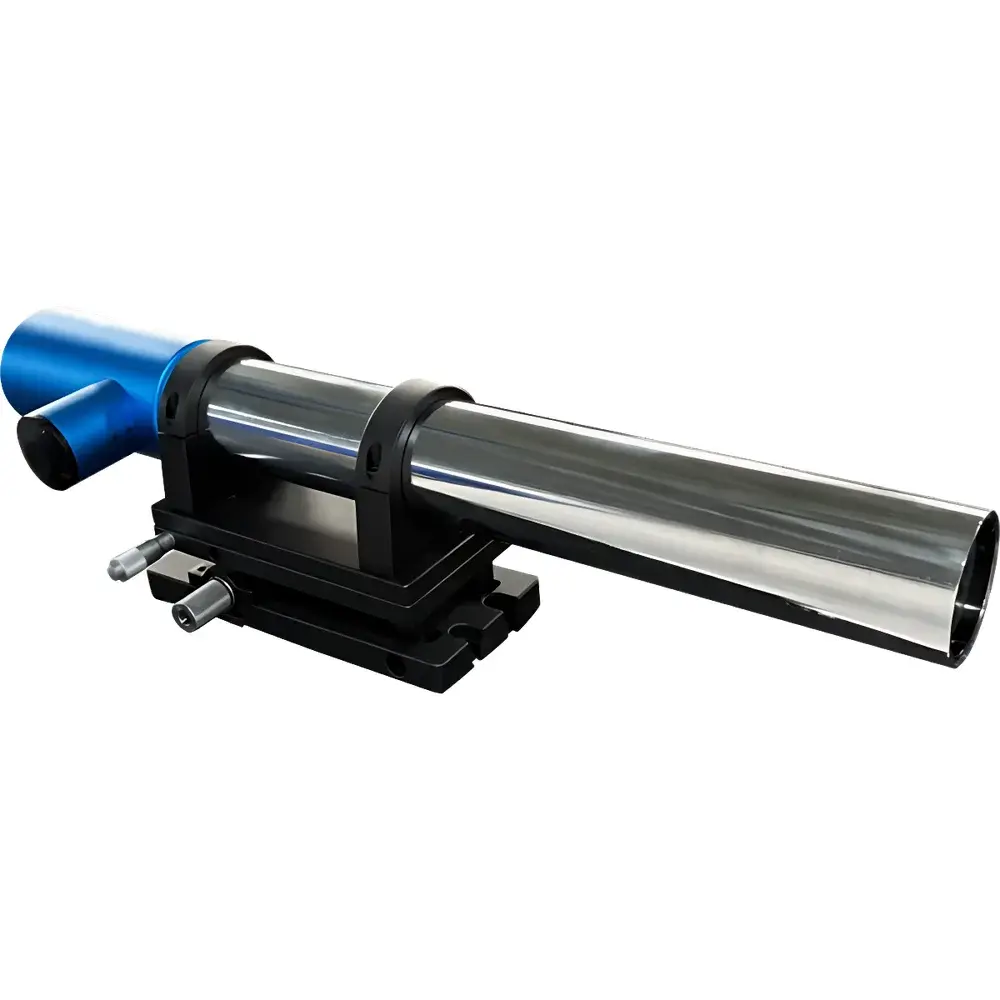
YANRUN MC030-LD500/80/0.2 Auto-Collimator
| Brand | YANRUN |
|---|---|
| Origin | Shanghai, China |
| Manufacturer Type | Manufacturer |
| Model | MC030-LD500/80/0.2 |
| Dimensions | 488 × 125 × 115 mm |
| Focal Length | 500 mm |
| Aperture | 80 mm |
| Light Source | High-Stability LED |
| Measurement Range | 0–80 m |
| Angular Resolution | Adjustable down to 0.0001″ (arc second) |
| Field of View (X/Y) | 1450″ × 1200″ (arc sec) |
| Accuracy (Center) | ±0.2″ (0–±100″), ±0.5″ (0–±600″) |
| Sampling Frequency | ≤30 Hz |
| Interface | USB 2.0 |
| OS Compatibility | Windows 7 or later, 64-bit |
| Detection Principle | Photoelectric auto-collimation based on collimated beam re-imaging onto a precision photodetector array |
Overview
The YANRUN MC030-LD500/80/0.2 Auto-Collimator is a high-precision, photoelectric angular metrology instrument engineered for non-contact measurement of minute angular deviations in optical and mechanical systems. It operates on the fundamental principle of optical auto-collimation: a collimated beam—generated by projecting a reticle located at the focal plane of a high-aperture (80 mm) f = 500 mm objective lens—is directed toward a reflective surface (e.g., a mirror or optomechanical mount). Upon reflection, the beam retraces its path and re-images the reticle onto a calibrated photodetector array positioned at the same focal plane. Any angular tilt α of the reflector induces a linear displacement ΔS = 2f·α (in radians) on the detector; this displacement is measured with sub-microradian resolution, enabling direct calculation of angular deviation with traceable uncertainty. Designed for laboratory-grade stability and industrial robustness, the system integrates a thermally stabilized semiconductor LED light source, eliminating filament drift and ensuring long-term photometric consistency over >10,000 hours of operation.
Key Features
- Simultaneous dual-axis (X and Y) angular measurement with real-time digital display and automatic error computation.
- Electronic eyepiece interface eliminates parallax and observer-dependent aiming errors common in traditional visual auto-collimators.
- High-resolution CMOS-based photodetector with active pixel calibration and noise-suppressed analog front-end, supporting selectable angular resolution from 0.1″ to 0.0001″ (arc second).
- Modular architecture compatible with interchangeable accessories—including rotary stages, alignment brackets, retroreflector mounts, and beam-splitting modules—for extended application flexibility.
- Onboard data processing engine supports multiple fitting algorithms (centroid, Gaussian, cross-correlation) to optimize signal-to-noise ratio under varying illumination and surface reflectivity conditions.
- Native multi-language UI (English, Chinese, Russian, Korean) compliant with international lab deployment requirements.
- USB 2.0 interface enables deterministic data transfer with <10 ms latency; driver support validated under Windows 7–11 (64-bit) with signed INF files.
Sample Compatibility & Compliance
The MC030-LD500/80/0.2 is optimized for use with flat, polished, or coated mirrors (R > 85% @ 520–650 nm), kinematic mounts, optical tables, and precision rotary stages. Its 80 mm aperture and f/6.25 optical design ensure sufficient étendue for stable signal acquisition across working distances up to 80 meters—making it suitable for large-scale alignment tasks in aerospace assembly bays or cleanroom-based optical bench integration. The instrument conforms to ISO 10110-7 (optical element surface irregularity assessment) and supports traceable calibration per ISO/IEC 17025 when used with NIST-traceable angle standards. Its mechanical housing meets IP42 environmental rating for dust resistance and limited moisture ingress protection during controlled lab or factory-floor operation.
Software & Data Management
The bundled YANRUN AutoAlign Suite provides comprehensive metrology software for instrument control, real-time visualization, statistical process monitoring (SPC), and report generation. All raw detector frames and computed angular values are timestamped and stored with full metadata (exposure time, gain setting, ambient temperature, operator ID). Export options include CSV, XML, and native Excel (.xlsx) formats with embedded formula-driven tolerance checks and pass/fail flagging per user-defined GD&T specifications. Audit trail functionality records all parameter changes, measurement initiations, and export events—supporting compliance with FDA 21 CFR Part 11 requirements for electronic records and signatures when configured with Windows domain authentication and encrypted local storage.
Applications
- Precision alignment of laser cavities, interferometer arms, and synchrotron beamlines.
- Verification of straightness, flatness, perpendicularity, and parallelism in coordinate measuring machine (CMM) verification protocols per ISO 10360.
- In-process monitoring of rotational stage wobble and axial runout in semiconductor lithography tool qualification.
- Calibration of goniometers and angular encoders used in space-borne optical payloads.
- Alignment of segmented mirror arrays in astronomical telescopes and adaptive optics systems.
- GD&T validation of machined aerospace components (e.g., turbine blade root geometry, wing spar interfaces) against ASME Y14.5–2018 tolerancing frameworks.
- Teaching and research in undergraduate and graduate optics laboratories, supporting experimental verification of beam propagation theory and wavefront sensing fundamentals.
FAQ
What is the maximum recommended working distance for optimal signal-to-noise ratio?
At 80 m, the system maintains ≥45 dB SNR for mirrors with R ≥ 90%; performance degrades gradually beyond this range depending on surface quality and ambient stray light conditions.
Can the instrument measure dynamic angular motion?
Yes—its ≤30 Hz sampling bandwidth supports characterization of low-frequency mechanical vibrations, thermal drift, and slow-stage positioning errors when synchronized via external trigger input.
Is third-party calibration documentation available?
Yes; accredited calibration certificates (with uncertainty budgets per ISO/IEC 17025) are provided upon request, traceable to PTB/NIM primary angle standards.
Does the software support automated script-based measurement sequences?
Yes—the AutoAlign SDK includes COM and .NET APIs for integration into LabVIEW, MATLAB, or Python-based metrology automation platforms.
How is thermal drift compensated during extended measurements?
The optical head incorporates passive thermal stabilization; internal reference tracking and zero-point recalibration routines mitigate long-term baseline drift to <0.05″/°C over 8-hour sessions.