
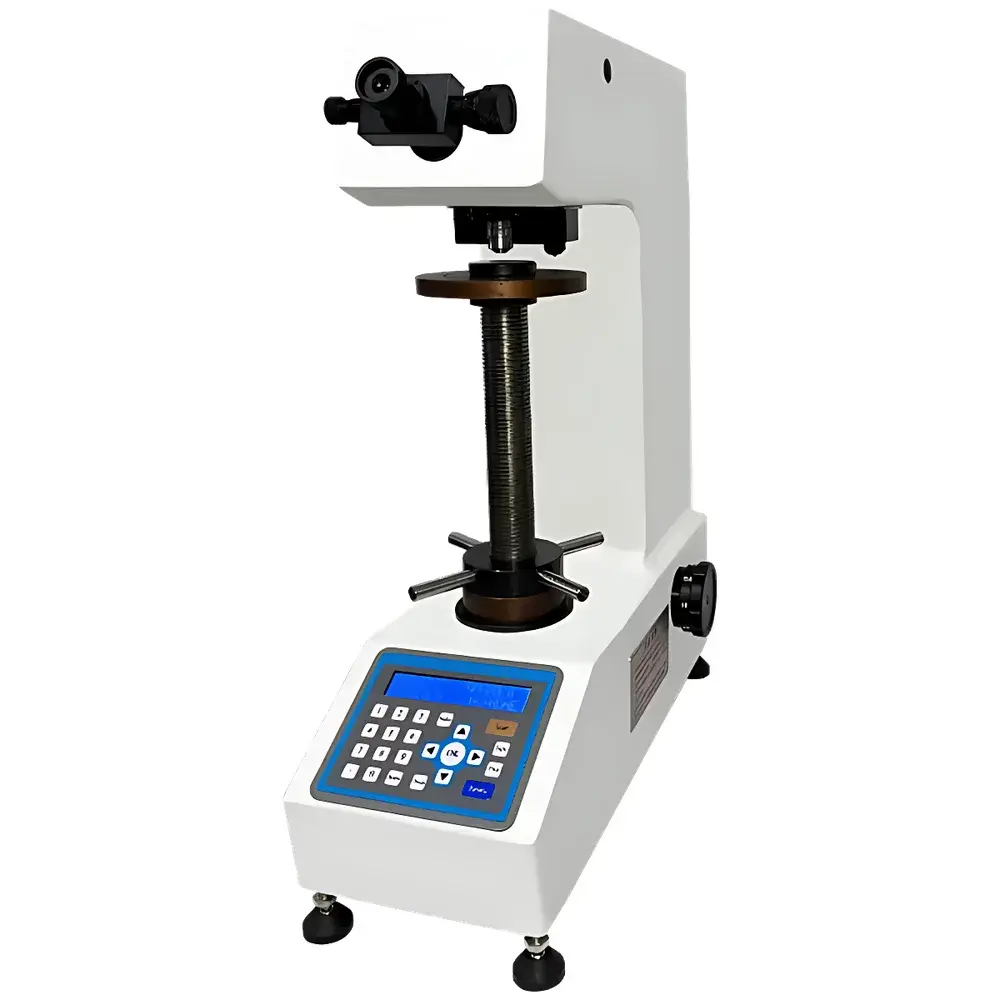
YANRUN HV-10 Vickers Hardness Tester
| Brand | YANRUN |
|---|---|
| Origin | Shanghai, China |
| Manufacturer Type | Direct Manufacturer |
| Product Origin | Domestic (China) |
| Model | HV-10 |
| Test Force Range | 0.2–50 kgf (1.96–490.3 N) |
| Loading Method | Fully Automatic (Load–Hold–Unload) |
| Standard Compliance | GB/T 4340, ISO 6507 |
| Measuring Resolution | 0.06 µm (at 20× objective), 0.12 µm (at 10× objective) |
| Max Specimen Height | 235 mm |
| Depth from Indenter to Chamber Wall | 130 mm |
| Optical System | Dual-Magnification (10× observation / 20× measurement for 5–10 kgf |
| Total Magnification | 100× (observation), 200× (measurement) |
| Hold Time Range | 0–60 s (1 s increments) |
| Display | LCD with real-time force indication |
| Hardness Range | 8–3000 HV |
| Conversion Support | HV ↔ HK ↔ HRC ↔ HB ↔ HRB (per ASTM E140) |
| Construction | One-piece cast aluminum housing with automotive-grade baked enamel finish |
| Net Weight | 46.0 kg |
| Dimensions (L×W×H) | 570 × 220 × 680 mm |
| Power Supply | AC 220 V / 50 Hz |
Overview
The YANRUN HV-10 Vickers Hardness Tester is a precision mechanical-optical instrument engineered for micro- and macro-scale hardness evaluation of metallic and non-metallic materials using the Vickers indentation method. Based on the principle of diamond pyramid indentation under controlled static load, the system measures the diagonal lengths of the resulting impression in a calibrated optical path, then computes hardness values (HV) according to the standardized formula: HV = 0.1891 × F/d², where F is applied test force (in kgf or N) and d is the arithmetic mean of two perpendicular diagonal measurements (in mm). Designed for laboratory, quality control, and R&D environments, the HV-10 supports both manual and semi-automated workflows—featuring fully automatic loading, dwell, and unloading sequences compliant with ISO 6507-1 and GB/T 4340.1. Its dual-magnification optical train (10×/20× objectives) enables reliable assessment across thin films, case-hardened layers, brittle ceramics, and miniature components where surface integrity and spatial resolution are critical.
Key Features
- Fully automated test cycle: precise electro-mechanical force application with programmable dwell time (0–60 s, adjustable in 1-second increments)
- High-resolution optical measurement: dual-objective configuration (10× for observation, 20× for measurement at ≤10 kgf loads) delivering 0.06 µm detection limit at 200× total magnification
- Dual-mode data acquisition: direct key-entry via front-panel keypad or optional PC-based image analysis software (USB interface supported)
- Multi-force capability: six selectable test force ranges (0.2–50 kgf) covering microhardness (≤1 kgf) through macrohardness (≥10 kgf) applications
- Rugged one-piece cast aluminum frame with industrial-grade baked enamel coating—resistant to abrasion, corrosion, and thermal drift
- Integrated hardness conversion tables aligned with ASTM E140, supporting cross-referencing between HV, HK, HRC, HB, and HRB scales
- Compliance-ready architecture: built-in audit trail support for GLP/GMP environments; firmware logs force calibration events, operator ID, and test parameters
Sample Compatibility & Compliance
The HV-10 accommodates a broad spectrum of material classes—including ferrous and non-ferrous metals, sintered carbides, optical glasses, technical ceramics (Al₂O₃, SiC), semiconductor wafers, PVD/CVD-coated substrates, polymer films, and geological specimens. Its 235 mm maximum specimen height and 130 mm indenter-to-chamber-wall clearance permit testing of irregularly shaped parts, small gears, bearing races, and cross-sectioned metallographic mounts. All operational protocols adhere strictly to ISO 6507 (Parts 1–4) and GB/T 4340 (Parts 1–4), ensuring traceability to national metrological standards. The instrument’s mechanical stability and thermal mass minimize vibration-induced measurement scatter, contributing to inter-laboratory reproducibility within ±1.5% RSD per ASTM E384 guidelines.
Software & Data Management
While the HV-10 operates autonomously via its embedded LCD interface, it integrates seamlessly with optional Windows-compatible analysis software for advanced metrology tasks. This software enables digital image capture, automated diagonal detection via edge-enhancement algorithms, statistical reporting (mean, SD, min/max, Cpk), and export to CSV, PDF, or XML formats. All test records include timestamp, operator ID, environmental conditions (user-entered), and calibration verification status—supporting FDA 21 CFR Part 11 compliance when configured with electronic signature modules and audit-log encryption. Raw measurement data and processed results are stored locally with version-controlled firmware updates available directly from YANRUN’s technical support portal.
Applications
- Quality assurance of heat-treated steel components (case depth profiling, carburized layer verification)
- Mechanical property mapping of thin-film coatings (TiN, DLC, CrN) on aerospace and medical implant substrates
- Hardness gradient analysis in diffusion-bonded or clad metal interfaces
- Microstructural characterization of powder metallurgy parts and additive-manufactured alloys
- Calibration verification of reference blocks per ISO 6507-3 and ASTM E92
- Educational use in materials science laboratories for teaching indentation plasticity fundamentals
FAQ
Does the HV-10 meet international calibration requirements for accredited labs?
Yes—it complies with ISO/IEC 17025 metrological traceability frameworks when used with NIST-traceable reference blocks and documented periodic verification procedures.
Can the instrument perform Knoop hardness testing?
No—the HV-10 is configured exclusively for Vickers (square pyramid) indentation. However, it supports HK conversion tables per ASTM E140 for comparative reporting.
Is remote diagnostics or firmware update capability available?
Firmware updates are delivered via USB flash drive; remote diagnostic support is provided by YANRUN’s global technical team upon registration of the unit’s serial number.
What maintenance intervals are recommended for long-term accuracy?
Annual verification of force transducer linearity and optical calibration is advised; daily cleaning of the objective lens and indenter tip using lint-free optics tissue is required.
Is the HV-10 compatible with automated sample stage integration?
The base model does not include motorized XY stages, but the mechanical design allows third-party retrofitting with compatible CNC positioning systems via standard M4 mounting threads.
Related Products







