
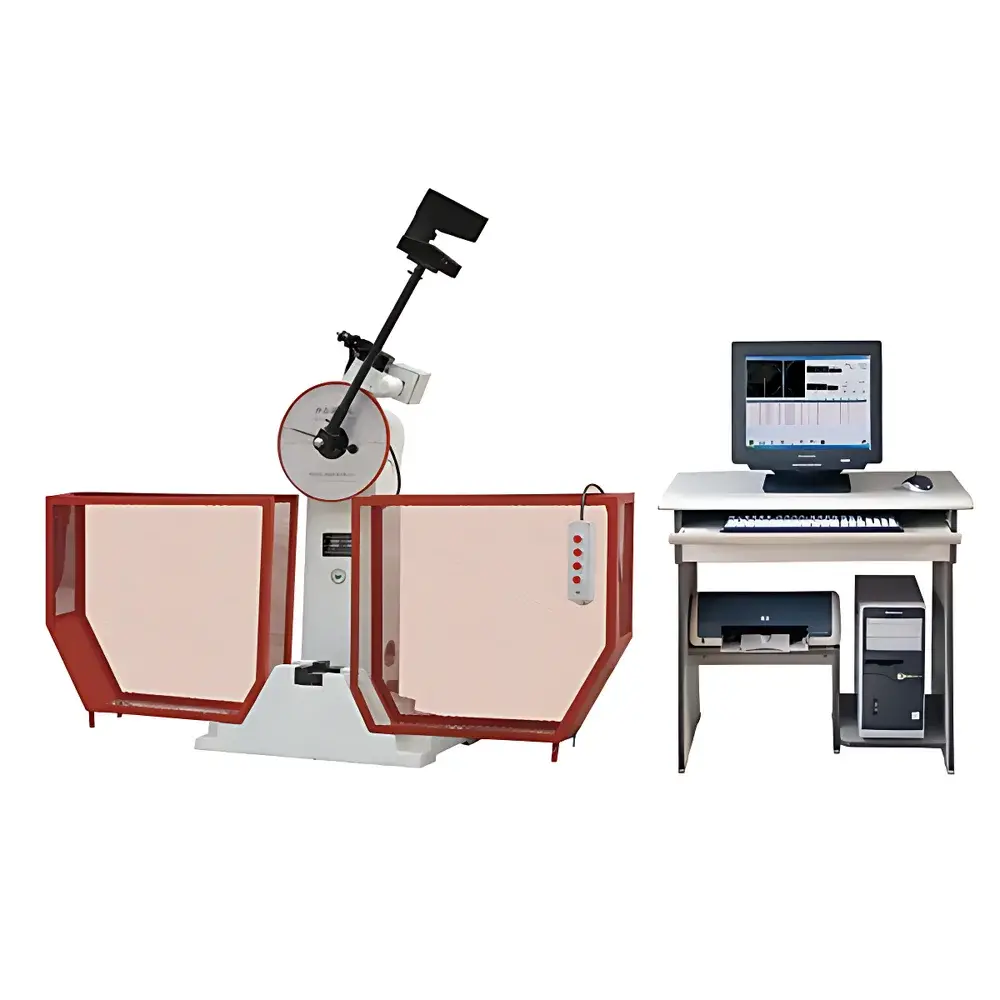
YANRUN JBS-300B Digital Semi-Automatic Charpy Impact Testing Machine
| Brand | YANRUN |
|---|---|
| Origin | Shanghai, China |
| Manufacturer Type | Direct Manufacturer |
| Country of Origin | China |
| Model | JBS-300B |
| Instrument Category | Charpy/Izod Impact Tester |
| Nominal Impact Energy | 150 J / 300 J |
| Impact Velocity | 5.2 m/s |
| Pendulum Center-to-Anvil Distance | 750 mm |
| Specimen Span | 40.0 ± 0.2 mm |
| Pendulum Pre-lift Angle | 150° |
| Impact Blade Radius | R2–R2.5 mm (standard), R8 ± 0.05 mm (optional) |
| Specimen Dimensions | 10 × 10 × 55 mm (also compatible with 7.5, 5, and 2.5 mm thickness variants) |
| Anvil Radius | R1–R1.5 mm |
| Compliance | GB/T 229–2007, GB/T 3803–2002 |
Overview
The YANRUN JBS-300B Digital Semi-Automatic Charpy Impact Testing Machine is a precision-engineered pendulum-type impact tester designed for standardized metal toughness evaluation in accordance with ISO 148-1, ASTM E23, and national standard GB/T 229–2007. It operates on the principle of gravitational potential energy conversion: a calibrated pendulum is raised to a defined pre-lift angle (150°), released, and allowed to strike a notched specimen supported in a three-point bending configuration (simply supported beam). The energy absorbed by the specimen during fracture—calculated from the difference between initial and residual pendulum height—is displayed digitally as impact absorption energy (J), enabling direct determination of Charpy impact toughness (kJ/m²). The machine features a single-column rigid frame with cantilevered pendulum suspension and a U-shaped hammer body optimized for minimal air resistance and high repeatability. Its semi-automatic architecture integrates electromechanical lifting, release, and post-fracture automatic repositioning—leveraging residual kinetic energy after impact—to ensure consistent pendulum positioning and reduce operator intervention between consecutive tests.
Key Features
- Microprocessor-based control system with dual-mode operation: standalone digital display unit or PC-integrated interface for enhanced data logging and traceability
- Electromechanically driven pendulum lifting and release mechanism ensuring precise angular positioning and reproducible impact initiation
- Automatic post-impact pendulum recovery: utilizes residual swing energy to re-lift the hammer to the 150° reference position, minimizing cycle time and mechanical wear
- Interchangeable impact blades with standardized radii (R2–R2.5 mm for general use; R8 ± 0.05 mm for ISO-compliant testing), secured via screw-mount design for rapid calibration and replacement
- Robust single-column structural frame with integrated safety pin and full perimeter protective mesh meeting ISO 13857 minimum separation requirements
- Standardized anvil geometry with 40.0 ± 0.2 mm span and R1–R1.5 mm anvil radius, fully compliant with GB/T 229–2007 and ASTM E23 specimen support specifications
- Digital measurement of absorbed energy (150 J / 300 J range), impact angle, and calculated toughness values; optional thermal printer for audit-ready hardcopy output
Sample Compatibility & Compliance
The JBS-300B accommodates standard Charpy V-notch and U-notch specimens per GB/T 229–2007, including full-size (10 × 10 × 55 mm) and sub-sized variants (7.5, 5, and 2.5 mm thicknesses). Specimen alignment is facilitated by precision-ground supports and centering guides to ensure repeatable notch positioning relative to the impact blade. The instrument conforms to verification requirements outlined in GB/T 3803–2002 for pendulum impact testers, including pendulum length tolerance (750 mm ± 0.5 mm), velocity accuracy (5.2 m/s ± 0.1 m/s), and energy indication error (≤ ± 0.5% of full scale). It supports laboratory accreditation under CNAS-CL01 (equivalent to ISO/IEC 17025) and is suitable for quality control environments operating under ISO 9001 or IATF 16949 frameworks.
Software & Data Management
When operated in PC-connected mode, the JBS-300B communicates via RS-232 or USB-to-serial interface to proprietary Windows-based software. This platform enables real-time test monitoring, batch data export (CSV, Excel), statistical analysis (mean, SD, CV%), and customizable report generation—including specimen ID, test date/time, operator ID, energy absorption, and pass/fail status against predefined thresholds. Audit trail functionality records all parameter changes and test executions with timestamps, supporting compliance with GLP principles and internal QA documentation requirements. Data files are stored locally with optional network folder synchronization; no cloud transmission or third-party hosting is involved.
Applications
This instrument is routinely deployed in metallurgical laboratories, foundries, and heavy equipment manufacturing facilities for routine assessment of ductile-to-brittle transition behavior, heat treatment validation, weldment qualification, and incoming material verification. Typical use cases include: evaluating temper embrittlement in low-alloy steels; verifying cryogenic toughness of pipeline steels (ASTM A370); screening cast iron fracture resistance; and supporting failure analysis investigations where impact energy correlates with service performance under dynamic loading. Its semi-automatic throughput makes it especially suited for high-volume QC labs performing ≥50 tests per shift.
FAQ
What standards does the JBS-300B comply with?
It meets GB/T 229–2007 (Chinese equivalent of ISO 148-1), GB/T 3803–2002 (verification standard), and is functionally aligned with ASTM E23 and ISO 148-1 for Charpy testing.
Can the machine test sub-sized specimens?
Yes—it accepts 10 × 10 × 55 mm, 10 × 7.5 × 55 mm, 10 × 5 × 55 mm, and 10 × 2.5 × 55 mm specimens using appropriate supports and calculation factors.
Is the pendulum calibration traceable?
Calibration certificates for pendulum moment of inertia and energy scale are provided upon factory verification; users must perform periodic verification per GB/T 3803–2002 Annex B using certified reference specimens.
Does the system support 21 CFR Part 11 compliance?
The standalone unit does not include electronic signature or audit trail features required for FDA-regulated environments; however, the PC software can be configured with user access controls and manual logbook integration for hybrid compliance workflows.
What maintenance is required for long-term accuracy?
Biannual verification of pendulum axis alignment, blade edge radius (using optical profilometry), and anvil geometry is recommended; lubrication of lifting motor gear train every 6 months ensures consistent lift torque and angular repeatability.



