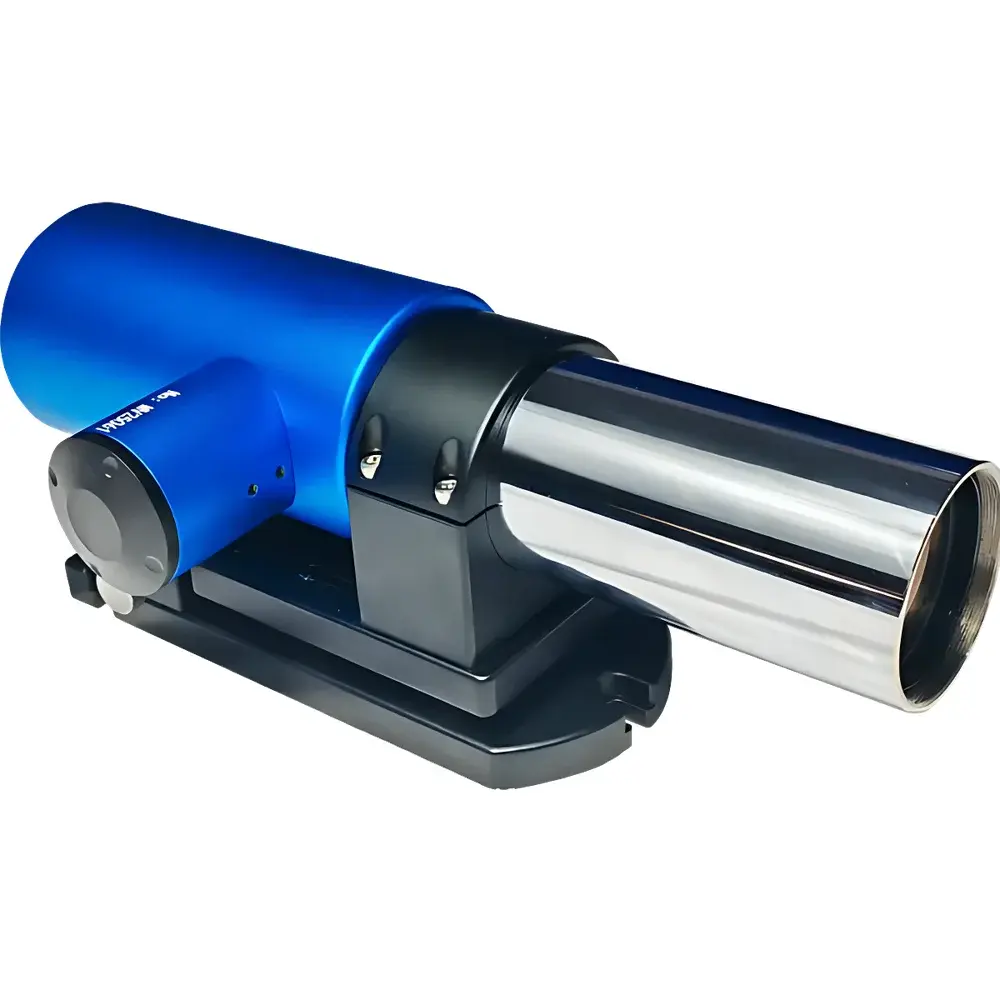
YANRUN MC030-MAT200 Dual-Axis Electronic Autocollimator with 48 arcsec / 0.5 arcsec Resolution
| Brand | YANRUN |
|---|---|
| Origin | Shanghai, China |
| Manufacturer Type | Direct Manufacturer |
| Model | MC030-MAT200 (48"/0.5") |
| Dimensions | 288 × 125 × 115 mm |
| Resolution Options | 0.1", 0.01", 0.001", 0.0001" (arcseconds) |
| Compliance | ISO 10110-5, ISO 230-1, ASTM E2917, GB/T 22096–2008 |
Overview
The YANRUN MC030-MAT200 is a high-precision dual-axis electronic autocollimator engineered for non-contact angular metrology in controlled laboratory and industrial environments. It operates on the fundamental principle of optical autocollimation: a collimated beam is reflected from a target mirror surface back into the instrument’s objective lens; angular deviations of the mirror cause proportional lateral displacement of the returned image on a high-resolution CMOS sensor array. Real-time digital image processing algorithms convert pixel-level shifts into calibrated angular values in arcseconds (″), enabling traceable, repeatable measurements of tilt, deviation, and alignment. Unlike traditional visual autocollimators requiring subjective eyepiece interpretation, the MC030-MAT200 integrates an embedded electronic eyepiece display, eliminating parallax and observer-dependent bias. Its compact monolithic housing (288 × 125 × 115 mm) and solid-state LED illumination system ensure thermal stability and long-term drift resistance—critical for multi-hour alignment campaigns in metrology labs, optical assembly cleanrooms, and precision machine tool verification.
Key Features
- Dual-axis simultaneous measurement of X- and Y-direction angular deviations, with selectable resolution modes: standard 48 arcsec full-scale range at 0.5 arcsec resolution, or extended high-resolution variants down to 0.0001 arcsec (subject to optional sensor calibration and environmental control)
- Real-time electronic eyepiece interface with on-device LCD preview, reducing human aiming uncertainty and enabling operator-independent data acquisition
- High-sensitivity CMOS imaging detector with sub-pixel centroiding algorithm for enhanced angular sensitivity and repeatability (typical standard deviation < ±0.05″ over 100 readings under ISO 230-1 environmental conditions)
- Stable, low-noise LED light source with >50,000-hour operational lifetime and minimal spectral drift—ensuring consistent beam quality across extended calibration cycles
- Modular accessory ecosystem including precision mirror mounts, rotary stages, linear translation stages, and reference flats compliant with ISO 10110-7 surface specifications
- Onboard firmware supports real-time curve fitting, error envelope calculation (e.g., straightness per ISO 230-2 Annex B), and automatic generation of deviation plots relative to nominal geometry
- Export-ready data output in native .CSV and standardized Excel (.xlsx) formats, with configurable column headers aligned to ISO/IEC 17025 reporting requirements
- Firmware-integrated multilingual UI (English, Chinese, Russian, Korean) for global deployment in multinational manufacturing and calibration facilities
Sample Compatibility & Compliance
The MC030-MAT200 is designed for use with optically flat reflective surfaces—typically first-surface mirrors, polished steel targets, or coated optical flats—with surface quality ≥ λ/20 (RMS) and reflectivity >95% in the visible spectrum (520–580 nm). It complies with core international standards governing angular metrology instrumentation, including ISO 10110-5 (specification of optical components), ISO 230-1 (determination of geometric accuracy of machine tools), and ASTM E2917 (standard practice for laser-based angular measurement). When deployed in regulated environments—such as aerospace component final inspection or medical device manufacturing—it supports audit-ready operation through timestamped measurement logs, user-access controls, and optional firmware modules aligned with FDA 21 CFR Part 11 electronic record requirements. All factory calibrations are traceable to NIM (National Institute of Metrology, China) via accredited internal standards.
Software & Data Management
The instrument ships with YANRUN AutoAlign Suite v4.x—a Windows-based application supporting both local standalone operation and networked fleet management. The software provides advanced analysis modules for straightness (ISO 230-2), flatness (ISO 1101), perpendicularity (ISO 1101), and parallelism evaluation using least-squares and minimum-zone fitting algorithms. Raw sensor data is stored with full metadata (timestamp, operator ID, ambient temperature/humidity, mirror serial number), enabling GLP/GMP-compliant traceability. Export functions include customizable Excel reports with embedded uncertainty budgets per GUM (JCGM 100:2008), PDF measurement certificates, and ASCII-compatible files for integration into enterprise MES or LIMS platforms. Remote firmware updates and configuration backup/restore are supported via USB-C or Ethernet interfaces.
Applications
- Precision alignment of CNC machine tool spindles, guideways, and rotary tables per ISO 230-1 and VDI/VDE 2617
- Verification of optical bench collimation, interferometer cavity alignment, and laser cavity angular stability
- Flatness and planarity assessment of granite surface plates, air-bearing stages, and semiconductor wafer chucks
- Angular calibration of inertial sensors, gyroscopes, and MEMS-based attitude determination systems
- Final acceptance testing of aerospace actuators, satellite pointing mechanisms, and telescope secondary mirror mounts
- Root-cause analysis of thermal drift in ultra-precision coordinate measuring machines (CMMs)
FAQ
What is the smallest resolvable angle for the MC030-MAT200 in its highest-resolution mode?
The base model supports 0.5 arcsec resolution; optional configurations with enhanced sensor calibration and vibration-isolated mounting achieve effective resolution down to 0.0001 arcsec—subject to environmental stabilization per ISO 554 and ISO 230-1 Class 1 conditions.
Can the instrument measure dynamic angular changes in real time?
Yes—the onboard processor supports up to 25 Hz continuous acquisition with buffered storage; external triggering and synchronization via TTL input enable correlation with motion controllers or environmental monitoring systems.
Is third-party software integration supported?
The device exposes a documented COM/DCOM API and TCP/IP command set compatible with LabVIEW, MATLAB, Python (PySerial/PyVISA), and C# applications—enabling custom automation and integration into Industry 4.0 architectures.
How is traceable calibration maintained over time?
Each unit includes a certificate of calibration against NIM-traceable angle standards; annual recalibration is recommended, and field verification routines using certified reference mirrors are embedded in firmware.
Does the system require external cooling or climate control?
No active cooling is required; however, optimal performance (≤0.1″ repeatability) is achieved within a stabilized environment: 20 ± 1°C, humidity 40–60% RH, and vibration isolation per ISO 25378 Class A.