
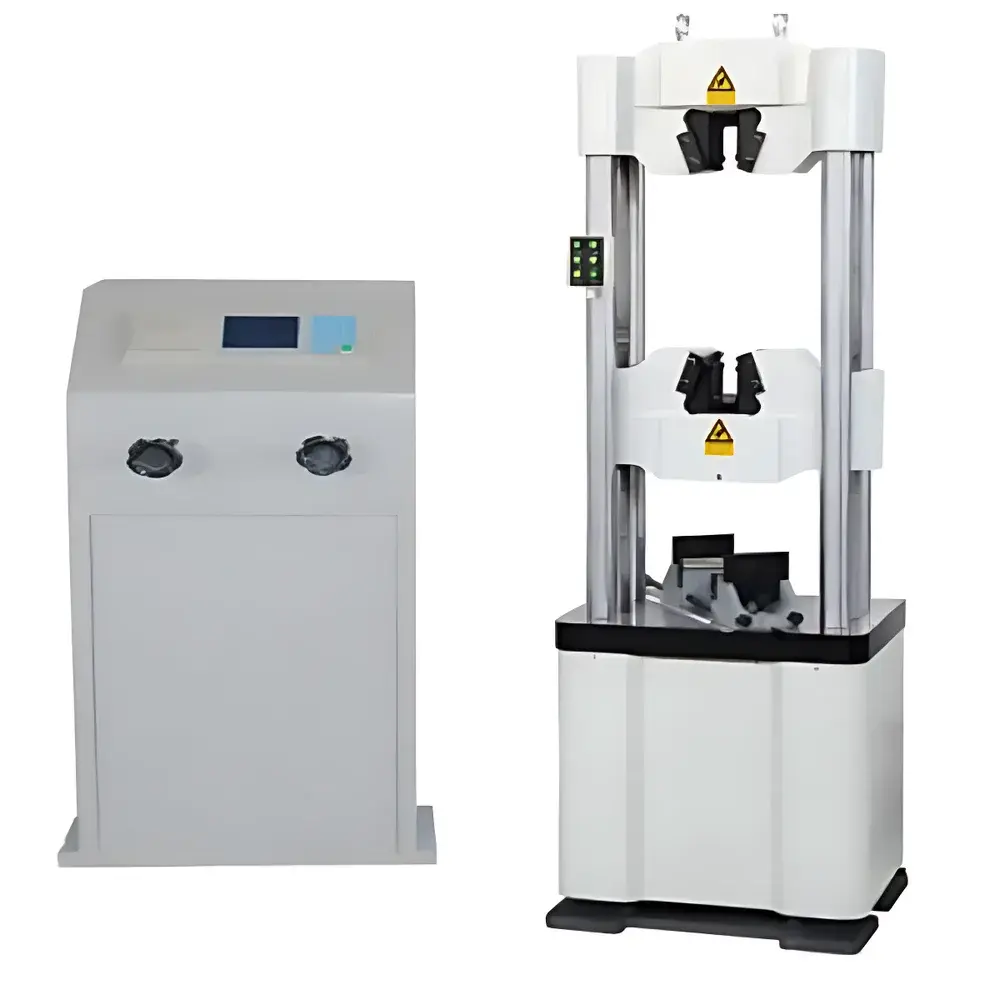
YANRUN WES-600D Electro-Hydraulic Servo Universal Testing Machine
| Brand | YANRUN |
|---|---|
| Origin | Shanghai, China |
| Manufacturer Type | Direct Manufacturer |
| Country of Origin | China |
| Model | WES-600D |
| Instrument Type | Electro-Hydraulic Servo Testing Machine |
| Max Test Load | 600 kN |
| Max Tensile Jaw Spacing | 600 mm |
| Flat Specimen Clamping Thickness | 0–15 mm |
| Round Specimen Clamping Diameter | Φ13–Φ40 mm |
| Compression Test Height | 550 mm |
| Piston Stroke | 150 mm |
| Load Indication Accuracy | ±1% of full scale |
| Bend Support Roller Spacing | 450 mm |
| Column Spacing | 450 mm |
| Motor Power | 3 kW |
| Overall Dimensions (W×D×H) | 950 × 630 × 2265 mm |
| Weight | 2600 kg |
Overview
The YANRUN WES-600D Electro-Hydraulic Servo Universal Testing Machine is a high-capacity, precision-engineered mechanical testing system designed for static tensile, compression, bending, and shear evaluations of metallic, polymeric, composite, and ceramic materials. Built on a robust dual-column frame architecture with integrated hydraulic actuation and closed-loop servo control, the WES-600D operates in accordance with fundamental principles of force transduction and displacement measurement governed by ISO 7500-1 (Class 1 accuracy), ASTM E4, and GB/T 228.1–2021. Its 600 kN nominal load capacity supports structural component validation, quality assurance in heavy manufacturing, and R&D-grade mechanical property characterization—including yield strength, ultimate tensile strength, modulus of elasticity, and fracture elongation—under controlled displacement or load-rate profiles.
Key Features
- Electro-hydraulic servo actuation system delivering stable, programmable loading rates from 0.01% to 100% of full scale, with real-time feedback via high-resolution load cell and piston position encoder.
- Dual-column rigid frame with 450 mm column spacing and reinforced base plate, engineered to minimize deflection during high-load compression and eccentric bending tests.
- Multi-configurable gripping system: interchangeable round-specimen jaws (Φ13–Φ40 mm) and flat-specimen clamps (0–15 mm thickness), both featuring self-aligning wedge mechanisms and serrated grip surfaces for enhanced specimen retention.
- Integrated compression and flexure fixtures: hardened upper/lower platens with spherical seating for uniform stress distribution; adjustable three-point bend support rollers (450 mm span) with micrometer-scale positioning capability.
- Hydraulic power unit rated at 3 kW, optimized for low-noise operation and thermal stability across extended test cycles; includes pressure relief valves, filtration, and temperature monitoring per ISO 4413.
- Front-accessible maintenance layout with standardized hydraulic couplings and modular electrical interface, facilitating service compliance with ISO 13849-1 safety requirements.
Sample Compatibility & Compliance
The WES-600D accommodates standardized specimens per ISO 6892-1 (tensile), ISO 37 (rubber), ISO 14125 (composites), and ASTM D695 (rigid plastics), as well as custom geometries up to 600 mm gauge length and 550 mm compression height. All mechanical components meet GB/T 16825.1–2008 verification criteria for force-measuring systems. The system’s ±1% load indication error conforms to ISO 7500-1 Class 1 tolerance limits. When configured with optional extensometers or digital image correlation (DIC) modules, it supports strain-controlled protocols aligned with ASTM E83 and ISO 9513. Full traceability documentation—including factory calibration certificates and uncertainty budgets—is provided for GLP/GMP environments.
Software & Data Management
The embedded Windows-based control software enables multi-step test sequencing (e.g., preload → ramp → hold → unload), real-time curve overlay, and automated parameter extraction (Rp0.2, Rm, A%, E). Raw data exports are compliant with ASTM E1434 and ISO 10360-5 formats (CSV, XLSX, XML). Audit trail functionality logs user actions, method changes, and calibration events in accordance with FDA 21 CFR Part 11 requirements when paired with network authentication and electronic signature modules. Data integrity safeguards include cyclic redundancy checksums, automatic backup to external NAS, and role-based access control (RBAC) for QA/QC workflows.
Applications
- Mechanical validation of structural steel grades (Q345, S355JR), aluminum alloys (6061-T6, 7075-T6), and stainless steels (304, 316) in metallurgical laboratories.
- Compression testing of concrete cylinders (ASTM C39), cementitious composites, and geotechnical specimens under controlled strain rates.
- Bending performance evaluation of welded joints, extruded profiles, and additive-manufactured lattice structures per ISO 14556.
- Quality conformance testing in automotive Tier-1 supplier facilities for suspension components, fasteners, and chassis subassemblies.
- Educational use in university materials science labs for hands-on instruction in Hooke’s law, plastic deformation theory, and fracture mechanics fundamentals.
FAQ
What standards does the WES-600D comply with for force calibration?
It meets ISO 7500-1 Class 1 requirements, verified via third-party accredited calibration against dead-weight standards traceable to NIM (China) or NIST (USA).
Can the system be upgraded to support high-temperature testing?
Yes—optional furnace integration (up to 1000 °C) and high-temp extensometry are available as OEM accessories, requiring recalibration per ISO 204.
Is remote diagnostics supported?
Standard Ethernet connectivity enables secure remote monitoring and firmware updates via TLS-encrypted VNC sessions, subject to local IT policy approval.
What is the recommended maintenance interval for hydraulic oil?
Per ISO 4406:2017, hydraulic fluid should be sampled quarterly and replaced every 24 months or after 5,000 operating hours, whichever occurs first.
Does the system support multi-axis load control?
No—the WES-600D is a uniaxial electro-hydraulic platform; biaxial or torsional capabilities require separate systems such as servo-hydraulic multiaxial testers.



