YANRUN MC030-ZJ3000W Photoelectric Autocollimator
| Brand | YANRUN |
|---|---|
| Origin | Shanghai, China |
| Manufacturer Type | Direct Manufacturer |
| Country of Origin | China |
| Model | MC030-ZJ3000W |
| Price Range | USD 11,200 – 22,400 (FOB Shanghai) |
| Dimensions | 385 × 125 × 115 mm |
Overview
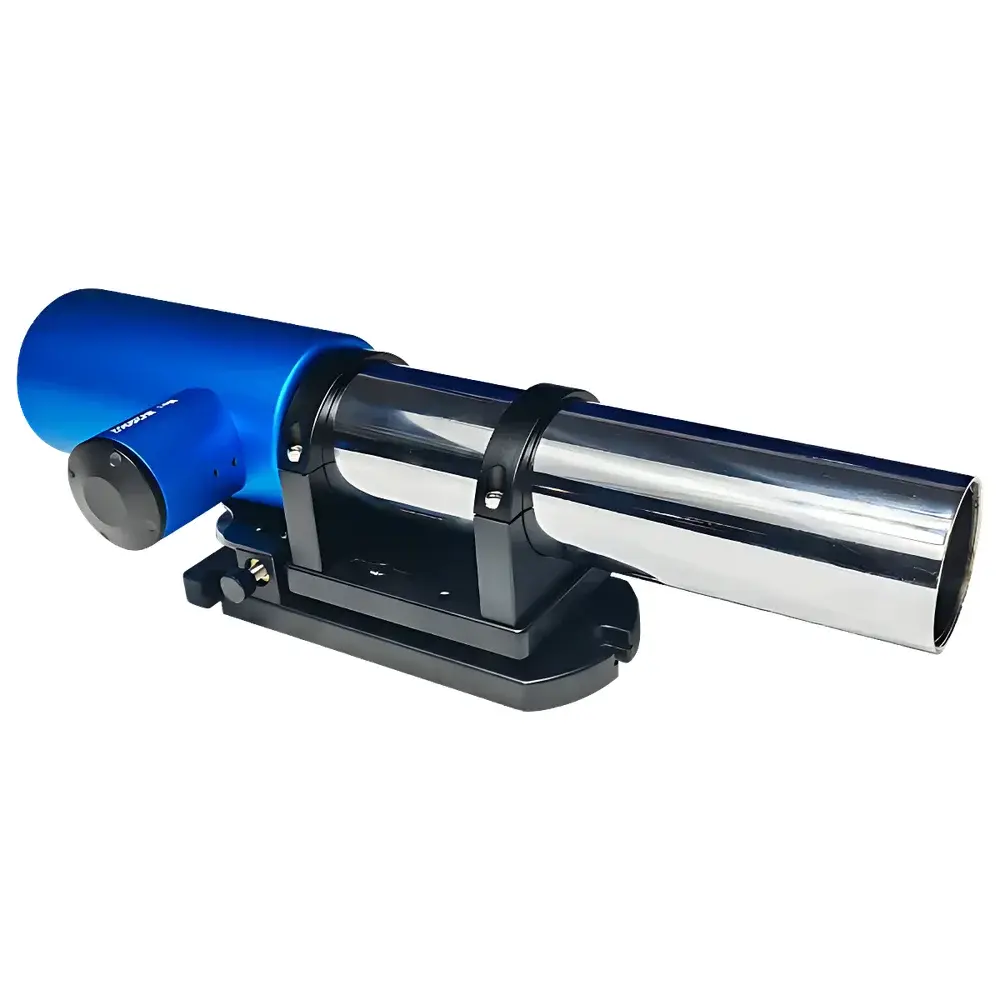
The YANRUN MC030-ZJ3000W is a high-precision photoelectric autocollimator engineered for non-contact angular metrology in industrial metrology labs, precision assembly lines, and optical research environments. It operates on the fundamental principle of optical autocollimation: a collimated beam—generated by projecting a reticle located at the focal plane of a high-stability objective lens—is reflected back from a planar mirror surface orthogonal to the optical axis. Any angular deviation (α) of the mirror induces a linear displacement (ΔS) of the returned reticle image on a calibrated photodetector array, where ΔS = 2f·α (f = effective focal length). This first-order linear relationship enables traceable, sub-arcsecond angular resolution without mechanical contact or thermal drift associated with mechanical goniometers. The system integrates a stabilized LED light source, a dual-axis quadrant photodiode or CMOS-based position-sensitive detector (PSD), and real-time digital signal processing firmware to deliver repeatable measurements under ambient laboratory conditions.
Key Features
- Dual-axis simultaneous measurement (X and Y angular deviations) with independent calibration and real-time cross-coupling compensation
- Real-time electronic eyepiece interface with on-screen reticle overlay and dynamic tilt visualization—eliminating observer-dependent parallax and human aiming error
- High-resolution optoelectronic detection system with <1 arcsecond angular resolution and <0.1 arcsecond repeatability (typical, 1σ over 100 readings)
- Long-life, thermally stabilized LED illumination module (635 nm nominal wavelength) ensuring consistent intensity and spectral stability over >20,000 hours of operation
- Modular hardware architecture supporting interchangeable measurement modules—including rotary stage adapters, multi-mirror alignment fixtures, and extended-range retroreflector kits
- Embedded firmware with configurable sampling rate (1–50 Hz), digital filtering (low-pass, median), and auto-zero drift correction algorithms
- Multi-language UI support (English, Chinese, Russian, Korean) compliant with international deployment requirements
Sample Compatibility & Compliance
The MC030-ZJ3000W is compatible with standard optical flat mirrors (≥λ/10 surface flatness), kinematic mirror mounts, and commercially available autocollimation targets. It supports measurement distances from 0.3 m to 15 m (dependent on mirror size and ambient lighting control). The instrument conforms to ISO 10110-7 (optical element surface quality), ISO 230-1 (machine tool testing — geometric accuracy), and ASTM E2919-21 (standard practice for angular measurement using autocollimators). Its firmware architecture includes audit-trail logging and user-access controls aligned with GLP and GMP documentation requirements. While not FDA-certified as a medical device, its data export structure satisfies 21 CFR Part 11 readiness when deployed with validated third-party LIMS integration.
Software & Data Management
The included Windows-based YANRUN AutoCal Suite provides full instrument control, live waveform display, statistical process monitoring (SPC), and automated report generation. Raw angular deviation data (in arcseconds or milliradians) is timestamped and exported directly to Excel (.xlsx) with embedded metadata (operator ID, calibration certificate ID, environmental conditions). The software supports batch analysis across multiple measurement sessions, comparative trend charts, and tolerance band overlays per ISO 2768-mK or customer-defined GD&T specifications. All exported files retain digital signatures and are structured to meet internal QA documentation standards for aerospace (AS9100) and precision manufacturing audits.
Applications
- Precision alignment of CNC machine tool spindles, guideways, and rotary tables during installation and periodic verification
- Verification of straightness, flatness, perpendicularity, and parallelism in large-scale mechanical assemblies (e.g., coordinate measuring machine frames, laser interferometer baselines)
- Dynamic angular stability assessment of air-bearing rotation stages used in semiconductor lithography equipment
- Optical bench alignment in R&D laboratories—including laser cavity collimation, interferometer null testing, and adaptive optics wavefront sensor calibration
- Aerospace component inspection: wing spar angular indexing, turbine blade vane alignment, and inertial navigation platform leveling
- Physics education and metrology training—demonstrating fundamental principles of paraxial optics, small-angle approximation, and error propagation in indirect measurement
FAQ
What is the maximum working distance supported by the MC030-ZJ3000W?
The system is optimized for 0.3–10 m under typical indoor lighting; up to 15 m is achievable with ≥50 mm diameter mirrors and controlled ambient conditions.
Does the instrument support external trigger input for synchronized measurements?
Yes—TTL-compatible trigger input is provided for integration into automated test stands or motion-control systems.
Is NIST-traceable calibration documentation available?
Factory calibration certificates (with uncertainty budgets per ISO/IEC 17025) are supplied; optional NIST-traceable calibration via accredited third-party labs is available upon order.
Can measurement data be integrated into LabVIEW or Python environments?
A documented ASCII-based serial protocol (RS-232/USB-VCOM) and DLL API package are provided for custom scripting and automation.
What maintenance is required for long-term accuracy stability?
No routine optical recalibration is needed; annual verification against a reference angle standard (e.g., precision polygon or calibrated wedge) is recommended per ISO 10012.