
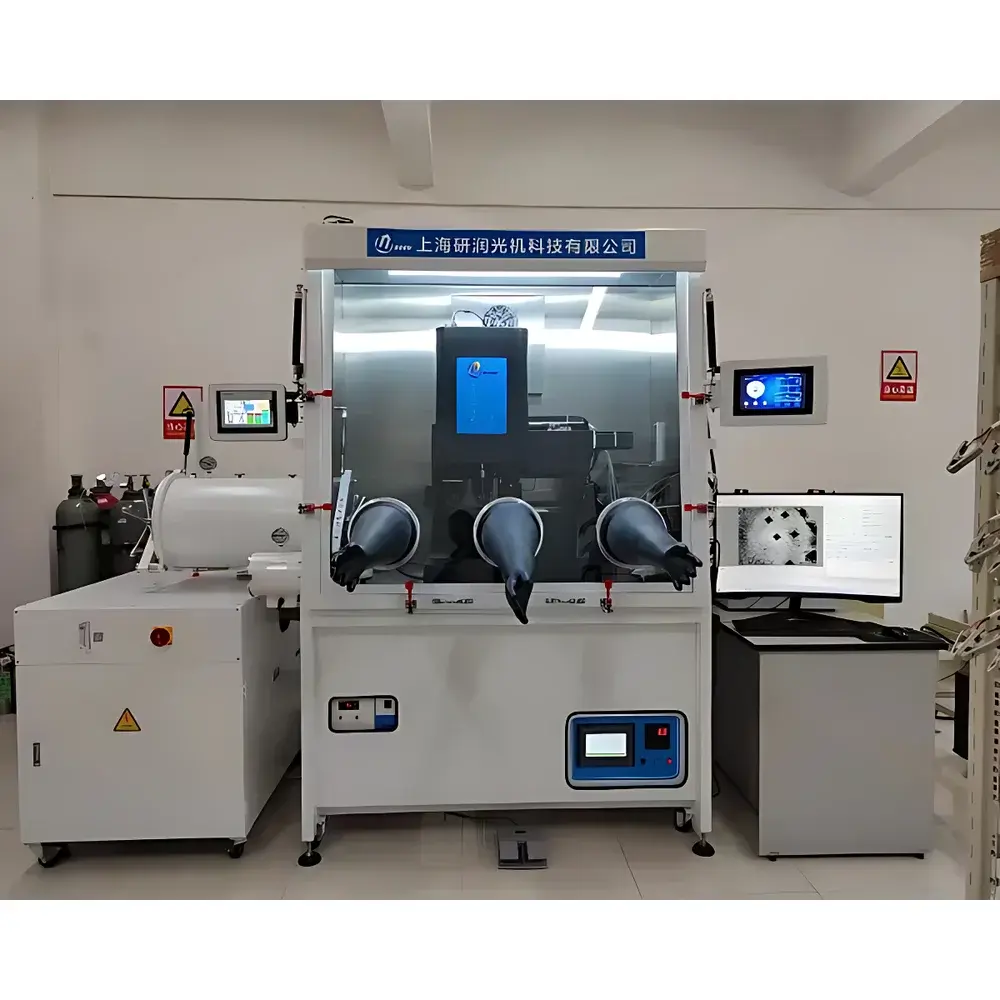
YANRUN HMAS-UHT1700CM Full-Field High-Temperature Vickers Hardness Tester (up to 1600 °C)
| Brand | YANRUN |
|---|---|
| Origin | Shanghai, China |
| Manufacturer Type | Direct Manufacturer |
| Instrument Type | Vickers Hardness Tester |
| Model | HMAS-UHT1700CM |
| Load Range | 0.1–30 kgf (standard), optional up to 150 kgf |
| Operating Temperature Range | 400–1600 °C (full-field uniformity) |
| Optical Working Temperature | ≤1600 °C (10× or 20× objective) |
| Temperature Control Accuracy | ±1 °C |
| Max. Dwell Time | 72 h |
| Force Resolution | 0.01% FS |
| Multi-Axis Control | Up to 9 axes |
| Sample Size Limit | Ø30 mm × 30 mm |
| Heating Element | U-shaped MoSi₂ (4 units) |
| Thermocouple | Type B |
| Furnace Cavity | 100 × 80 × 80 mm³ |
| Image Magnification | 1000× (10× objective), optional 2000× (20× objective) |
| Objective Resolution | 1.44 µm (10×), optional 1.19 µm (20×) |
| Rapid Sample Exchange | ≤50 s at 1600 °C |
| Cooling | Dual-mode (water + inert gas), ≤5 s cooldown to safe handling |
Overview
The YANRUN HMAS-UHT1700CM is a full-field, high-temperature Vickers hardness tester engineered for in-situ mechanical characterization of advanced materials under extreme thermal conditions—from 400 °C up to 1600 °C. Unlike conventional hot-stage microhardness systems limited to localized heating or short-duration testing, the HMAS-UHT1700CM maintains a spatially uniform temperature field across the entire furnace cavity (100 × 80 × 80 mm³), enabling true isothermal indentation, real-time optical observation, and quantitative force–time response acquisition without thermal gradient artifacts. Its core measurement principle adheres to ASTM E384 and ISO 6507-1 for Vickers microhardness, extended rigorously to elevated temperatures via high-stability MoSi₂ heating elements, B-type thermocouples, and active thermal compensation algorithms embedded in the motion and load control architecture. The system supports not only standard hardness evaluation but also fracture toughness estimation (e.g., Anstis model), creep-influenced indentation behavior analysis, and time-dependent plasticity modeling—critical for ceramic matrix composites, refractory alloys, nuclear fuel claddings, and ultra-high-temperature ceramics (UHTCs) used in aerospace propulsion and next-generation fission/fusion environments.
Key Features
- Full-field 1600 °C operational capability: Uniform temperature distribution (±5 °C gradient) maintained across the entire sample chamber using four U-shaped MoSi₂ heating elements and dual-zone PID feedback control with Type B thermocouples.
- High-temperature optical imaging: 10× objective rated for continuous operation at 1600 °C; optional 20× objective enables sub-micron resolution (1.19 µm) under identical thermal conditions—enabling real-time observation of indentation initiation, crack propagation, and surface relaxation phenomena.
- Dynamic load control with real-time force–time acquisition: Electromechanical loading module delivers programmable force profiles (0.1–30 kgf standard; up to 150 kgf optional) with ≤0.5% accuracy (>1 kgf) and 0.01% full-scale resolution; synchronized force–time logging at ≥1 kHz sampling rate supports viscoplastic modeling and dwell-time-dependent hardness evolution studies.
- In-situ multi-axis positioning: Nine-axis coordinated motion system (X/Y/Z + sample tilt/rotation + objective focus + pressure head alignment + gas nozzle positioning) achieves ≤1 µm repeatability and ≤0.1 µm step resolution—essential for high-throughput mapping, gradient testing, and automated crack-tip indentation.
- Rapid sample exchange at temperature: Manual or motorized sample stage enables full specimen replacement within ≤50 seconds at 1600 °C, preserving thermal equilibrium and minimizing experimental downtime during comparative alloy screening or irradiation-damaged sample series.
- Integrated environmental management: Optional glovebox integration (H₂O/O₂ ≤1 ppm) with vacuum transition lock and inert gas purging (Ar ≥99.999%) ensures oxidation-sensitive testing of TiAl, Nb–Si, and MAX-phase materials; dual cooling modules (water + inert-gas jet) achieve ≤5 s cooldown from 1600 °C to <100 °C for safe post-test handling.
Sample Compatibility & Compliance
The HMAS-UHT1700CM accommodates cylindrical or disc-shaped specimens up to Ø30 mm × 30 mm, compatible with sintered ceramics, directionally solidified superalloys, additively manufactured refractories, and thin-film coated substrates. All structural and optical components—including the 1700 °C-rated pyramidal indenter (standard Berkovich geometry, optional spherical/conical/cylindrical tips), high-temperature lens assemblies, and load cell housing—are fabricated from vacuum-melted refractory alloys and ceramic composites validated per ASTM C1161 (flexural strength of advanced ceramics) and ISO 14577-1 (instrumented indentation testing). System compliance includes traceable calibration to NIST-traceable reference standards, adherence to GLP documentation requirements (audit-ready electronic logbooks with user-level access control), and compatibility with FDA 21 CFR Part 11–compliant software configurations for regulated R&D environments.
Software & Data Management
Control and analysis are executed via YANRUN’s proprietary HMAS-Studio v5.x platform, running on an industrial-grade wall-mounted PC with real-time Linux kernel extensions. The software provides synchronized acquisition of force, displacement, temperature, image stream, and environmental parameters (gas flow, pressure, dew point) with timestamp alignment to ±100 µs. Raw data is stored in HDF5 format with embedded metadata (test protocol, calibration history, operator ID, instrument configuration), supporting reproducible reprocessing and third-party interoperability (MATLAB, Python via h5py). Advanced modules include automatic indentation detection with sub-pixel centroiding, crack-length quantification using edge-enhanced segmentation, dwell-time-dependent hardness decay fitting (Norton–Bazant models), and multi-parameter correlation dashboards for DOE-driven material optimization. Audit trails record all parameter changes, file exports, and user actions with SHA-256 hashing for integrity verification.
Applications
- Development and qualification of UHTCs (ZrB₂–SiC, HfC–graphite) for hypersonic leading edges and scramjet combustors.
- Thermomechanical property mapping of nuclear-grade SiC/SiC composites under simulated LOCA (Loss-of-Coolant Accident) thermal transients.
- In-situ evaluation of interfacial degradation in thermal barrier coating (TBC) systems (YSZ/bond coat/superalloy) during cyclic oxidation.
- Creep–plasticity coupling analysis in Ni-based single-crystal turbine blade alloys above 0.8 Tm.
- Fracture mechanics parameter extraction (KIC, R-curve behavior) in brittle oxides and borides at service-relevant temperatures.
- Validation of phase-field and crystal plasticity finite element (CPFEM) models against experimentally derived indentation pile-up/sink-in metrics.
FAQ
What is the maximum allowable dwell time at 1600 °C?
The system supports uninterrupted dwell periods of up to 72 hours at 1600 °C, with active thermal drift compensation and real-time load recalibration enabled throughout.
Can the instrument perform hardness testing under controlled atmospheres other than argon?
Yes—optional vacuum integration (10−3 Pa base pressure) and reactive gas dosing (e.g., O2, CO, H2) enable oxidation, carburization, or nitridation-coupled mechanical testing.
Is remote operation supported for hazardous or shielded environments?
Fully supported via fiber-optic isolated Ethernet interface; control station can be located up to 100 m from the main unit, with radiation-hardened variants available for hot-cell deployment.
How is force calibration maintained at elevated temperatures?
A high-temperature load cell (rated to 1700 °C) undergoes in-situ zero-point and span verification prior to each test sequence using a secondary reference transducer mounted outside the furnace zone.
Does the system comply with ISO/IEC 17025 requirements for accredited testing laboratories?
Yes—calibration certificates, uncertainty budgets (k=2), and procedural SOPs are provided per ISO/IEC 17025:2017 Annex A.3, with optional third-party accreditation support services available.



