
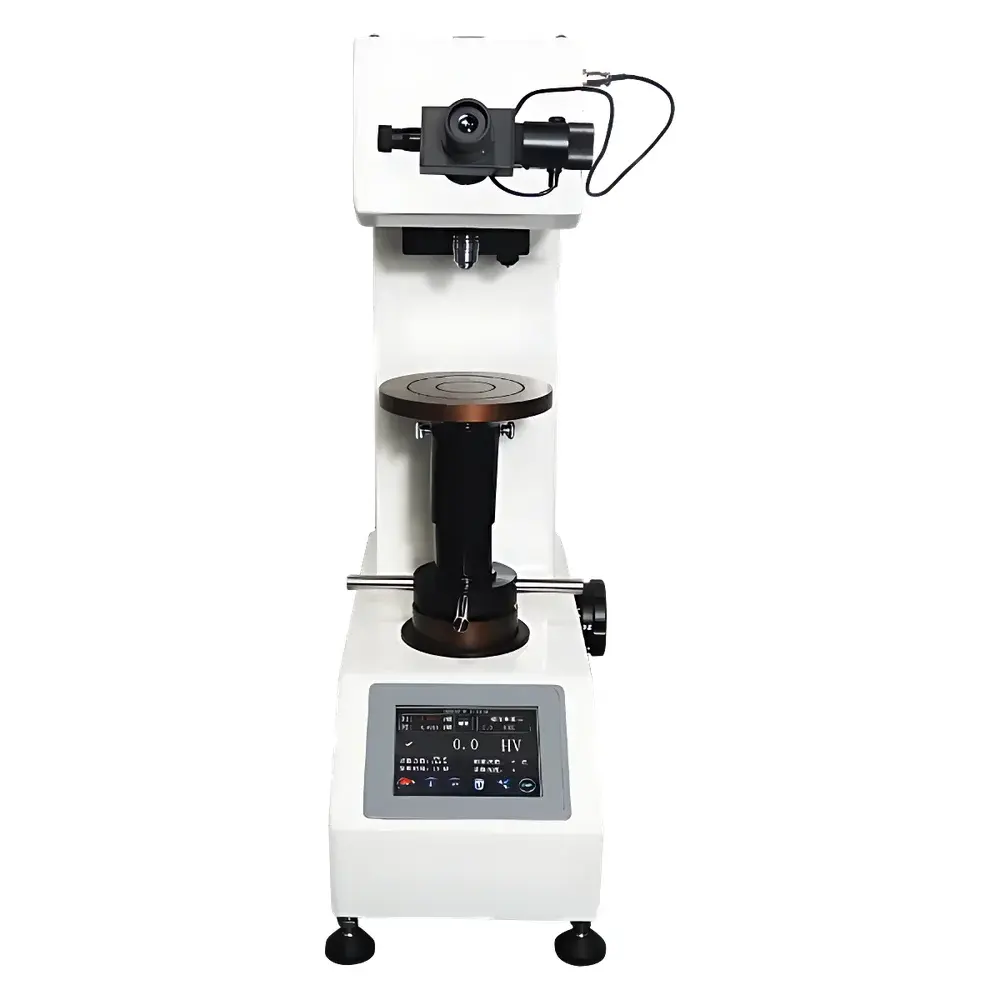
YANRUN HVI-5/10/20/30/40/50/100 Sensor-Feedback Digital Vickers Hardness Tester
| Brand | YANRUN |
|---|---|
| Origin | Shanghai, China |
| Manufacturer Type | Direct Manufacturer |
| Product Category | Domestic |
| Model | HVI-5/10/20/30/40/50/100 |
| Hardness Tester Type | Vickers |
| Measurement Range | 8–3000 HV |
| Testing Force Options | 0.2–100 kgf (12–16 selectable steps per load range) |
| Load Application | Motor-driven, fully automatic (loading/holding/unloading) |
| Standards Compliance | GB/T 4340, ISO 6507 |
| Objective Lenses | 10× (observation), 20× (measurement for ≤10 kgf models) |
| Total Magnification | 100× (observation), 200× (measurement for ≤10 kgf) |
| Minimum Detectable Indentation Step | 0.12 µm (10×), 0.06 µm (20×) |
| Dwell Time | 0–60 s (1 s increments) |
| Max Specimen Height | 235 mm |
| Distance from Indenter Center to Chamber Wall | 130 mm |
| Power Supply | AC 220 V / 50 Hz |
| Dimensions (L×W×H) | 570 × 220 × 680 mm |
| Net Weight | 46.0 kg |
Overview
The YANRUN HVI-5/10/20/30/40/50/100 is a precision-engineered digital Vickers hardness tester designed for laboratory and industrial quality control environments requiring traceable, repeatable micro- and macro-hardness measurements. It operates on the fundamental principle of Vickers indentation—applying a precisely controlled diamond pyramid indenter (136° apex angle) under defined test forces ranging from 0.2 kgf to 100 kgf, followed by optical measurement of the resulting diagonal impression in the specimen surface. The system employs closed-loop sensor feedback for real-time force regulation during loading, eliminating mechanical lever-arm dependency and ensuring high reproducibility across the full 8–3000 HV hardness range. Unlike traditional dead-weight testers, this model integrates motor-driven loading and unloading mechanisms with programmable dwell time (0–60 s), enabling automated test cycles without manual weight handling or mechanical calibration adjustments.
Key Features
- Sensor-based closed-loop force control ensures ±0.5% accuracy across all load ranges—critical for compliance with ISO 6507-1 and GB/T 4340-1 requirements.
- Motorized loading/unloading mechanism eliminates reliance on gravity-based weights; no manual installation, alignment, or recalibration of砝码 (mass sets) required.
- Touchscreen HMI interface supports intuitive test setup, result review, and report generation—optimized for routine QC workflows.
- Automatic hardness calculation includes statistical outputs: mean, max, min, and range—stored internally with timestamped records.
- Integrated thermal-printer provides immediate hard-copy documentation compliant with GLP audit trails (no external PC required).
- Manual turret design accommodates dual-objective configuration (10× observation + 20× measurement for low-load models; 10× only for ≥20 kgf configurations), ensuring optimal resolution and field-of-view balance.
- Robust mechanical architecture features trapezoidal lead screw elevation system for stable Z-axis positioning and long-term repeatability.
Sample Compatibility & Compliance
The HVI series accommodates specimens up to 235 mm in height and 130 mm lateral clearance from the indenter axis—suitable for machined components, heat-treated parts, thin coatings (with appropriate load selection), and metallurgical cross-sections. Standard accessories include large, small, and V-shaped anvil platforms, enabling secure support for irregular geometries. Calibration verification is supported via certified reference hardness blocks (high- and low-range), traceable to national metrology institutes. The instrument conforms to ISO 6507-1:2018 (Metallic materials — Vickers hardness test — Part 1: Test method) and GB/T 4340.1–2012, and its operational logic aligns with FDA 21 CFR Part 11 data integrity expectations when used with printed output as primary record. While not inherently 21 CFR Part 11–validated (as it lacks electronic signature capability), its deterministic test sequence, immutable print logs, and non-editable internal storage meet baseline ALCOA+ principles for regulated manufacturing environments.
Software & Data Management
This model does not rely on external PC software; all functionality—including test parameter definition, image capture (via integrated eyepiece camera interface), diagonal measurement, hardness conversion, and statistical summary—is executed onboard. Results are stored in non-volatile memory with date/time stamps and operator ID fields (configurable via touchscreen). Internal storage capacity supports ≥500 test records. Export is limited to thermal-printed reports (two-roll thermal paper included), formatted with test ID, load, dwell time, measured diagonals (d₁/d₂), calculated HV value, and statistical summary. For laboratories requiring digital archiving, optional USB-to-PC connectivity (via accessory module) enables CSV export of raw data—compatible with LIMS integration or custom post-processing in Excel or MATLAB.
Applications
- Quality assurance of heat-treated steels, tool steels, and case-hardened components in automotive and aerospace supply chains.
- Mechanical property verification of weld zones, cladding layers, and dissimilar metal joints per ASTM E384 guidelines.
- Research-grade hardness profiling across metallographic cross-sections, including grain-level analysis using low-force settings (e.g., 0.2–0.5 kgf).
- In-process verification of surface treatments such as nitriding, carburizing, and PVD/CVD coatings—when combined with proper specimen preparation and load optimization.
- Calibration lab use for intermediate checks against certified reference blocks in accordance with ISO/IEC 17025 internal audit protocols.
FAQ
Is this instrument suitable for testing thin films or coatings?
Yes—provided the selected test force yields an indentation depth ≤10% of the coating thickness and the substrate hardness does not significantly influence the measurement. Use loads ≤0.5 kgf with 20× objective for optimal resolution.
Does it support ASTM E384 microhardness testing?
Yes—the 0.2–1 kgf load range, 20× objective (0.06 µm resolution), and automatic diagonal measurement meet ASTM E384–22 requirements for microindentation procedures.
Can test parameters be password-protected?
Yes—the touchscreen interface supports multi-level user access (Operator, Technician, Administrator) with configurable permissions for parameter editing, calibration, and data deletion.
What maintenance is required for long-term accuracy?
Annual verification using certified reference blocks is recommended; periodic cleaning of the objective lenses and indenter tip with lens-grade solvent; inspection of the Z-axis lead screw for lubrication integrity every 6 months.
Is ISO 17025 calibration certification available?
Factory calibration certificates are provided with each unit. Third-party ISO/IEC 17025 accreditation can be arranged through authorized metrology partners upon request—valid for one year from issuance.



