
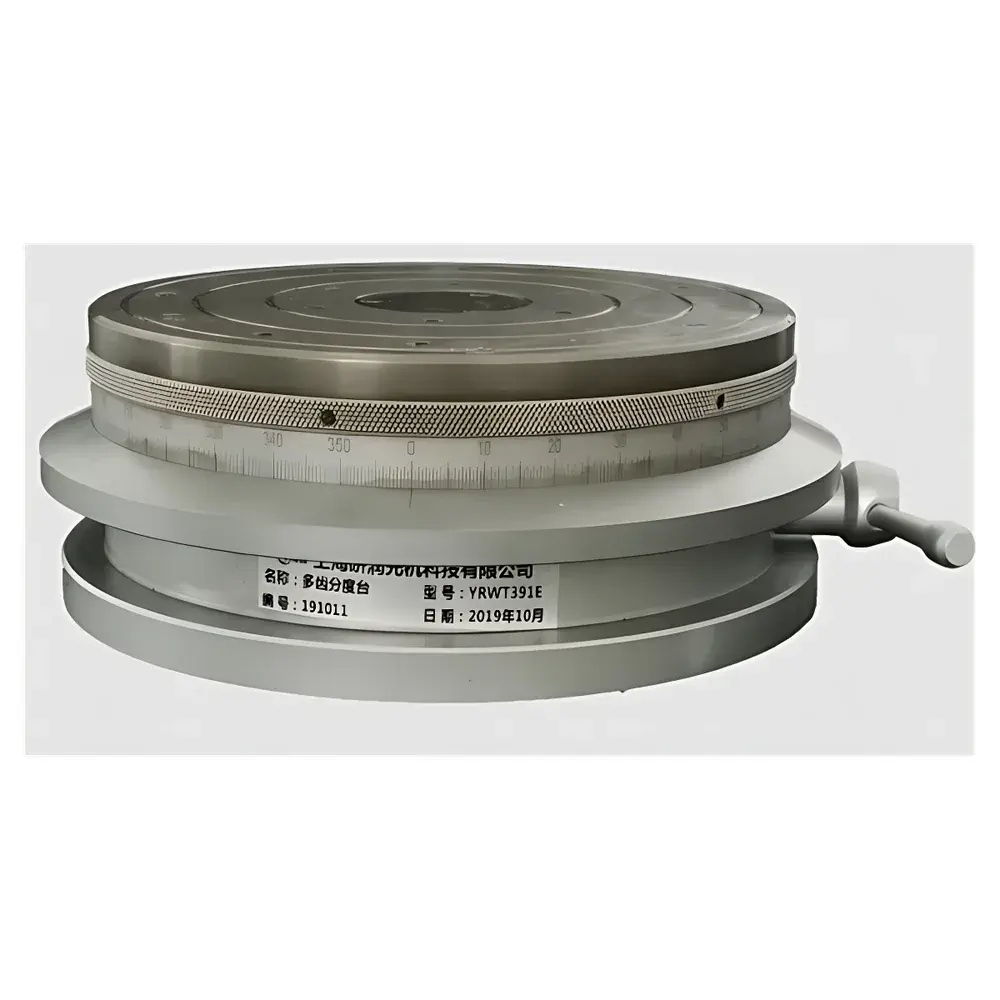
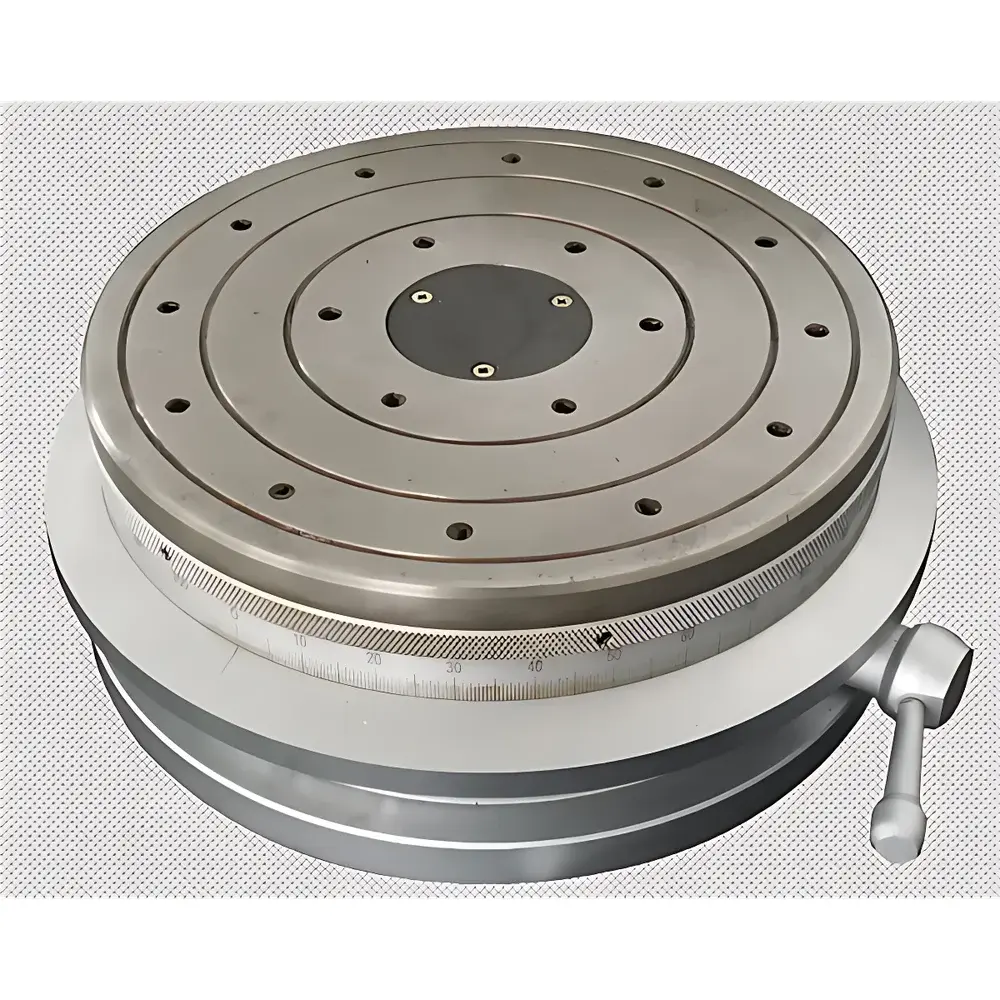
YANRUN YR-720A Programmable Multi-Tooth Indexing Table
| Brand | YANRUN |
|---|---|
| Origin | Shanghai, China |
| Manufacturer Type | Direct Manufacturer |
| Product Category | Domestic (PRC-Made) |
| Model | YR-720A |
| Component Type | Precision Angular Positioning Stage |
| Interface | RS232 Serial Port |
| Compliance | Designed for ISO 10012 & JJG 472 Metrological Verification Procedures |
| Control Mode | Computer-Controlled Stepping Motor Drive |
| Indexing Principle | Mechanical Gear-Based Averaging via Multi-Tooth Engagement |
Overview
The YANRUN YR-720A Programmable Multi-Tooth Indexing Table is a high-precision angular positioning stage engineered for metrological calibration and optical alignment applications in national institutes, aerospace test labs, and precision optics manufacturing facilities. It operates on the mechanical averaging principle inherent to multi-tooth gear engagement—where hundreds of precisely machined teeth (391 or 552, depending on configuration) simultaneously mesh to suppress individual tooth errors, yielding sub-arcsecond repeatability and exceptional centering stability. Unlike motorized rotary stages relying solely on encoder feedback, the YR-720A achieves intrinsic angular accuracy through deterministic mechanical indexing, making it ideal for primary standard calibration tasks such as angle block verification, pentaprism error mapping, and autocollimator-based flatness or perpendicularity assessment. Its rigid cast-iron base and kinematic mounting interface ensure minimal thermal drift and vibration coupling during extended measurement cycles.
Key Features
- Programmable indexing with RS232 serial interface for integration into automated metrology workstations and custom LabVIEW/Python control environments
- Two standard indexing configurations: 391-tooth variant optimized for 17-face and 23-face polygon calibration per ISO 10012 Annex B; 552-tooth variant aligned with JJG 472 requirements for theodolite horizontal axis error evaluation (including “one-set horizontal direction standard deviation” and “horizontal circle eccentricity”)
- Color-coded indexing markers (red/green dots on graduated ring) enabling rapid visual confirmation of divisional reference points without software dependency
- High rigidity monolithic base structure with precision-ground top surface, supporting direct mounting of autocollimators, interferometers, or collimators up to 150 mm aperture
- No backlash design achieved via preloaded dual-gear train and hardened steel tooth profiles, ensuring consistent torque transmission across full 360° rotation
- Mechanical zero-reference point with physical detent and optical alignment groove for traceable re-homing after power loss or manual override
Sample Compatibility & Compliance
The YR-720A is validated for use with industry-standard optical metrology instruments including ZYGO GPI interferometers, Thorlabs PAF autocollimators, and Trioptics OptiCentric systems. It complies with Chinese national metrological verification regulation JJG 472–2017 (Multi-Tooth Indexing Tables) and supports traceability pathways under ISO/IEC 17025 accredited laboratories. When used in conjunction with calibrated autocollimators meeting ISO 10110-5 specifications, the system enables uncertainty budgets compliant with EURAMET cg-21 guidelines for angular metrology. The stage meets electromagnetic compatibility (EMC) Class B requirements per GB/T 18268.1–2010 and is rated for continuous operation within ambient temperature ranges of 20 ± 1 °C, relative humidity ≤ 60 % RH non-condensing.
Software & Data Management
The YR-720A communicates via ASCII command protocol over RS232 at 9600 baud, supporting standard SCPI-like syntax for position commands (e.g., “MOV 123.456”), status queries (“POS?”), and homing sequences (“HOM”). No proprietary software is required; integration is demonstrated with MATLAB Instrument Control Toolbox, National Instruments DAQmx, and open-source PySerial libraries. All motion logs—including commanded position, actual encoder reading (if external encoder is added), timestamp, and error flags—are exportable as CSV for audit trail generation. While the base unit does not include built-in data logging, its serial interface permits seamless inclusion in GLP/GMP-compliant workflows where instrument control and raw position data are captured by validated third-party acquisition software meeting FDA 21 CFR Part 11 electronic record requirements.
Applications
- Calibration of angular standards: gauge blocks, polygon mirrors, and optical polygons per ISO 7976 and VDI/VDE 2617-12
- Verification of theodolite and total station horizontal circle graduation accuracy, particularly for military-grade survey instrumentation requiring < ±0.5″ systematic error
- Alignment of multi-element optical benches in laser cavity construction and synchrotron beamline commissioning
- Dynamic angular error profiling of high-speed goniometers using synchronized photodiode arrays
- Teaching laboratory implementation for undergraduate metrology courses covering gear averaging theory, Abbe error compensation, and uncertainty propagation in angular measurements
FAQ
What is the difference between the 391-tooth and 552-tooth configurations?
The 391-tooth version provides exact integer divisions for both 17 and 23 facets (391 = 17 × 23), enabling precise indexing for polygon mirror calibration. The 552-tooth variant supports 23- and 24-fold subdivisions required for theodolite horizontal circle testing per JJG 472.
Can the YR-720A be integrated with modern USB-based controllers?
Yes—via commercially available RS232-to-USB adapters certified to FTDI or Silicon Labs chipsets; driver-level latency remains below 10 ms, preserving timing integrity for closed-loop sequencing.
Is thermal expansion compensated in the indexing mechanism?
No active compensation is implemented; however, the symmetric cast-iron housing and matched CTE materials minimize differential expansion. Users operating outside 20 ± 0.5 °C should apply linear correction per coefficient α = 11.5 µm/m·K.
Does the unit include an internal position encoder?
No—the YR-720A relies on deterministic mechanical indexing rather than servo feedback. Optional external high-resolution encoders (e.g., Renishaw RESOLUTE™) may be mounted externally for hybrid verification.
What maintenance intervals are recommended for long-term accuracy retention?
Lubrication of gear trains every 12 months using Klüberplex BEM 41-132 grease; periodic verification of indexing repeatability using a calibrated autocollimator per JJG 472 section 6.3.





