
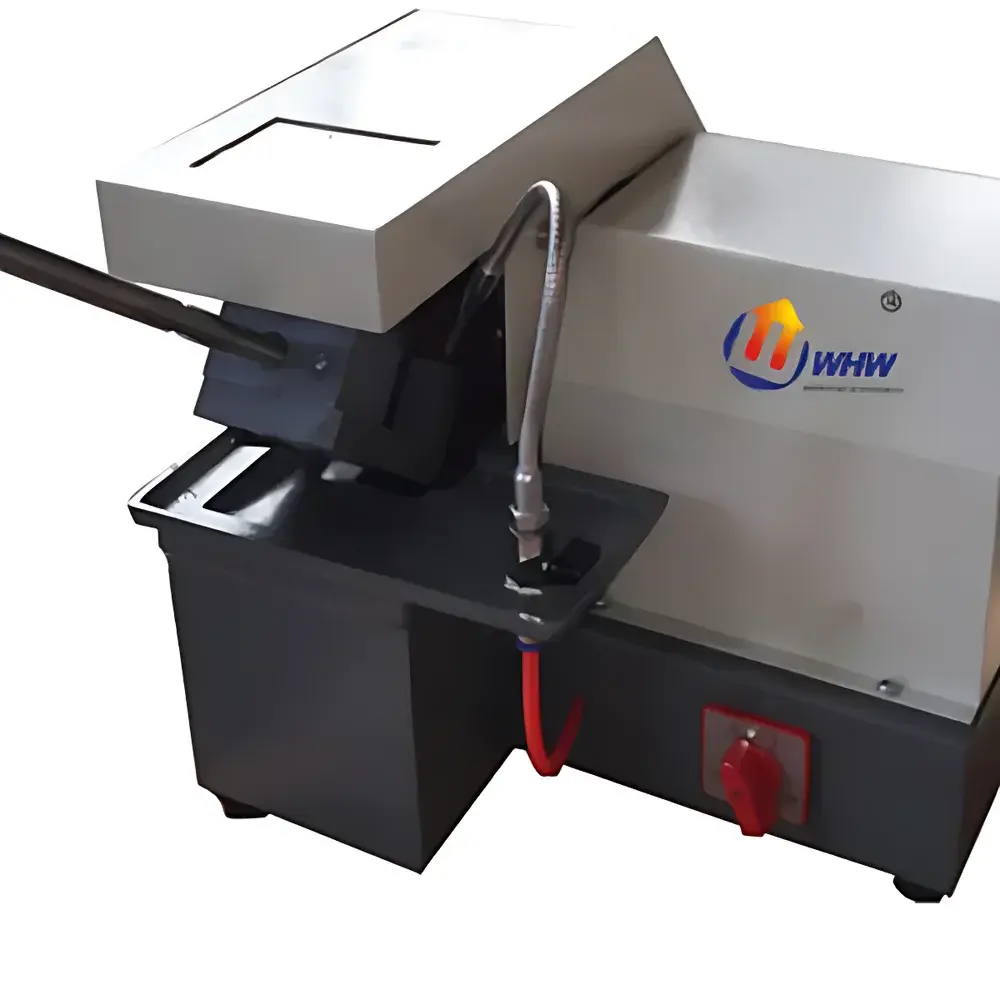
YANRUN Q-2 Manual Metallographic Cutting Machine
| Brand | YANRUN |
|---|---|
| Origin | Shanghai, China |
| Manufacturer Type | Direct Manufacturer |
| Country of Origin | China |
| Model | Q-2 |
| Instrument Type | Manual Metallographic Cutting Machine |
| Maximum Cutting Diameter | 35 mm |
| Cutting Wheel Dimensions | 250 × 1.5 × 32 mm |
| Spindle Speed | 2800 rpm |
| Motor Power | 1.1 kW |
| Mounting Style | Benchtop |
| Power Supply | 380 V AC |
| Net Weight | 60 kg |
| Standard Configuration | Main Unit (1), Precision Cutting Wheels (2 pcs), Tool Kit (1 set) |
Overview
The YANRUN Q-2 Manual Metallographic Cutting Machine is a precision-engineered benchtop instrument designed for controlled, low-heat sectioning of metallic and hard-brittle specimens in metallurgical, quality assurance, and materials research laboratories. Operating on a manually actuated feed mechanism, the Q-2 employs a high-rigidity spindle rotating at a fixed 2800 rpm to drive standard 250 mm diameter abrasive wheels (1.5 mm thick, 32 mm bore). Its mechanical design prioritizes operator control and reproducible cut geometry—critical for preparing planar, distortion-free cross-sections suitable for subsequent grinding, polishing, and optical or electron microscopy analysis. Unlike automated systems, the manual feed allows experienced technicians to modulate cutting pressure in real time, minimizing thermal damage and microstructural artifacts—particularly important when sectioning heat-sensitive alloys, coated components, or small-diameter samples up to 35 mm in diameter.
Key Features
- Benchtop architecture with rigid cast-iron base and precision-machined column for vibration damping and dimensional stability during manual feed operation
- 2800 rpm induction motor (1.1 kW) delivering consistent torque across load variations, optimized for carbide-impregnated and silicon carbide cutting wheels
- Ergonomic handwheel-driven vertical feed system with calibrated scale for repeatable specimen immersion depth control
- Integrated coolant delivery nozzle with adjustable flow rate, compatible with aqueous and oil-based metallographic coolants to suppress oxidation and wheel loading
- Quick-change wheel arbor (32 mm bore) supporting ISO-standard 250 mm cutting wheels; includes two precision-grade abrasive wheels and universal tool kit
- CE-compliant electrical enclosure (380 V AC, three-phase) with emergency stop button and interlocked safety guard meeting EN 60204-1 requirements
Sample Compatibility & Compliance
The Q-2 accommodates a broad range of conductive and non-conductive solid specimens, including ferrous and non-ferrous metals (e.g., stainless steels, aluminum alloys, titanium grades), sintered carbides, ceramic matrix composites, and mineralogical samples. Its 35 mm maximum cutting diameter supports common rod, tube, and small-part geometries used in ASTM E3, ISO 643, and GB/T 13298 metallographic preparation workflows. The machine conforms to general laboratory safety standards for mechanical cutting equipment and supports GLP-compliant documentation when integrated into validated sample preparation SOPs. While not intrinsically rated for hazardous environments, its sealed motor housing and coolant containment tray facilitate safe operation in ISO Class 7–8 cleanrooms or QA labs handling sensitive aerospace or medical-grade components.
Software & Data Management
As a manually operated mechanical system, the Q-2 does not incorporate embedded firmware, digital controls, or data logging capabilities. All operational parameters—including feed rate, dwell time, and coolant application—are recorded manually by the technician in lab notebooks or LIMS-integrated electronic batch records. This analog interface ensures full traceability under FDA 21 CFR Part 11 when paired with controlled document practices and witnessed sign-offs. For laboratories requiring audit-ready workflows, the Q-2 is routinely deployed alongside digital calipers, microscope image capture systems, and ELN platforms where cutting parameters are linked to downstream microstructural analysis reports.
Applications
- Preparation of ASTM E3-compliant transverse/longitudinal sections from rolled stock, weld joints, and castings for grain size evaluation and inclusion rating
- Sectioning of turbine blades, landing gear components, and fasteners in aerospace QA labs prior to SEM-EDS or XRD phase identification
- Routine sampling of engine blocks, cylinder heads, and transmission gears in automotive Tier-1 supplier QC laboratories
- Controlled biopsy of coated or heat-treated surfaces for diffusion zone and decarburization layer measurement per ISO 3887
- Mineralogical thin-section preparation in geological survey labs using diamond-impregnated wheels
- Pathology support in veterinary or materials failure analysis labs for brittle fracture surface extraction
FAQ
Is the Q-2 suitable for cutting non-metallic materials such as ceramics or composites?
Yes—the rigid spindle and stable feed mechanism support sectioning of silicon nitride, alumina, carbon-fiber-reinforced polymers, and other hard-brittle materials when paired with appropriate diamond or cubic boron nitride wheels.
Does the machine include coolant recycling capability?
No—the Q-2 features a gravity-fed coolant delivery system with a removable drip tray; external recirculation units must be added separately per lab coolant management policy.
Can the Q-2 be integrated into an automated sample prep line?
Not natively—the absence of programmable logic controllers or I/O interfaces limits integration to manual workflow segments; however, it is frequently positioned upstream of automated grinders and polishers in hybrid preparation cells.
What maintenance intervals are recommended for the spindle bearing assembly?
Per manufacturer guidelines, grease replenishment is required every 500 operating hours; full bearing inspection is advised annually or after 2,000 hours of cumulative use under continuous operation.
Are replacement cutting wheels supplied with certification of particle size distribution and bond hardness?
Standard wheels are supplied with batch-specific ISO 9001 manufacturing certificates; certified reference wheels with traceable grit distribution data are available upon request for metrology-critical applications.



