
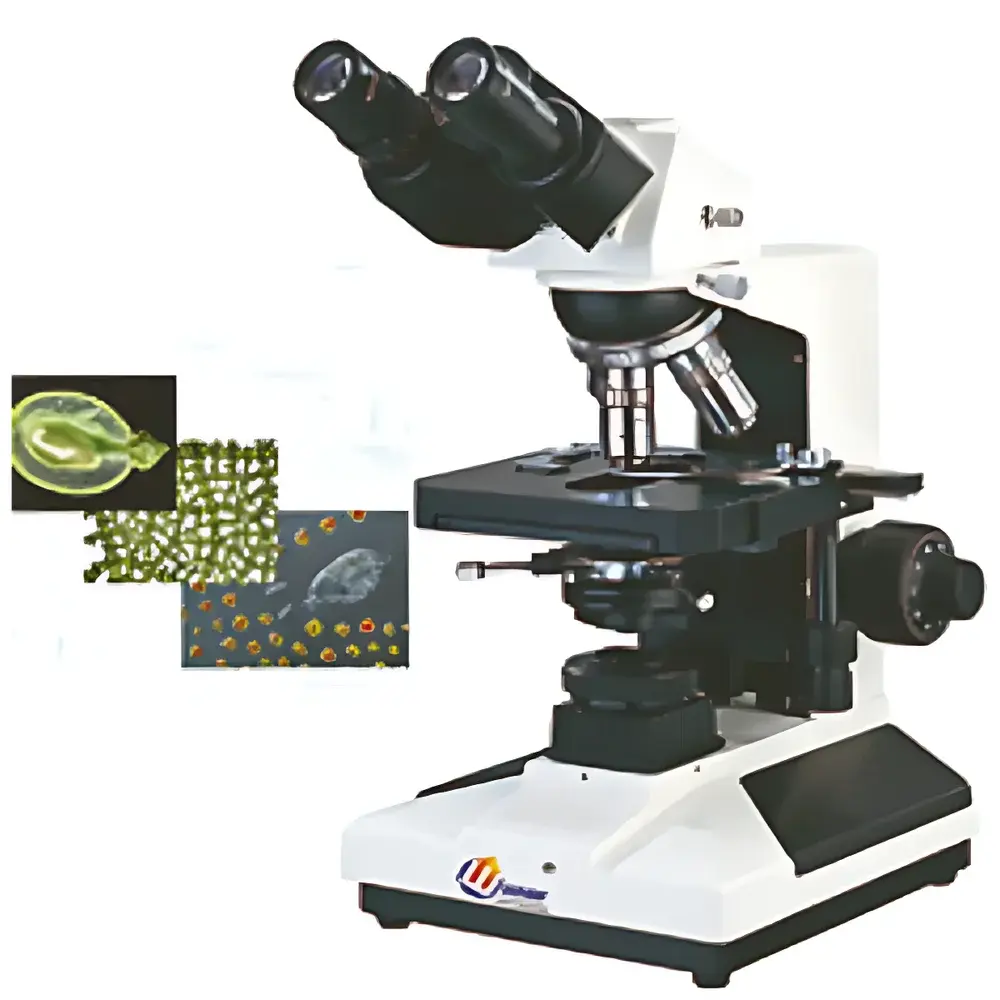
YANRUN BI-21 Biological Inverted Microscope
| Brand | YANRUN |
|---|---|
| Origin | Shanghai, China |
| Manufacturer Type | Direct Manufacturer |
| Product Category | Domestic (China-made) |
| Model | BI-21 Biological Microscope |
| Microscope Type | Inverted Microscope |
| Eyepiece Configuration | Binocular |
| Magnification Range | 40×–1000× |
| Eyepieces | Widefield WF10× (Φ20 mm) |
| Objective Lenses | Achromatic (BI-21A: 4×/0.10, 10×/0.25, 40×/0.65 spring, 100×/1.25 spring/oil) |
| Semi-Plan Achromatic (BI-21B | 4×/0.10, 10×/0.25, 20×/0.40, 40×/0.65 spring, 100×/1.25 spring/oil) |
| Nosepiece | BI-21A – 4-position inward ball-bearing turret |
| Stage | Dual-layer mechanical stage (160 mm × 140 mm), travel range 75 mm × 50 mm |
| Condenser | Abbe condenser, N.A. 1.25, vertically adjustable |
| Illumination | 6 V / 20 W halogen lamp with brightness control, integrated field diaphragm and collector |
| Focus Mechanism | Coaxial coarse/fine focus with adjustable coarse tension, locking mechanism, limit stop, fine focus graduation: 2 µm |
| Optical Design | Finite-conjugate (standard) |
| Optional Accessories | Phase contrast kits (PH-I/PH-II turret, PHP objectives), LED illumination upgrade (9 V / 500 mA adapters), polarizing system (360° rotatable polarizer, push-pull analyzer), darkfield condensers (dry/wet), plan achromat objectives (up to 60×/0.85), USB/VIDEO trinocular photo-tube |
Overview
The YANRUN BI-21 Biological Inverted Microscope is engineered for routine and advanced life science applications requiring stable, high-contrast observation of living cells and tissue cultures in standard Petri dishes, multi-well plates, and flasks. Unlike upright microscopes, its inverted configuration positions the objective lenses beneath the specimen stage and the condenser above—enabling unobstructed access to culture vessels while maintaining optimal working distance and thermal stability during long-term live-cell imaging. The optical system adheres to finite-conjugate (160 mm tube length) design principles, delivering consistent resolution across the specified magnification range (40×–1000×) when paired with standardized achromatic or semi-plan achromatic objectives. Köhler illumination ensures uniform brightness and maximal contrast by independently controlling field and aperture diaphragms, while the Abbe condenser (N.A. 1.25) supports oil-immersion objectives up to 100× for high-resolution morphology assessment. All optical components—including widefield WF10× eyepieces (20 mm field number)—are optimized for minimal chromatic aberration and flatness of field, meeting ISO 10934-1 criteria for basic biological microscopy performance.
Key Features
- Binocular inclined viewing head (30° tilt) with interpupillary adjustment and diopter compensation for extended user comfort during daily laboratory use.
- Coaxial coarse/fine focusing mechanism featuring calibrated fine-focus graduations (2 µm per division), adjustable coarse-focus tension, mechanical upper limit stop, and dual-position locking for repeatable Z-axis positioning.
- Robust dual-layer mechanical stage (160 mm × 140 mm) with 75 mm × 50 mm travel range, precision-machined dovetail guides, and vernier scales for reproducible specimen repositioning.
- Integrated halogen illumination system (6 V / 20 W) with continuous brightness regulation, heat-absorbing filter, and built-in field diaphragm for precise illumination control—compatible with optional high-efficiency white LED retrofit modules (9 V / 500 mA).
- Modular turret design: BI-21A accommodates four achromatic objectives; BI-21B supports five semi-plan achromatic objectives—including spring-loaded 40× and 100× oil-immersion lenses—via precision-ground inward ball-bearing positioning.
- Standard compatibility with phase contrast (PH-I/PH-II turret, PHP objectives), darkfield (dry/wet condensers), polarization (rotatable polarizer + push-pull analyzer), and digital imaging (USB/VIDEO trinocular port) modules—each conforming to ANSI Z80.10 and ISO 8578 optical interface specifications.
Sample Compatibility & Compliance
The BI-21 supports direct observation of adherent and suspension cell cultures in standard polystyrene or glass-bottom cultureware (e.g., 35 mm dishes, 6–96-well plates). Its inverted geometry eliminates interference from vessel lids or media menisci, making it suitable for time-lapse monitoring under ambient CO₂ conditions. The microscope complies with IEC 61000-6-3 (EMC emissions) and IEC 61000-6-2 (immunity) standards for laboratory equipment. While not certified for GLP/GMP production environments, its mechanical repeatability, calibration traceability (via micrometer stage and focus scale), and documentation-ready configuration support audit-readiness for academic and preclinical research workflows aligned with ISO/IEC 17025 and NIH Office of Laboratory Animal Welfare (OLAW) guidelines.
Software & Data Management
The BI-21 itself is an analog optical platform; however, its trinocular port enables integration with third-party digital imaging systems—including USB 3.0 CMOS cameras and HDMI video capture devices—that support DICOM-compliant metadata tagging, timestamped acquisition, and audit-trail logging. When used with validated software (e.g., NIS-Elements, ZEN Blue, or open-source MicroManager), image sequences can be exported with EXIF-compatible headers containing objective ID, magnification, exposure settings, and stage coordinates—facilitating FAIR (Findable, Accessible, Interoperable, Reusable) data practices. Firmware-upgradable LED controllers (optional) provide programmable intensity profiles compatible with LabVIEW and Python-based automation via TTL triggering.
Applications
- Routine quality control of mammalian and insect cell lines (e.g., HEK293, CHO, Sf9) including confluency estimation, morphology scoring, and contamination screening (bacterial/fungal/mycoplasma).
- Long-term live-cell imaging of fluorescently labeled organelles (mitochondria, lysosomes) using compatible epi-illumination add-ons and narrow-band excitation filters.
- Phase contrast evaluation of unstained primary neurons, stem cell colonies, and organoid spheroids without fixation or staining artifacts.
- Preparatory work for micromanipulation procedures (e.g., intracytoplasmic sperm injection, single-cell picking) where ergonomic access and vibration-damped stability are critical.
- Teaching laboratories requiring robust, serviceable instrumentation compliant with ASTM E2877-22 (Standard Guide for Selection of Microscopes in Educational Settings).
FAQ
Is the BI-21 compatible with fluorescence imaging?
The base model does not include epi-fluorescence illumination or filter cubes; however, it accepts aftermarket vertical illuminators (e.g., Leica EL6000-compatible units) mounted on the trinocular port—provided mechanical clearance and parfocality are verified during installation.
Can the BI-21 meet ISO 10934-2 requirements for quantitative microscopy?
While its optics satisfy ISO 10934-1 (basic performance), quantitative intensity measurements require external calibration with NIST-traceable photometric standards and validated camera systems—not inherent to the microscope chassis.
What maintenance intervals are recommended for the halogen illumination system?
Lamp replacement is advised every 100–150 hours of operation; condenser alignment and objective cleaning should occur quarterly in shared core facilities per CLSI EP29-A3 recommendations.
Does YANRUN provide documentation for regulatory submissions (e.g., FDA 21 CFR Part 11)?
The BI-21 is supplied with a Declaration of Conformity (DoC) to CE marking directives; full Part 11 compliance requires integration with validated software, electronic signatures, and audit-trail-enabled hardware—none of which are embedded in the base instrument.
Are replacement parts available globally through authorized distributors?
Yes—objective lenses, eyepieces, condensers, and mechanical stage components are stocked by YANRUN’s EU and North American distribution partners, with lead times averaging 2–4 weeks for non-stock items.
Related Products



