
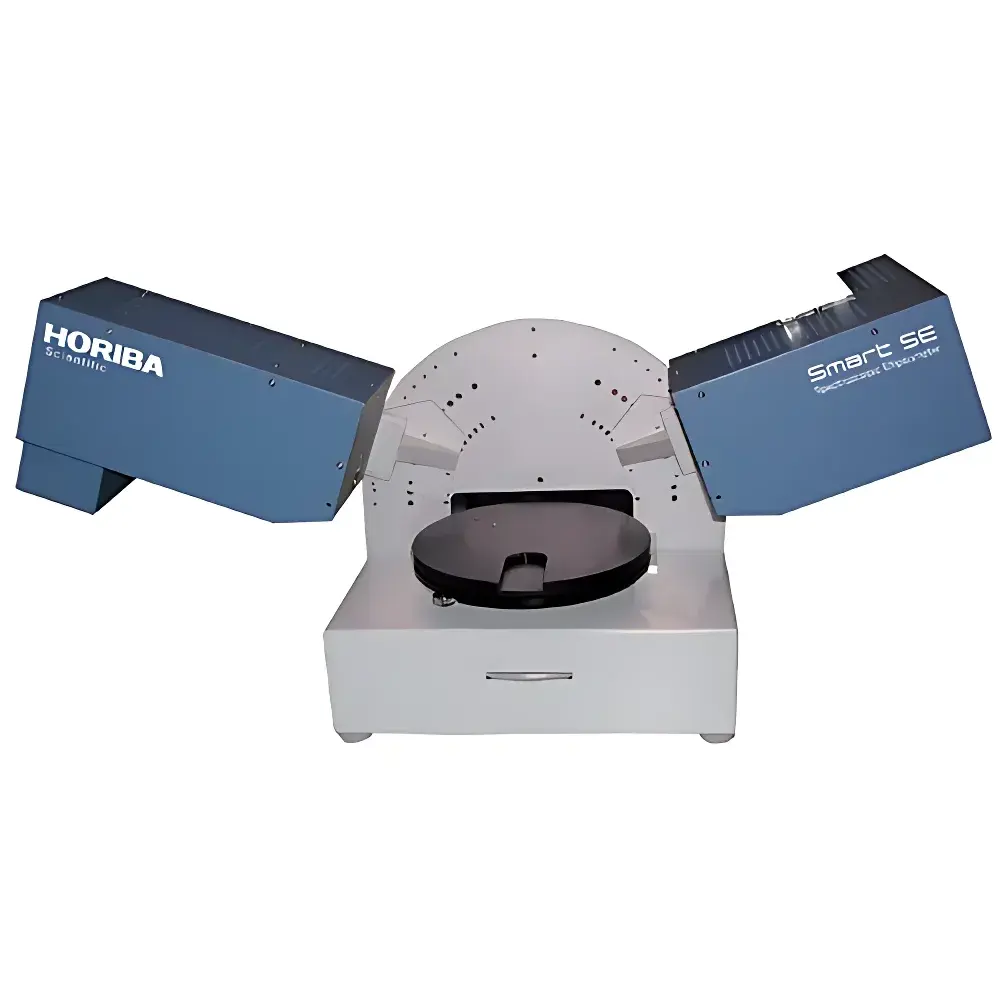
HORIBA Smart SE Smart Ellipsometer
| Brand | HORIBA |
|---|---|
| Origin | France |
| Model | Smart SE |
| Spectral Range | 450–1000 nm |
| Detector | CCD |
| Spot Visualization | Patented real-time surface imaging |
| Spot Selection | Motorized multi-size micro-spot (e.g., 30 µm, 100 µm, 300 µm) |
| Sample Stage | Motorized XYZ stage (200 mm × 200 mm travel, Z-axis range >35 mm) |
| Modulation | Liquid Crystal Variable Retarder (LCVR), no moving parts in optical path |
| Measurement Mode | Variable-angle spectroscopic ellipsometry |
| Output | Full-spectrum Ψ(λ) and Δ(λ) in <1 s per angle |
| Configuration | Supports both offline lab-based and inline process-integrated deployment |
Overview
The HORIBA Smart SE Smart Ellipsometer is a benchtop spectroscopic ellipsometer engineered for rapid, non-destructive, and contactless characterization of thin-film optical properties—including thickness, refractive index (n), extinction coefficient (k), and interfacial roughness—across single-layer and multilayer stack architectures. Based on the fundamental principles of polarized light interaction with layered dielectric or semiconductor structures, the Smart SE measures the change in polarization state (Ψ and Δ) upon reflection from a sample surface across a broad spectral range (450–1000 nm). Its fixed-optic design leverages liquid crystal variable retarder (LCVR) modulation—eliminating mechanical choppers or rotating compensators—to ensure long-term stability, high reproducibility, and minimal maintenance. The system operates under standard laboratory ambient conditions and requires no vacuum or purge gas, making it suitable for routine QC, R&D prototyping, and academic thin-film studies.
Key Features
- Single-button measurement workflow: Automated acquisition, modeling, and report generation—including thickness, n/k dispersion, and confidence intervals—without manual intervention.
- Patented real-time spot visualization: Integrated coaxial camera enables precise positioning and immediate verification of measurement location on any substrate—opaque, transparent, patterned, or highly reflective—without interrupting optical alignment.
- Motorized multi-size micro-spot selection: Three calibrated spot sizes (30 µm, 100 µm, 300 µm nominal) are switchable under software control to accommodate varying lateral resolution requirements and sample heterogeneity.
- High-speed full-spectrum acquisition: CCD-based detection captures the entire 450–1000 nm spectrum simultaneously at each incidence angle; typical acquisition time is <1 second per angle, enabling rapid mapping or kinetic monitoring.
- Modular variable-angle platform: Manual or motorized angular adjustment (40°–90°, 1° increments) supports isotropic and anisotropic film analysis, including uniaxial or biaxial optical models where required.
- Robust XYZ motorized stage: 200 mm × 200 mm travel range with ±35 mm Z-axis vertical clearance accommodates thick wafers, glass substrates, and custom fixtures; stage calibration traceable to NIST-traceable standards.
Sample Compatibility & Compliance
The Smart SE accepts rigid planar samples up to 200 mm × 200 mm and 50 mm in height—including silicon wafers (up to 300 mm diameter with optional adapter), fused silica, ITO-coated glass, OLED test substrates, and metal-organic thin films. No conductive coating or vacuum compatibility is required. The instrument complies with IEC 61000-6-3 (EMC emission) and IEC 61000-6-2 (immunity) standards. Data handling workflows support GLP/GMP-aligned documentation practices, including user access control, electronic signatures, and audit trail generation when integrated with HORIBA’s DeltaPsi² software (v5.0+), which meets FDA 21 CFR Part 11 requirements for electronic records and signatures.
Software & Data Management
DeltaPsi² software provides an integrated environment for instrument control, optical modeling (via Cauchy, Tauc-Lorentz, Cody-Lorentz, or user-defined dispersion models), regression analysis, and reporting. All raw Ψ/Δ spectra, model parameters, and fit residuals are stored in vendor-neutral HDF5 format. Batch processing, scripting via Python API, and export to CSV, Excel, or SDF (Structure Data Format) enable seamless integration into LIMS or MES platforms. Version-controlled project files include full metadata: date/time stamp, operator ID, instrument serial number, calibration status, and environmental logs (ambient temperature/humidity if external sensors are connected).
Applications
- Routine thickness metrology of SiO₂, SiNₓ, Al₂O₃, and polymer films in semiconductor front-end and MEMS fabrication.
- Optical constant determination of perovskite absorber layers and charge transport materials in photovoltaic R&D.
- Real-time monitoring of ALD and CVD growth kinetics using in-situ-compatible configurations.
- Quality assurance of anti-reflective, hard-coat, and touch-sensitive multilayer stacks on display cover glass.
- Characterization of biofunctionalized surfaces (e.g., SAMs, hydrogels) in life science interface studies.
FAQ
Does the Smart SE require periodic recalibration?
Yes—HORIBA recommends annual factory calibration using NIST-traceable reference standards; field verification with certified Si/SiO₂ wafers is supported via built-in calibration routines.
Can the Smart SE measure absorbing or metallic films?
Yes—within its spectral range, it quantifies complex dielectric functions of metals (e.g., Au, Ag, TiN) and semiconductors (e.g., a-Si, CdTe) using appropriate dispersion models and multi-angle data constraints.
Is inline integration supported out of the box?
The Smart SE is supplied as a standalone benchtop unit; inline integration requires optional OEM modules—including Ethernet/IP communication, industrial I/O triggers, and environmental enclosures—which are available under HORIBA’s Process Analytics division.
What file formats does DeltaPsi² support for data exchange?
Raw and processed data export to HDF5 (primary), CSV, XLSX, TXT, and SDF; optical models can be imported/exported in .dp2 and .xml formats.
Is training included with purchase?
HORIBA provides remote and on-site application training (8 hours standard), covering measurement setup, model building, uncertainty estimation, and compliance reporting—delivered by certified thin-film metrology engineers.






