
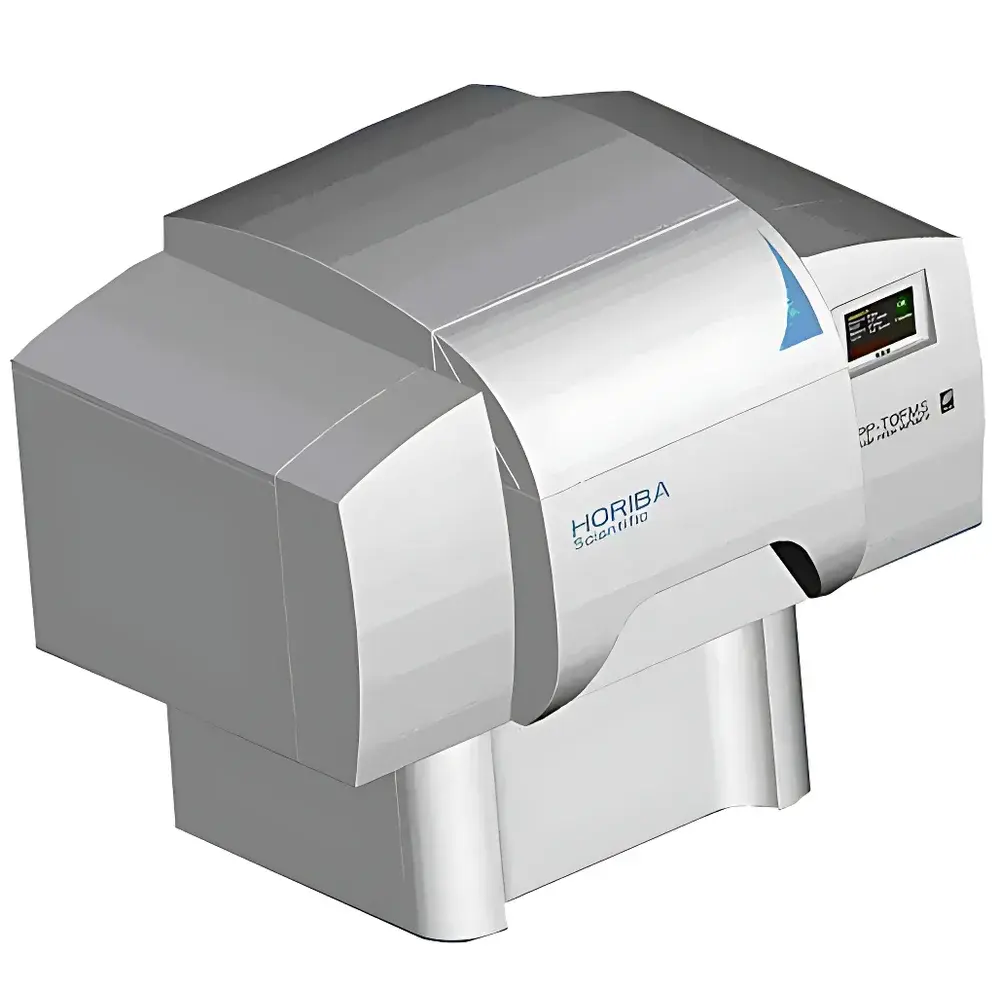
HORIBA PP-TOFMS Plasma Profiling Time-of-Flight Mass Spectrometer
| Brand | HORIBA |
|---|---|
| Origin | France |
| Model | PP-TOFMS |
| Acquisition Rate | 1 spectrum per 30 µs |
| Mass Resolution | 5,000 at m/z 208 (high-resolution mode) |
| Dynamic Range | 10⁷ |
| Mass Accuracy | ±40 ppm |
| Sensitivity | 10³ cps/ppm |
| Depth Resolution | down to 1 nm |
| Ion Modes | Positive and Negative |
| Flexible Ion Gating | up to 4 ions |
| Sample Loading | Horizontal, tool-free |
| Mass Coverage | H to U, including isotopes and molecular species |
| RF Pulsed Glow Discharge Mode | Patented |
| Quantitative Capability | Matrix-effect-minimized semi-quantitative depth profiling without calibration standards |
Overview
The HORIBA PP-TOFMS Plasma Profiling Time-of-Flight Mass Spectrometer is a high-performance analytical platform engineered for rapid, quantitative depth profiling of solid materials with nanometer-scale depth resolution and full-mass spectral fidelity. It integrates a pulsed radiofrequency glow discharge (RF-GD) plasma source with orthogonal-acceleration time-of-flight mass spectrometry (oa-TOFMS), enabling simultaneous detection of all elements—from hydrogen to uranium—and their isotopes in a single transient acquisition. Unlike conventional GD-MS systems relying on magnetic sector or quadrupole mass analyzers, the PP-TOFMS captures complete mass spectra at microsecond temporal resolution (1 full spectrum per 30 µs), preserving transient signal integrity during sputtering and enabling precise correlation between ion yield and depth. This architecture supports both elemental and isotopic depth profiling under controlled vacuum conditions without ultra-high vacuum requirements, making it suitable for routine laboratory deployment in semiconductor process development, advanced materials R&D, and failure analysis laboratories.
Key Features
- Pulsed RF Glow Discharge Source: Patented RF pulsing technology enables stable, low-thermal-load sputtering of insulating, conductive, and multilayered samples—including oxides, nitrides, and polymer-coated substrates—without external bias or cooling stages.
- Orthogonal Acceleration TOF Analyzer: Delivers high mass resolution (5,000 at m/z 208) and mass accuracy (±40 ppm) across the full mass range (1–260 u), supporting unambiguous isotope identification and interference-free detection of adjacent masses (e.g., 16O16O vs. 32S).
- Nanometer Depth Resolution: Achieves true depth resolution down to 1 nm in optimized sputter conditions—enabling characterization of ultrathin gate oxides, interfacial diffusion layers, and atomic-layer-deposited (ALD) films.
- Full-Mass Detection & Isotopic Fidelity: Simultaneous acquisition of H to U covers light elements critical for dopant analysis (e.g., B, P, As in Si) and heavy isotopes used in tracer studies (e.g., 18O in Ta2O5), with no duty-cycle loss or mass-scanning delay.
- Flexible Ion Gating: Four independently programmable ion gates allow real-time suppression of dominant matrix peaks (e.g., Si+, O+) to enhance detection limits for trace dopants or contaminants without sacrificing acquisition speed.
- Horizontal Sample Loading: Tool-free, ambient-access sample stage simplifies handling of wafers (up to 200 mm), cross-sectioned TEM lamellae, and irregularly shaped components—reducing preparation time and contamination risk.
Sample Compatibility & Compliance
The PP-TOFMS accepts bulk solids, thin films, multilayer stacks, and coated substrates without conductive coating or embedding. It complies with ISO/IEC 17025 requirements for analytical instrument validation and supports GLP/GMP-aligned workflows through audit-trail-enabled software logging. Data output conforms to ASTM E1301 (standard guide for quantitative analysis by GD-MS) and ISO 14707 (surface chemical analysis — glow discharge optical emission spectrometry). Full spectral data export (mzXML, NetCDF) ensures interoperability with third-party quantification tools and laboratory information management systems (LIMS).
Software & Data Management
HORIBA’s proprietary PP-TOFMS Control Suite provides integrated instrument control, real-time spectral visualization, depth scale calibration (via SRM reference materials or interferometric etch rate monitoring), and 3D data reconstruction (intensity × mass × depth). The software embeds FDA 21 CFR Part 11-compliant electronic signatures, user-access tiers, and immutable audit trails for raw data acquisition, processing parameters, and report generation. Batch processing supports automated peak integration, isotope ratio calculation (e.g., 18O/16O), and dopant concentration mapping using internal standard normalization or relative sensitivity factor (RSF) libraries.
Applications
- Dopant Profiling in Semiconductors: Quantitative B, P, and As depth distribution in Si wafers; Mg activation in InGaN LEDs; Al and Ga gradients in HEMT heterostructures.
- Surface Contamination & Interface Analysis: Identification of metallic residues (Fe, Ni, Cu) on PVD-coated optical mirrors; oxygen diffusion across Cu/Ta/NiFe interfaces in spintronic devices.
- Corrosion & Isotopic Tracer Studies: In-situ monitoring of 18O-labeled oxide growth kinetics; sulfur segregation at grain boundaries in stainless steel; hydrogen embrittlement mapping via D/H ratio profiling.
- Photovoltaic & Energy Materials: CdTe/CdS interface intermixing; Li distribution in NMC cathodes; carbon contamination in perovskite solar cell layers.
FAQ
Does the PP-TOFMS require ultra-high vacuum (UHV) conditions?
No—operational base pressure is 10−7 mbar, achieved with standard turbomolecular pumping; no UHV bake-out or differential pumping is needed.
Can it analyze non-conductive samples such as glass or polymers?
Yes—the pulsed RF-GD source maintains stable plasma ignition and sputtering on insulators without charge compensation or metallization.
Is matrix-matched calibration required for quantification?
Not for semi-quantitative profiling; the decoupled sputtering/ionization mechanism minimizes matrix effects, enabling RSF-based quantification with certified reference materials (CRMs) like NIST SRM 2136 or BAM S012.
How is depth scale calibrated?
Via secondary ion mass spectrometry (SIMS)-traceable reference standards, profilometry (e.g., AFM step height), or in situ optical interferometry during sputtering.
What data formats are supported for export and third-party analysis?
Raw transients (.bin), processed spectra (.mzML, .mzXML), depth profiles (.csv), and 3D datasets (.h5) are natively supported; Python and MATLAB APIs enable custom algorithm integration.





