
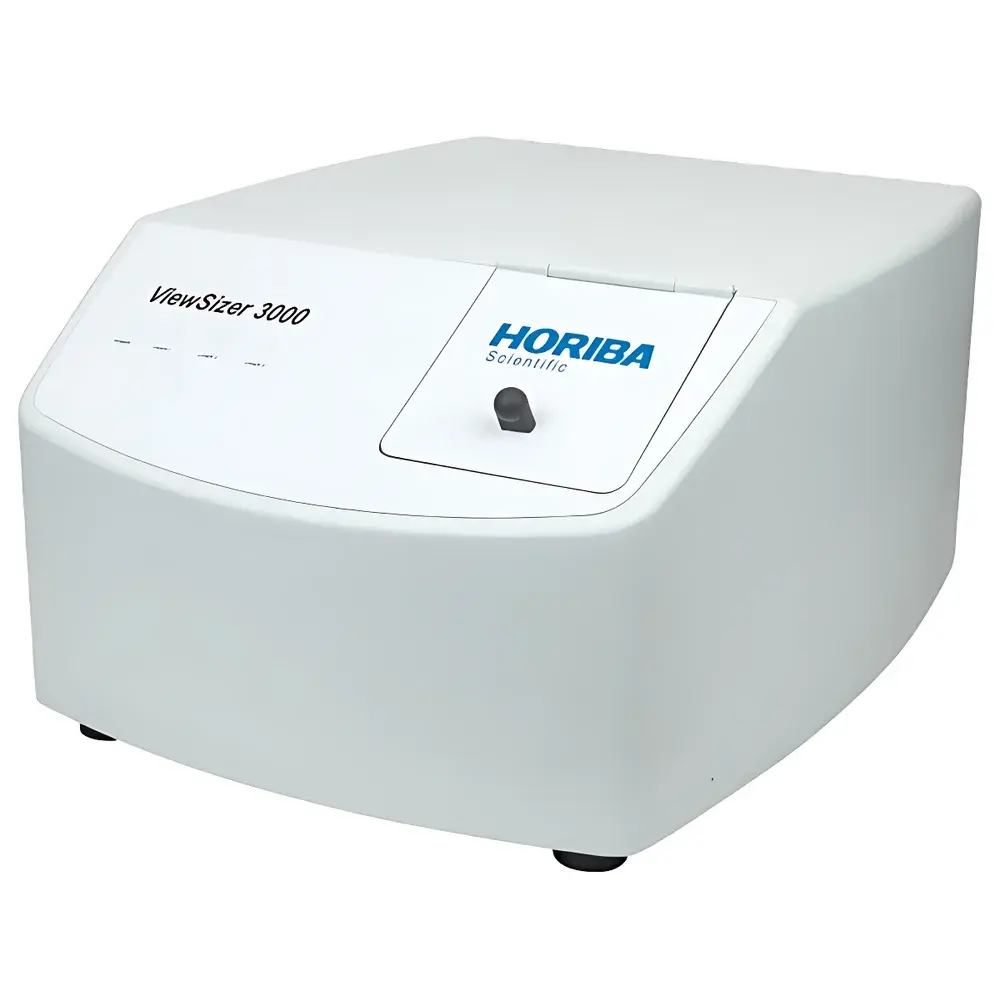
HORIBA ViewSizer 3000 Nanoparticle Tracking Analysis (NTA) System
| Brand | HORIBA |
|---|---|
| Origin | Japan |
| Model | ViewSizer 3000 |
| Particle Size Range | 10 nm – 15 µm |
| Size Measurement Reproducibility | ±1% |
| Temperature Control Range | 10°C – 50°C |
| Temperature Stability | ±0.1°C |
| Light Sources | Blue, Green, Red (visible spectrum) |
| Measurement Principle | Nanoparticle Tracking Analysis (NTA) via dynamic light scattering and single-particle trajectory tracking |
| Sample Volume | 350 µL – 1.25 mL |
| Particle Concentration Range | 5×10⁶ – 2×10⁸ particles/mL |
| Measurement Duration | ~2 minutes per acquisition |
| Fluorescence Capability | Multi-wavelength excitation & detection enabled |
| Zeta Potential Measurement | Not supported |
| Molecular Weight Determination | Not supported |
Overview
The HORIBA ViewSizer 3000 is a high-performance Nanoparticle Tracking Analysis (NTA) system engineered for direct visualization, sizing, and concentration quantification of nanoparticles in liquid suspension. Unlike ensemble-averaging techniques such as classical Dynamic Light Scattering (DLS), the ViewSizer 3000 tracks individual particle Brownian motion in real time using high-sensitivity video microscopy coupled with multi-wavelength illumination. By applying the Stokes–Einstein equation to measured diffusion coefficients, it calculates hydrodynamic diameter distributions with high resolution across an exceptionally broad size range—from 10 nm to 15 µm. Its vertical optical configuration enables unambiguous observation of sedimentation-sensitive processes—including protein aggregation, crystal dissolution, and colloidal instability—without interference from convection or meniscus effects. The system is not a DLS instrument in the conventional sense; rather, it implements NTA as a single-particle counting and trajectory-based method, delivering both number-weighted size distribution and absolute particle concentration in a single, non-invasive measurement.
Key Features
- Triple-wavelength illumination (405 nm blue, 532 nm green, 640 nm red): Enables optimal scattering contrast across diverse particle chemistries and refractive indices—critical for polydisperse or heterogeneous samples containing liposomes, exosomes, polymeric nanoparticles, or inorganic colloids.
- Vertical-viewing sample chamber: Minimizes gravitational artifacts and supports time-resolved monitoring of density-driven phenomena (e.g., aggregation kinetics, crystallization onset, or dissolution front propagation).
- Integrated temperature control (10–50°C, ±0.1°C stability): Ensures thermally consistent measurements essential for kinetic studies and regulatory-compliant method development.
- Intermittent magnetic stirring: Maintains homogeneous particle dispersion during acquisition without introducing shear-induced artifacts or bubble formation.
- Fluorescence mode capability: Simultaneous or sequential excitation/detection across three visible channels allows spectral deconvolution of co-existing particle populations with identical size but distinct fluorophore labeling—enabling multiplexed formulation analysis.
- Automated calibration and drift compensation: Real-time correction for stage drift and focus drift ensures reproducible trajectory reconstruction over extended acquisition windows.
Sample Compatibility & Compliance
The ViewSizer 3000 accommodates aqueous and organic suspensions within a volume range of 350 µL to 1.25 mL, supporting low-volume screening and compatibility with microfluidic-derived samples. It operates effectively across particle concentrations from 5×10⁶ to 2×10⁸ particles/mL—bridging the gap between dilute biological extracellular vesicles and concentrated industrial nanomaterials. While the system does not perform zeta potential or molecular weight determination, its output aligns with key regulatory expectations for nanoparticle characterization under ICH Q5A(R2), ISO/TS 21365:2021 (nanomaterials — characterization of particle size distribution), and USP / guidance on subvisible particle analysis. Data integrity is maintained through audit-trail-enabled software compliant with FDA 21 CFR Part 11 requirements for electronic records and signatures when configured in validated environments.
Software & Data Management
ViewSizer software provides an intuitive, workflow-driven interface designed for both novice and expert users. All operations—from autofocus and laser alignment to particle detection thresholding and trajectory validation—are accessible via point-and-click interaction. Raw video files (.avi), processed trajectory data (.csv), and fully annotated reports (.pdf) are exportable in formats compatible with LIMS integration and statistical process control platforms. Batch processing supports automated analysis of multi-condition kinetic series, with built-in tools for overlaying size/concentration trends versus time, temperature, or pH. Version-controlled software updates ensure long-term compatibility with evolving laboratory informatics infrastructure and support GLP/GMP-aligned documentation practices including electronic signature capture and change history logging.
Applications
- Quantitative characterization of extracellular vesicles (exosomes, microvesicles) and viral vectors in biopharmaceutical development.
- Real-time monitoring of API dissolution kinetics, polymer self-assembly, and lipid nanoparticle (LNP) stability under thermal stress.
- Crystallization profiling in pharmaceutical and food science—tracking nucleation, growth, and agglomeration events at sub-micron resolution.
- Colloidal stability assessment of nanomaterials used in catalysis, coatings, and diagnostics—correlating size evolution with formulation variables.
- Multiplexed analysis of fluorescently labeled nanoparticles in complex biofluids, enabling differentiation of endogenous vs. administered particle populations.
- Process analytical technology (PAT) implementation for continuous manufacturing of nanosuspensions and emulsions.
FAQ
How does the ViewSizer 3000 differ from traditional DLS instruments?
It employs single-particle tracking rather than intensity-weighted ensemble averaging, delivering number-based size distributions and absolute concentration—without assumptions about sample monodispersity or optical properties.
Can the system analyze turbid or highly concentrated samples?
Yes—its adjustable illumination geometry and multi-wavelength flexibility allow optimization for samples where conventional NTA fails due to scattering saturation or poor contrast.
Is the instrument suitable for GMP-regulated environments?
When deployed with validated software configurations and documented IQ/OQ/PQ protocols, it meets requirements for use in quality control laboratories supporting regulatory submissions.
Does the system require specialized training to operate?
The intuitive interface enables rapid user onboarding; however, application-specific method development (e.g., for complex biological matrices) benefits from HORIBA’s technical support and application scientist consultation services.
What maintenance is required for long-term performance stability?
Routine cleaning of the sample cell and optical path, periodic verification of temperature calibration, and annual optical alignment checks are recommended—no consumables or proprietary reagents are required.



