
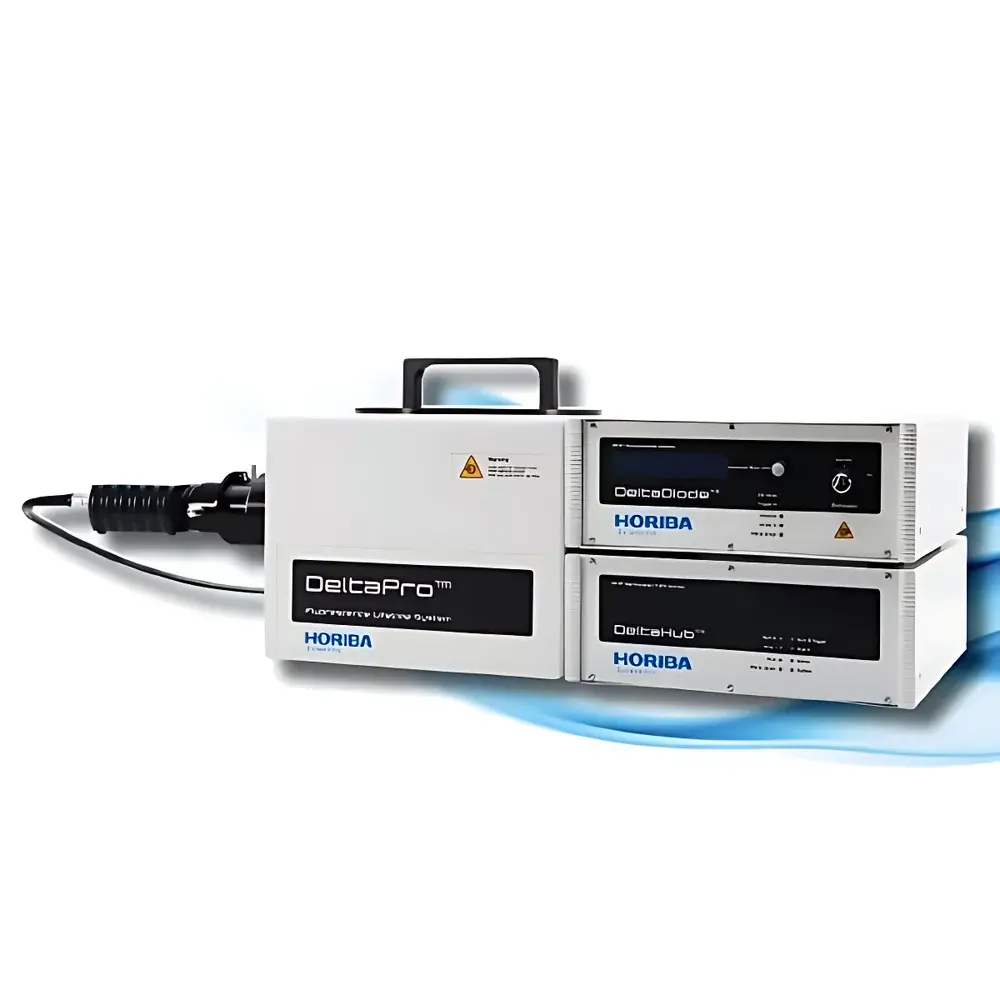
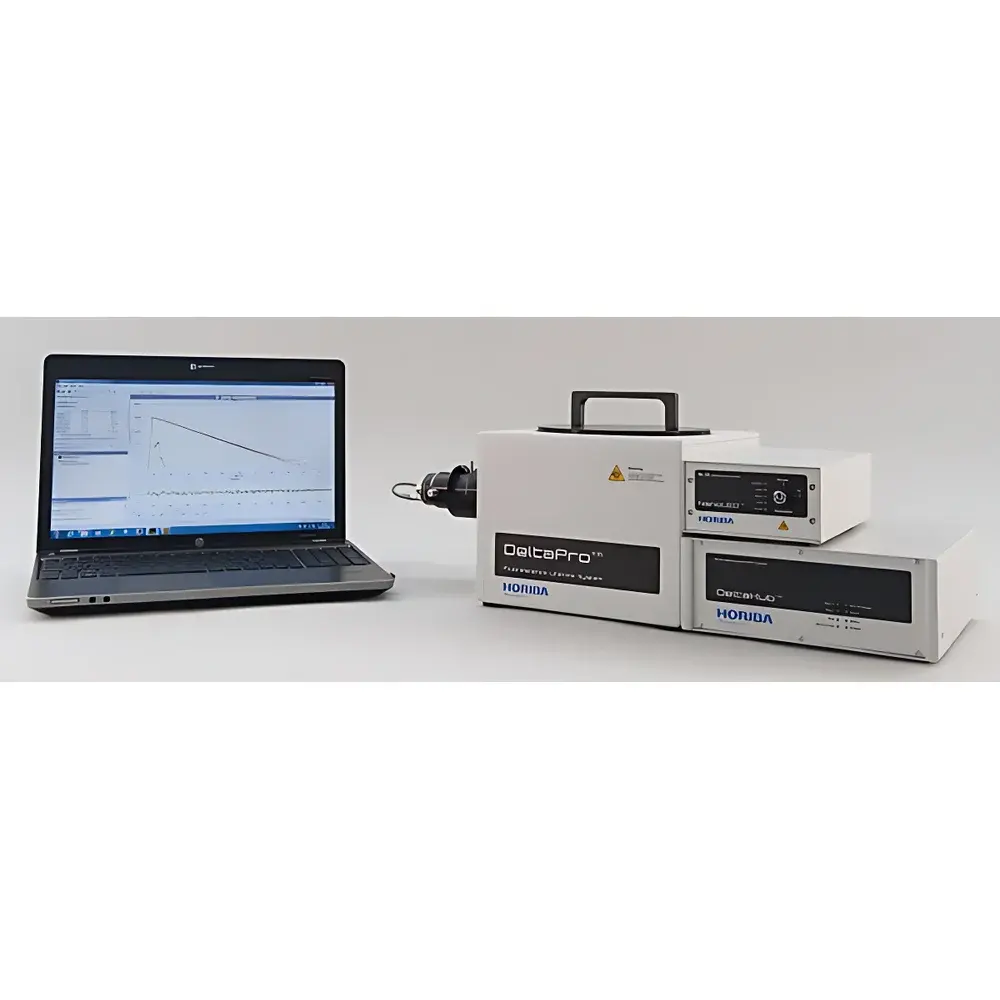
HORIBA Scientific DeltaPro High-Performance Time-Correlated Single Photon Counting (TCSPC) Fluorescence Lifetime Spectrometer
| Brand | HORIBA |
|---|---|
| Origin | United Kingdom |
| Model | DeltaPro |
| Dispersion Element | Grating and Interference Filters |
| Slit Width (Spectral Bandpass) | 1.0 nm to 32 nm |
| Optical Resolution | 1.0 nm |
| Sensitivity | >3000:1 |
| Wavelength Accuracy | ±0.5 nm |
| Detector Range (Standard) | 185–650 nm (upgradable to 850 nm or 900 nm) |
| Minimum Measurable Lifetime | 25 ps (with DeltaDiode/NanoLED) |
| Lifetime Range | 25 ps to 1 s (software-selectable source-dependent) |
| Excitation Sources | DeltaDiode (UV–NIR, 10 kHz–100 MHz rep. rate), NanoLED (UV–VIS, 10 kHz–1 MHz), SpectraLED (VIS–NIR, 0.1 Hz–10 kHz) |
| System Response FWHM | <200 ps (PPD/TBX + laser diode) |
| Dead Time | 10 ns |
| Time Range | 10 ns to 11 s (DeltaPro-DD configuration) |
| Interface | USB 2.0 (no PCI card required) |
| Operating System | Windows XP/7 (32-/64-bit English) |
| Dimensions (L×W×H) | 1875 mm × 1125 mm × 625 mm (excl. PC) |
Overview
The HORIBA Scientific DeltaPro is a modular, high-performance time-correlated single photon counting (TCSPC) fluorescence lifetime spectrometer engineered for precision, flexibility, and long-term reliability in academic, pharmaceutical, and industrial R&D laboratories. Built upon HORIBA’s four-decade heritage in TCSPC system design—originating from the foundational work of Jobin Yvon—the DeltaPro implements a rigorously validated physical measurement principle: excitation of fluorophores via pulsed semiconductor light sources followed by picosecond-resolved detection of emitted photons, with full deconvolution of instrument response function (IRF) to extract intrinsic decay kinetics. Its architecture supports both fluorescence and phosphorescence lifetime analysis across an unprecedented dynamic range—from 25 ps to 1 second—without hardware reconfiguration. This capability arises from intelligent source coupling: DeltaDiode and NanoLED enable ultrafast transient resolution (25 ps–10 µs), while SpectraLED extends coverage into microsecond-to-second regimes for long-lived emitters such as triplet states, lanthanide complexes, and delayed fluorescence systems.
Key Features
- Modular TCSPC platform supporting seamless integration of multiple excitation sources—DeltaDiode (UV–NIR, up to 100 MHz repetition rate), NanoLED (UV–VIS), and SpectraLED (VIS–NIR)—all controlled natively via USB 2.0 interface without legacy PCI dependencies.
- Optimized optical path with interchangeable interference filters (1.0–32 nm bandwidth) and fixed 1.0 nm spectral resolution, ensuring high signal fidelity and minimal stray light in lifetime-deconvoluted spectra.
- High-sensitivity photodetector array covering 185–650 nm standard (upgradable to 850 nm or 900 nm), paired with sub-200 ps FWHM system response (PPD/TBX + laser diode) and 10 ns detector dead time for accurate early-time decay capture.
- Integrated sample handling: standard liquid cuvette holder with optional temperature control (±0.1 °C), magnetic stirring, and motorized polarizers for anisotropy measurements and rotational correlation time extraction.
- F-link plug-and-play interface enables deterministic synchronization between excitation source, detector gating, and data acquisition—critical for reproducible GLP-compliant experiments.
- Three operational modes: (1) Lifetime mode (25 ps–1 s), (2) Kinetic TCSPC mode (1–10,000 sequential decays, acquisition time per decay adjustable from 1 ms to 1 min), and (3) Anisotropy mode with global deconvolution for sub-nanosecond rotational dynamics.
Sample Compatibility & Compliance
The DeltaPro accommodates standard 1-cm quartz cuvettes and supports solid, thin-film, and microvolume samples via optional accessories (e.g., fiber-coupled probes, microscope adapters). All optical components comply with ISO 17025 traceability requirements for wavelength calibration (NIST-traceable standards used during factory verification). The system meets key regulatory expectations for analytical instrumentation in GMP environments: audit trail functionality, electronic signature support, and user-access-level controls are implemented within the bundled FluoroHub software in accordance with FDA 21 CFR Part 11 guidelines. Data files adhere to ASTM E2500-14 metadata conventions, enabling interoperability with LIMS and ELN platforms. CE marking confirms compliance with EU Electromagnetic Compatibility (2014/30/EU) and Low Voltage (2014/35/EU) directives.
Software & Data Management
FluoroHub v4.x—the native acquisition and analysis suite—provides full TCSPC workflow automation: real-time IRF monitoring, iterative reconvolution fitting (Levenberg–Marquardt algorithm), multi-exponential decay modeling (1–4 components), χ² validation, and residual analysis. Export formats include ASCII, HDF5, and vendor-neutral JCAMP-DX for archival and third-party processing (e.g., MATLAB, Origin, Python-based lifetimes analysis libraries). All raw histograms and fitted parameters are stored with embedded metadata (excitation wavelength, slit width, detector HV, temperature, user ID), satisfying GLP documentation requirements. Software updates are delivered via secure HTTPS channel with SHA-256 integrity verification; no cloud dependency or telemetry is enabled by default.
Applications
The DeltaPro serves core applications requiring quantitative, model-independent lifetime determination: protein conformational dynamics (FRET efficiency mapping), membrane fluidity assessment (DPH anisotropy decay), nanomaterial surface state characterization (quantum dot blinking kinetics), pharmaceutical stability profiling (photodegradation pathway identification), and luminescent sensor development (O₂ quenching studies). Its extended lifetime range supports emerging use cases in organic optoelectronics (TADF emitter characterization), metal–organic framework (MOF) host–guest interactions, and time-gated bioimaging probe validation. Academic users routinely deploy it for teaching advanced photophysics concepts—including Förster radius calculation, rotational diffusion coefficients, and excited-state proton transfer kinetics—via built-in tutorial modules and exportable simulation templates.
FAQ
What excitation sources are compatible with the DeltaPro, and how do they affect lifetime range?
DeltaDiode and NanoLED support 25 ps–10 µs measurements; SpectraLED extends the range to 1 µs–>1 s. Source selection is software-configured and requires no hardware swap.
Is the system compliant with FDA 21 CFR Part 11 for regulated environments?
Yes—FluoroHub includes audit trail logging, electronic signatures, role-based access control, and data integrity safeguards aligned with Part 11 Annex 11 expectations.
Can the detector spectral range be upgraded post-purchase?
Yes—standard 185–650 nm detectors can be retrofitted to 250–850 nm or 300–900 nm configurations under service contract.
Does the DeltaPro require external cooling or dedicated power conditioning?
No—integrated thermoelectric cooling maintains detector stability; operation is stable on standard 100–240 VAC, 50/60 Hz laboratory circuits.
How is wavelength accuracy verified and maintained?
Factory calibration uses NIST-traceable Hg/Ar emission lines; users may perform routine verification using supplied spectral calibration standards (certified ±0.1 nm uncertainty).




