
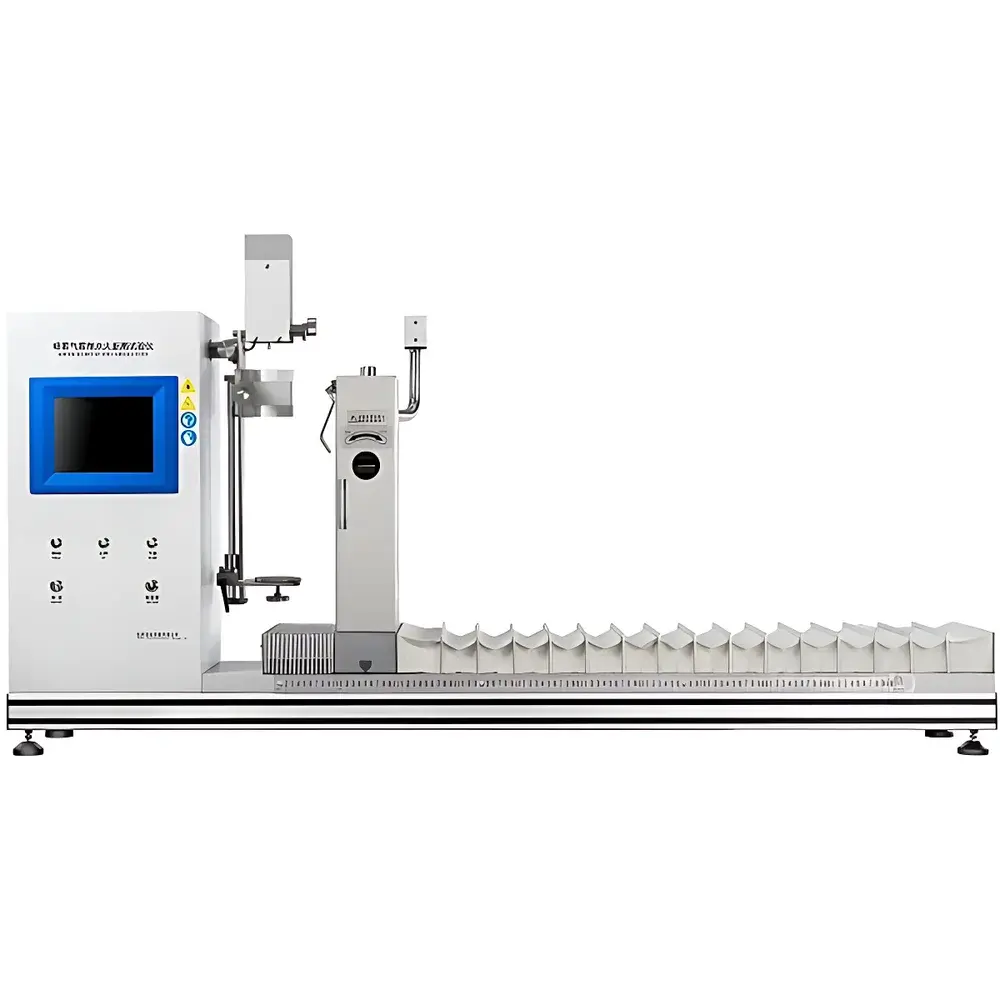
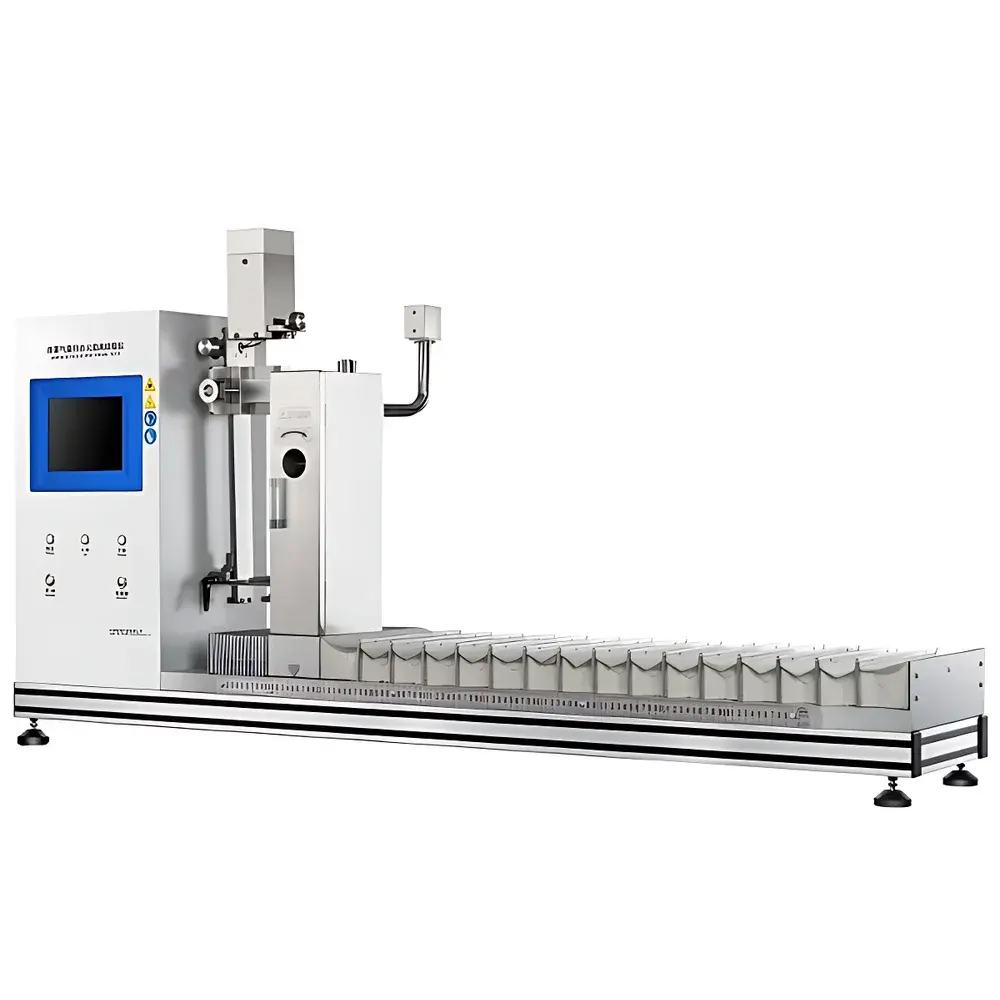
Young Instruments HWP09-10S Ignition Distance Tester for Aerosol Products
| Brand | Young Instruments |
|---|---|
| Origin | Zhejiang, China |
| Manufacturer | Yes |
| Country of Origin | Domestic (China) |
| Model | HWP09-10S |
| Quotation | Upon Request |
| Operating Environment | (-5–45) °C, <95% RH |
| Detection Method | Near-Infrared (NIR) |
| Spectral Response Range | 760–1100 nm |
| Spectral Response Frequency | 5000 Hz |
| Ambient Temperature Range | (-10–+60) °C |
| Ambient Temperature Accuracy | ±0.5 °C |
| Ambient Humidity Range | (5–95)% RH |
| Ambient Humidity Accuracy | ±5.0% RH |
| Combustion Detection Response Time | ≤6 ms |
| Ignition Distance Measurement Range | 15–90 cm |
| Burner Positioning Accuracy | ±1 mm |
| Timing Resolution | ±0.01 s |
| Minimum Actuation Duration | 5 s |
| Ignition Source | Gas-fired igniter |
| Aerosol Can Orientation | Motorized vertical/inverted repositioning |
| Compatible Can Dimensions | Height 120–400 mm, Diameter 30–80 mm |
Overview
The Young Instruments HWP09-10S Ignition Distance Tester is a fully automated, standards-compliant instrument engineered for the precise quantification of ignition distance in pressurized aerosol products—specifically those with spray projection distances ≥15 cm. It operates on the principle of near-infrared optical detection to identify flame initiation events in real time, enabling objective, repeatable assessment of flammability hazard under controlled conditions. Designed for regulatory testing laboratories, chemical safety evaluation centers, and R&D departments in consumer product and agrochemical manufacturing, the system implements a deterministic measurement protocol aligned with internationally recognized transport and classification frameworks.
Key Features
- Fully autonomous test sequence: From can positioning and orientation (vertical or inverted), actuation timing control (minimum 5 s dwell), to NIR-based flame detection and distance recording—no manual intervention required.
- High-speed NIR photodetection module (760–1100 nm spectral band, 5000 Hz sampling rate) with ≤6 ms response latency ensures reliable capture of transient ignition events, even during short-duration sprays.
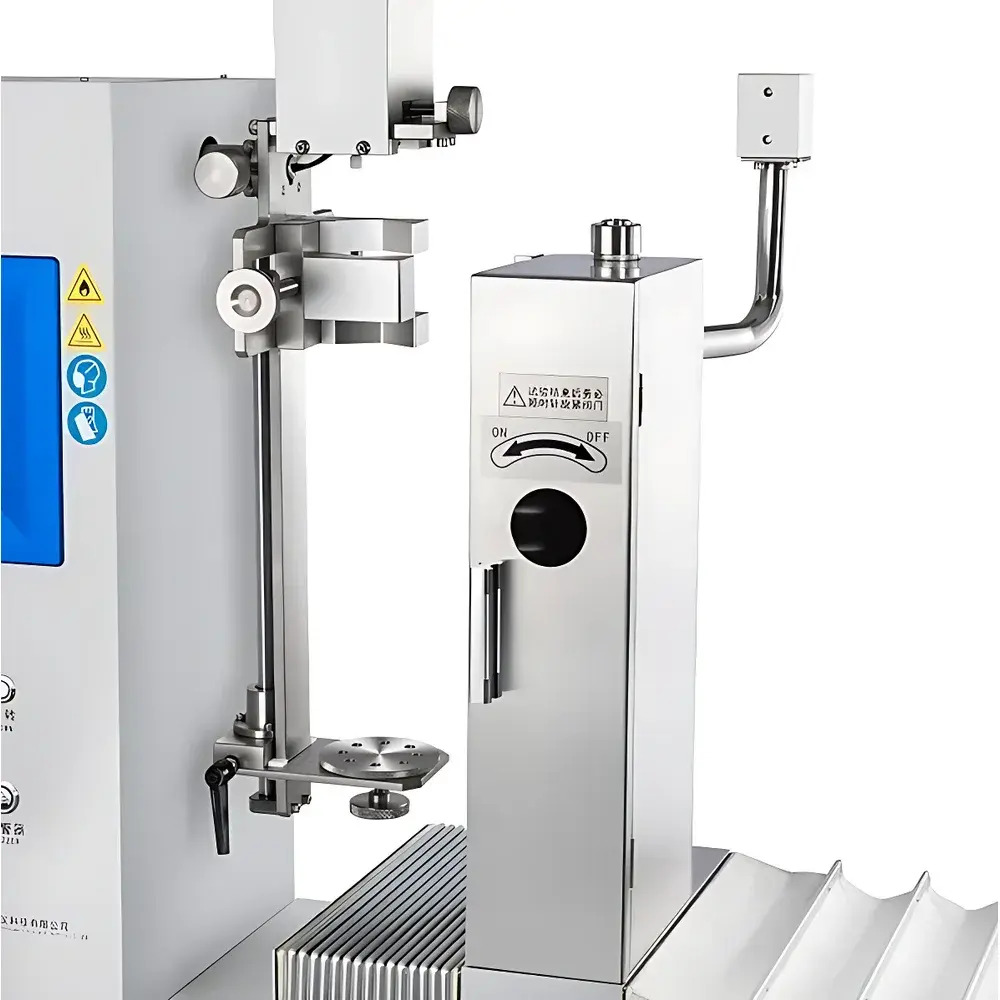
- Precision mechanical positioning system utilizing hybrid stepper motors and optical encoders achieves ±1 mm repeatability in burner-to-nozzle distance adjustment across the full 15–90 cm range.
- Integrated environmental monitoring: Real-time acquisition of ambient temperature (±0.5 °C accuracy, -10–+60 °C range) and relative humidity (±5.0% RH, 5–95% RH range) supports GLP-compliant test documentation and environmental correlation analysis.
- Dual-mode operation: Preconfigured “Standard Mode” executes test sequences per UN Manual of Tests and Criteria 31.4, GB/T 21630-2008, GAT 536, and NY/T 1860 Part 27; “Custom Mode” permits parameter override for method development and comparative studies.
- Gas-fired igniter with adjustable blue non-luminous flame (4–5 cm height) housed within a sealed combustion chamber, minimizing operator exposure and ensuring consistent ignition energy delivery.
- Motorized aerosol can fixture enables automatic 180° inversion—critical for evaluating bottom-discharge formulations—and accommodates cans from 120–400 mm height and 30–80 mm diameter.
- Industrial-grade 8-inch capacitive touchscreen running Windows CE OS provides intuitive workflow navigation, live status visualization, and on-device data review without external PC dependency.
Sample Compatibility & Compliance
The HWP09-10S is validated for use with all pressurized aerosol containers meeting dimensional specifications (height: 120–400 mm; diameter: 30–80 mm), including household cleaners, personal care mists, pesticide formulations, and industrial lubricants. Its operational methodology satisfies the technical requirements of multiple harmonized standards: UN Recommendations on the Transport of Dangerous Goods, Manual of Tests and Criteria, Section 31.4 (Ignition Distance Test); GB/T 21630-2008 (Dangerous Goods – Test Method for Ignition Distance of Aerosols); GAT 536 (Fire Hazard Classification and Test Methods for Flammable and Explosive Materials); and NY/T 1860.27 (Guidelines for Physicochemical Property Determination of Pesticides – Part 27: Flammability of Aerosol Formulations). The system’s architecture supports audit-ready traceability, with timestamped environmental logs, actuation metadata, and flame-detection event records stored in non-volatile memory.
Software & Data Management
Embedded firmware enforces strict data integrity protocols: All test parameters—including distance setting, actuation duration, ambient conditions, and detection timestamps—are logged automatically upon test initiation. Reports conform to ISO/IEC 17025 documentation requirements and may be exported via USB to CSV or PDF format. Audit trails include user login ID, session start/end times, and modification history for critical parameters—supporting compliance with FDA 21 CFR Part 11 where electronic records are subject to regulatory review. No cloud connectivity or remote access functionality is implemented, preserving data sovereignty and network security in regulated environments.
Applications
- Classification of aerosol products under UN GHS and CLP hazard communication systems.
- Pre-market safety assessment for consumer product registration (e.g., EPA, ECHA, NMPA submissions).
- Quality control screening of propellant-to-formulation ratios affecting flammability profiles.
- Comparative flammability studies during reformulation or alternative propellant evaluation.
- Validation of fire suppression efficacy in enclosed-space aerosol applications.
- Supporting fire risk modeling by generating empirical ignition probability vs. distance curves.
FAQ
What standards does the HWP09-10S directly support?
It is configured to execute test procedures defined in UN Manual of Tests and Criteria 31.4, GB/T 21630-2008, GAT 536, and NY/T 1860.27—with hardware and software logic aligned to each standard’s procedural constraints.
Is operator training required to operate the system?
Basic operation requires minimal training due to guided touchscreen workflows; however, personnel responsible for method validation or report sign-off should complete documented competency assessment per ISO/IEC 17025 clause 6.2.
Can test data be integrated into a LIMS environment?
Yes—CSV exports are structured for direct ingestion into common LIMS platforms; custom API integration is not supported, but batch file transfer via USB remains the validated interface.
How is ignition source consistency maintained over time?
The gas igniter uses a fixed-orifice nozzle and regulated fuel supply; flame height calibration is verified quarterly using a calibrated digital caliper and documented in the maintenance log.
Does the system require external ventilation or fume extraction?
While the integrated accordion-style fire-resistant enclosure contains incidental flash emissions, installation must comply with local laboratory exhaust requirements—especially when testing high-VOC or halogenated formulations.





