
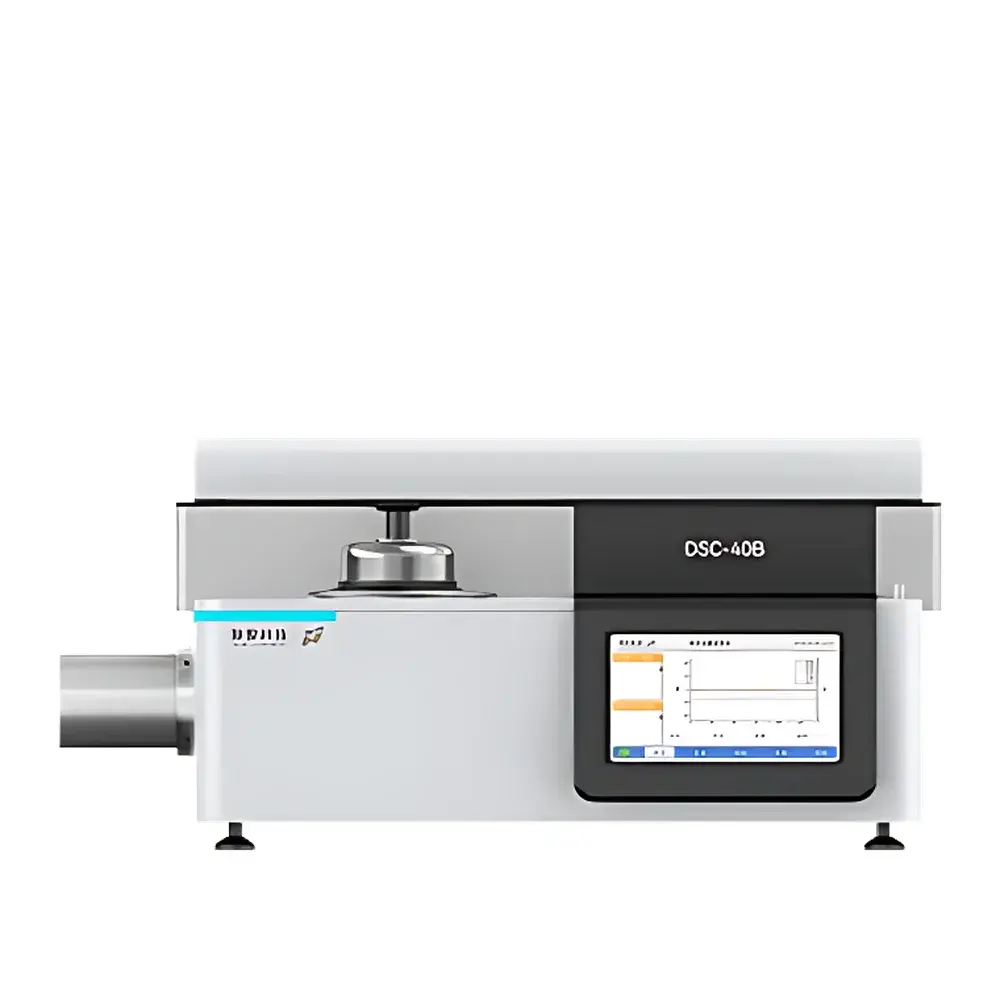
Young Instruments DSC-40B Thermal Flow-Type Differential Scanning Calorimeter
| Brand | Young Instruments |
|---|---|
| Origin | Zhejiang, China |
| Manufacturer Type | Direct Manufacturer |
| Instrument Type | Thermal Flow DSC |
| Sample Capacity | Single-sample |
| Temperature Range | –90 °C to 550 °C (with optional imported high-performance mechanical cryocooler) |
| Cooling Method | Mechanical refrigeration + air cooling |
| Heating/Cooling Rate | 0.05–200 °C/min (heating), 0.1–100 °C/min (cooling) |
| Temperature Accuracy | ±0.1 °C (In), Precision: ±0.02 °C (In) |
| Baseline Drift | ≤100 µW (–50–300 °C, no baseline correction) |
| Baseline Repeatability | ≤40 µW |
| Peak Noise (Heat Flow) | <8 µW |
| Enthalpy Accuracy | ±0.8% (In), Precision: ±0.08% (In) |
| Indium Peak Height/FWHM | ≥20.0 mW/K |
| Data Acquisition Rate | 50 Hz |
| Heat Flow Range | ±750 mW |
| Gas Control | 3-channel mass-flow-controlled atmosphere (inert/oxidizing, static/dynamic, 0–300 mL/min) |
Overview
The Young Instruments DSC-40B is a precision thermal flow-type differential scanning calorimeter engineered for high-fidelity measurement of heat flow differentials between a sample and inert reference under controlled temperature programs. Operating on the principle of heat flux detection via a high-stability thermopile sensor mounted on an integrated silver furnace block, the DSC-40B delivers quantitative thermal response data—including enthalpy changes, phase transition temperatures (melting, crystallization, glass transition), specific heat capacity (Cp), oxidative induction time (OIT), thermal stability profiles, and Arrhenius kinetic parameters—across a broad operational range from –90 °C to 550 °C. Its design adheres to fundamental thermodynamic constraints of calorimetric measurement, ensuring compliance with first-principle energy balance requirements in dynamic thermal analysis. The instrument is optimized for milligram-scale samples (typically 1–10 mg), minimizing material consumption while maintaining analytical robustness across polymer science, pharmaceutical solid-state characterization, food matrix analysis, and inorganic/organic chemical development.
Key Features
- Thermal flow architecture based on a tower-style, oxidation-resistant thermopile sensor—enabling superior sensitivity (heat flow detection limit <8 µW peak-to-peak noise) and long-term baseline stability (drift ≤100 µW over –50–300 °C without digital baseline subtraction)
- Monolithic silver furnace assembly with uniform thermal mass distribution—reducing inter-sample thermal crosstalk, improving heat transfer linearity, and enhancing temperature control accuracy (±0.1 °C at In melting point, ±0.02 °C repeatability)
- Triple-mode temperature programming: linear heating, controlled cooling, and isothermal hold—supporting complex thermal protocols such as step-scan, modulated DSC (MDSC)-compatible ramps, and multi-cycle aging studies
- High-resolution thermal data acquisition at 50 Hz with real-time signal conditioning—ensuring high signal-to-noise ratio and reproducible peak integration (baseline repeatability ≤40 µW across repeated In calibrations)
- Three independent, mass-flow-controlled gas channels (0–300 mL/min)—enabling precise atmosphere management for inert (N2, Ar), oxidative (air, O2), or dynamic/static conditions per ASTM E1269 and ISO 11357-2
- Integrated 7-inch HD capacitive touchscreen interface with embedded firmware—supporting standalone operation, method storage, real-time curve visualization, and parameter logging without external PC dependency
Sample Compatibility & Compliance
The DSC-40B accommodates standard hermetic and vented aluminum crucibles (e.g., 40 µL, 100 µL), platinum pans for high-temperature or corrosive applications, and custom geometries compatible with ISO 11357-1 mechanical interfaces. It supports routine analysis of thermoplastics (e.g., PE, PP, PET), amorphous and semi-crystalline pharmaceuticals (APIs, excipients), lipid-based food matrices, metal alloys, and energetic materials. Regulatory alignment includes full traceability to national and international standards: GB/T 19466 series (Chinese DSC standard), ASTM E794 (melting point), ASTM E1269 (heat capacity), ASTM E928 (baseline calibration), ASTM D3895 (oxidative induction), ISO 11357-1 through -7 (general DSC practice), and JJG 936 (national metrological verification). Data integrity conforms to GLP-compliant audit trail requirements when paired with optional PC-based software featuring 21 CFR Part 11–ready electronic signatures and user-access controls.
Software & Data Management
While the DSC-40B operates autonomously via its onboard touchscreen, optional Windows-based analysis software provides advanced post-processing capabilities: automatic onset/start/end point detection per ASTM E793, Cp calculation using sapphire calibration, multi-step kinetic modeling (e.g., Ozawa-Flynn-Wall, Kissinger), OIT quantification per ASTM D3895, and comparative overlay of up to 16 thermograms. Raw data export is supported in ASCII (.txt), CSV, and universal .Q2 format for third-party thermal analysis platforms. All software modules implement timestamped method logs, operator ID tagging, and version-controlled calibration records—facilitating internal QA/QC workflows and external regulatory submissions.
Applications
- Polymer characterization: Crystallinity assessment, Tg determination in amorphous domains, cold crystallization kinetics, degradation onset temperature (Td), and filler-matrix interaction analysis
- Pharmaceutical development: Polymorph screening, hydrate/anhydrate transition mapping, excipient compatibility studies, and stability-indicating assay validation
- Food science: Fat crystallization profiling, starch gelatinization enthalpy, protein denaturation thermodynamics, and shelf-life prediction via accelerated oxidation testing
- Materials R&D: Alloy solidus/liquidus determination, reaction enthalpy of curing systems (epoxies, silicones), and thermal aging behavior of composites under inert or oxidative atmospheres
- Quality control: Batch-to-batch consistency verification of thermal fingerprints, raw material identity testing, and release specification compliance per USP <1151> or Ph. Eur. 2.2.41
FAQ
What is the lowest achievable temperature with the standard configuration?
The base system achieves –40 °C using forced-air cooling; –90 °C requires the optional imported mechanical cryocooler module.
Is the DSC-40B compliant with FDA 21 CFR Part 11 for regulated environments?
Yes—when operated with the validated PC software package, it supports electronic signatures, audit trails, role-based access, and data immutability features required for GxP workflows.
Can the instrument perform heat capacity (Cp) measurements?
Yes—using sapphire reference calibration per ASTM E1269 and ISO 11357-4, with accuracy better than ±1.5% across the –40–300 °C range.
What crucible types are supported for high-temperature analysis above 400 °C?
Platinum crucibles (Pt-10%Rh) are recommended for extended use up to 550 °C; aluminum pans are limited to ≤600 °C only under short-duration, non-oxidizing conditions.
How is baseline stability maintained during rapid cooling cycles?
The monolithic silver furnace’s high thermal conductivity and low thermal inertia minimize thermal lag, while the oxidation-resistant thermopile ensures consistent Seebeck coefficient stability across thermal cycling—validated by ≤40 µW baseline repeatability after 10 consecutive In melt-cool-reheat cycles.



