
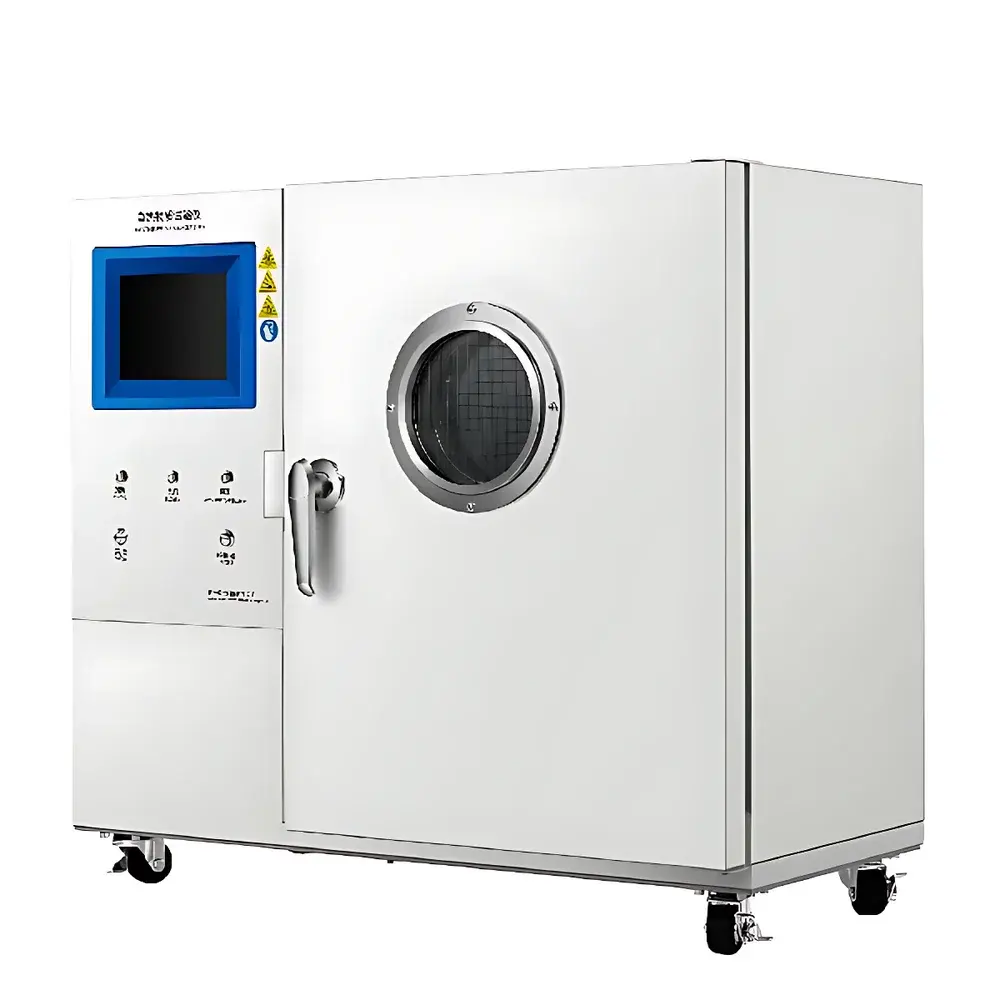
Young Instruments HWP01-10S Self-Heating Substance Tester
| Brand | Young Instruments |
|---|---|
| Origin | Zhejiang, China |
| Manufacturer Type | Manufacturer |
| Origin Category | Domestic |
| Model | HWP01-10S |
| Price | Upon Request |
| Operating Environment | 5–30 °C, <85% RH |
| Temperature Control Range | Ambient to 200 °C |
| Temperature Control Accuracy | ±1 °C |
| Uniformity in Test Zone | ±1.5 °C (≤140 °C), ±2 °C (140–180 °C), ±2.5 °C (180–200 °C) |
| Temperature Measurement Range | 0–500 °C |
| Temperature Resolution | 0.1 °C |
| Temperature Accuracy | ±2.5 °C (<300 °C), ±0.75% of reading (≥300 °C) |
| Standard Timer Range | 0–24 h |
| Custom Timer Range | 0–48 h |
| Timer Resolution | 1 s |
| Wire Mesh Containers | Small cube: 25 mm side, 0.05 mm aperture |
| Small cover | 30 × 30 × 30 mm |
| Large cube | 100 mm side, 0.05 mm aperture |
| Large cover | 105 × 105 × 105 mm |
| Cage dimensions | 150 × 150 × 250 mm |
| Chamber Interior Dimensions | 350 × 350 × 400 mm |
Overview
The Young Instruments HWP01-10S Self-Heating Substance Tester is an engineered thermal stability assessment system designed for the standardized determination of self-heating potential in solid substances under controlled oxidative conditions. It operates on the principle of accelerated thermal exposure—placing test samples in standardized wire mesh containers within a precisely regulated, forced-air convection chamber and monitoring temperature evolution over time. This method replicates the exothermic oxidation behavior that may occur during storage or transport when materials are exposed to ambient air at elevated temperatures. The instrument implements the fundamental thermokinetic protocol defined in UN Manual of Tests and Criteria, Part III, subsection 33.3.1.6 (Test N.4) and its national adoption in GB/T 21612—“Hazardous Substances – Test Method for Spontaneous Combustibility of Flammable Solids.” Its architecture integrates thermal uniformity validation, real-time thermal profiling, and fail-safe mechanical design to support regulatory compliance testing in chemical safety evaluation, hazardous goods classification, and transport hazard assessment laboratories.
Key Features
- Embedded Windows CE operating system with 8-inch capacitive touch interface for intuitive parameter configuration and live status monitoring
- Forced-air convection heating system with optimized airflow distribution to ensure spatial temperature uniformity across the 350 × 350 × 400 mm internal chamber
- Digital PID temperature control algorithm delivering ±1 °C setpoint accuracy and validated uniformity performance per ISO/IEC 17025-relevant chamber mapping protocols
- Real-time data acquisition and visualization: simultaneous display of elapsed time, chamber setpoint, and measured sample surface or ambient temperature; automatic generation of time–temperature curves
- Integrated safety architecture including dual-layer protection: tempered observation window with impact resistance rating and rear-mounted pressure-relief door actuated at ≥2.5 kgf internal overpressure
- Automated fault detection with audible/visual alerts for sensor failure, thermal runaway deviation, or timer interruption
- Configurable test sequencing—users define exposure temperature (e.g., 100 °C, 120 °C, or 140 °C), duration (0–48 h), and container type (25 mm or 100 mm mesh cube) without firmware modification
- Exportable test reports compliant with GLP documentation requirements—including timestamped raw data, operator ID, environmental conditions, and pass/fail determination against UN N.4 acceptance criteria
Sample Compatibility & Compliance
The HWP01-10S accommodates solid particulates, powders, granules, and compressed tablets intended for transport classification under the UN Recommendations on the Transport of Dangerous Goods. Standardized stainless-steel wire mesh containers (25 mm and 100 mm cubes, 0.05 mm aperture) conform to dimensional and permeability specifications outlined in Test N.4. Optional custom cage configurations (e.g., extended height or alternative aperture sizes) are available upon request for research-grade thermal screening. The system meets metrological traceability requirements for temperature measurement per ISO/IEC 17025 when used with calibrated reference thermocouples. It supports audit-ready operation under GHS, CLP, and ADR/RID regulatory frameworks and aligns with quality assurance expectations for laboratories accredited to ISO/IEC 17025:2017.
Software & Data Management
Data logging occurs at user-selectable intervals (default: 10 s) and is stored internally with timestamp, temperature, and timer status. All datasets are exportable via USB interface in CSV format for post-processing in Excel or statistical analysis platforms. The embedded software enforces data integrity through write-once storage logic and maintains immutable audit trails for all parameter changes, start/stop events, and alarm triggers—supporting alignment with FDA 21 CFR Part 11 principles where electronic records are subject to regulatory review. Report templates include UN hazard class assignment logic based on observed onset temperature and time-to-ignition thresholds per Section 33.3.1.6 criteria.
Applications
- Hazard classification of industrial chemicals, metal powders, activated carbon, and organic peroxides prior to UN transport certification
- Development and validation of thermal stabilization strategies for battery cathode materials and pyrophoric catalysts
- Supporting SDS authoring under REACH Annex II and OSHA HazCom standards
- Quality control screening of recycled polymer flakes or biomass-derived feedstocks for spontaneous combustion risk
- Research into oxidation kinetics of lignocellulosic materials in silo storage safety studies
FAQ
What standards does the HWP01-10S directly support?
It is fully aligned with UN Manual of Tests and Criteria, Test N.4 (Section 33.3.1.6) and GB/T 21612–2008.
Can the instrument perform tests beyond the standard 24-hour duration?
Yes—custom timer range extends to 48 hours to accommodate slow-developing exotherms in low-reactivity materials.
Is calibration traceable to national standards?
Temperature sensors are factory-calibrated against NIST-traceable references; users may perform in-house verification using certified RTDs or thermocouple calibrators.
Does the system meet explosion-proof requirements?
While not rated as Class I Division 1, its pressure-relief mechanism, sealed chamber design, and non-sparking internal components satisfy functional safety requirements for self-heating testing in non-hazardous area labs per IEC 60079-0.
How is data integrity ensured during long-duration tests?
Internal flash memory employs wear-leveling and power-fail protection; all logged entries include CRC checksums and sequential event tagging to prevent corruption or gaps.



