
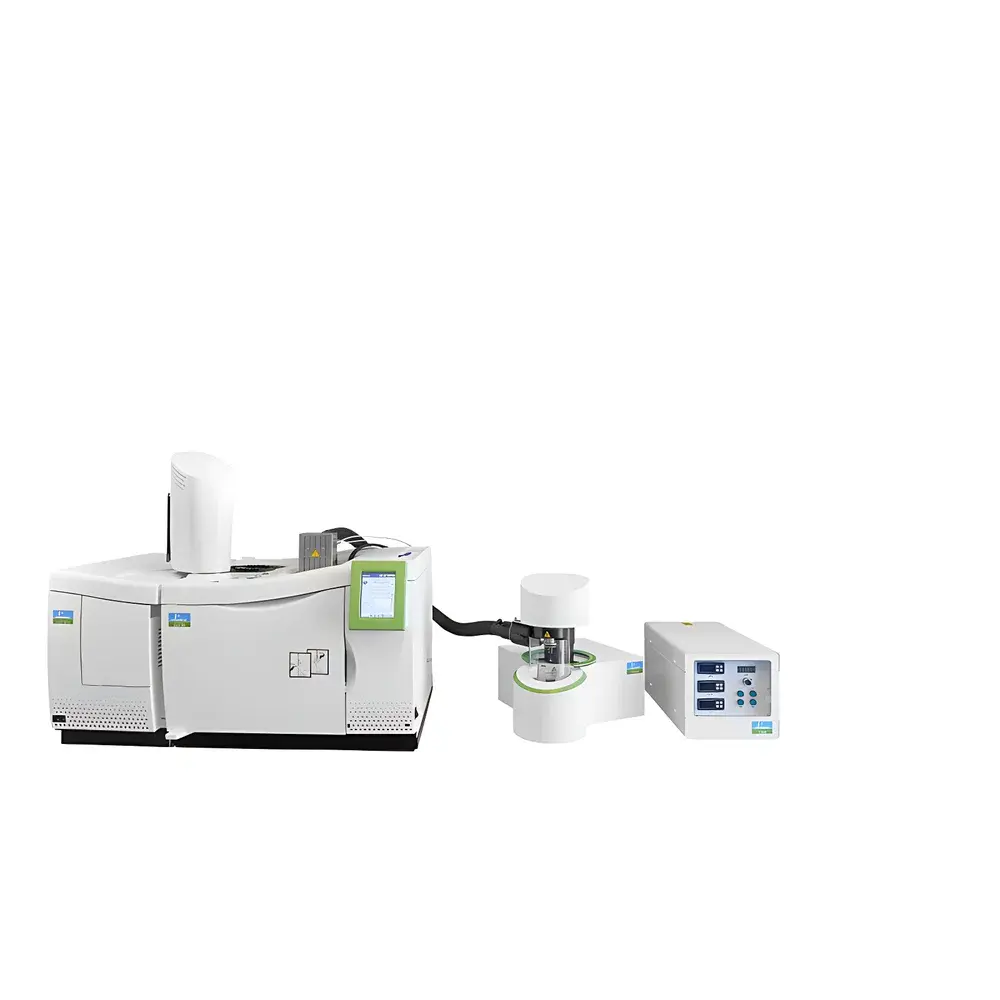
PerkinElmer TG-GC/MS Thermal Gravimetric Analysis–Gas Chromatography/Mass Spectrometry Coupled System
| Brand | PerkinElmer |
|---|---|
| Origin | USA |
| Manufacturer Type | Original Equipment Manufacturer (OEM) |
| Origin Category | Imported |
| Model | TG-GC/MS |
| Pricing | Available Upon Request |
Overview
The PerkinElmer TG-GC/MS is a fully integrated thermal analysis–hyphenated system that couples thermogravimetric analysis (TGA), gas chromatography (GC), and mass spectrometry (MS) in a single, synchronized platform. Unlike conventional TGA-MS configurations—where evolved gases are introduced directly into the mass spectrometer—this system incorporates an intermediate GC separation step. This architecture fundamentally enhances analytical specificity by resolving co-eluting or overlapping volatile species generated during thermal decomposition, oxidation, or desorption events. The system operates on the principle that thermal degradation products evolve sequentially as temperature increases; these gaseous effluents are transferred via a heated transfer line to a cryo-focused GC inlet, where compounds are trapped, thermally desorbed, separated by retention time, and finally ionized and detected by a quadrupole mass spectrometer. This staged detection workflow enables unambiguous identification of trace-level volatiles—even at sub-ppm concentrations—while preserving temporal correlation between mass loss events and compound evolution profiles.
Key Features
- Pyris™ 1 TGA platform with high-resolution microbalance (±0.1 µg sensitivity) and precise temperature control (±0.1 °C accuracy over 25–1000 °C range)
- TL2000 heated transfer line operating up to 210 °C, equipped with interchangeable fused-silica capillary tubes (ID: 0.1–0.5 mm) to optimize gas transmission efficiency and minimize condensation
- Clarus® 600 GC/MS system featuring split/splitless injection, programmable temperature vaporizing (PTV) inlet, and electron ionization (EI) source with unit-mass resolution (m/Δm ≥ 1000)
- Real-time synchronization of TGA weight-loss data, GC oven temperature ramping, and MS acquisition triggers via PerkinElmer’s TurboMass™ software suite
- Integrated hardware interlock logic ensuring GC carrier gas flow stability prior to TGA heating initiation and automatic MS tuning prior to each run
- OEM-engineered mechanical and thermal interfaces eliminating third-party coupling adapters, thereby minimizing dead volume and thermal lag
Sample Compatibility & Compliance
The TG-GC/MS accommodates solid, semi-solid, and polymer-based samples (typically 0.5–20 mg), including pharmaceutical excipients, battery cathode materials, polymer composites, food packaging films, and environmental filter extracts. Sample containment utilizes standard alumina or platinum crucibles compatible with inert (N₂, He) or reactive (air, O₂) atmospheres. Data acquisition and reporting support compliance with ISO 11358 (polymer thermal degradation), ASTM E2550 (thermal stability by TGA), and USP (residual solvents). Audit trail functionality, electronic signatures, and raw data integrity align with FDA 21 CFR Part 11 requirements for regulated laboratories engaged in GLP or GMP workflows.
Software & Data Management
TurboMass™ Connect software provides unified instrument control, method development, and post-run deconvolution. It supports spectral library searching (NIST, Wiley), retention index matching, and TGA-GC-MS overlay visualization—enabling direct correlation of derivative thermogravimetric (DTG) peaks with corresponding GC-MS chromatographic peaks. All raw data (TGA weight curves, GC total ion chromatograms, MS spectra) are stored in vendor-neutral .CDF format. Data archiving, version control, and secure user access levels (administrator, analyst, reviewer) are configurable per laboratory SOPs. Optional integration with LIMS platforms via ASTM E1578-compliant APIs facilitates automated result export and QA/QC workflow handoff.
Applications
- Identification of low-level residual solvents and catalyst residues in active pharmaceutical ingredients (APIs)
- Characterization of thermal decomposition pathways in flame-retardant polymers and carbon-fiber composites
- Detection of off-gassing species from lithium-ion battery electrode materials under thermal abuse conditions
- Forensic analysis of counterfeit electronics encapsulants through volatile fingerprint profiling
- Stability assessment of food-contact packaging under accelerated aging protocols (e.g., ISO 10993-12)
- Quantitative monitoring of moisture, plasticizers, and additives in medical device polymers per ISO 10993-18
FAQ
How does TG-GC/MS improve selectivity over conventional TGA-MS?
By inserting GC separation prior to MS detection, TG-GC/MS resolves isobaric interferences and co-evolving species that would otherwise produce ambiguous mass spectra in direct TGA-MS coupling.
Can the system perform quantitative analysis of evolved gases?
Yes—when calibrated with certified gas standards and using internal standardization (e.g., deuterated analogs), semi-quantitative to quantitative results (RSD <8% at 10 ppm level) are achievable for target volatiles.
Is method transfer possible between different PerkinElmer TG-GC/MS systems?
Fully supported via TurboMass™ method templates, instrument configuration files, and standardized GC column databases—ensuring reproducibility across sites and instruments.
What maintenance routines are recommended for long-term system stability?
Daily GC inlet liner replacement, weekly MS source cleaning, quarterly transfer line bake-out (250 °C for 2 h), and biannual TGA furnace calibration using certified reference materials (e.g., Ni, Cu, Al₂O₃).



