
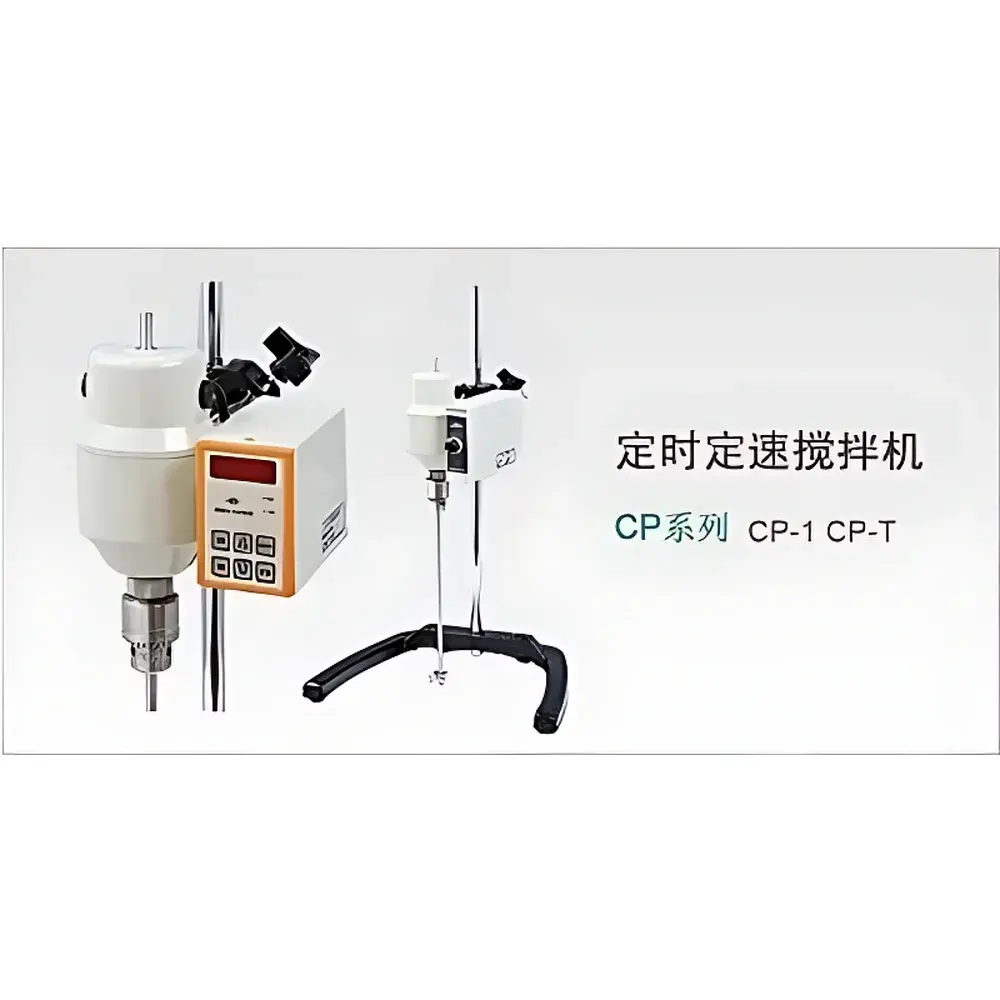
Daimai CP-Series Programmable Timer & Count-Controlled Magnetic Stirrer
| Origin | Taiwan |
|---|---|
| Manufacturer Type | Authorized Distributor |
| Domestic Product Category | Yes |
| Model | CP-1, CP-T |
| Pricing | Available Upon Request |
| Motor | DC 60 W |
| Max Speed | 3,000 rpm |
| Torque | 1.5 kg·cm |
| Viscosity Range | Up to 5,000 cP (at 1 L) |
| Timer Range | 0–99 h 59 min (digital keypad input) |
| Dimensions (W×D×H) | 155 × 120 × 215 mm |
| Net Weight | 4 kg |
| Power Supply | AC 110/220 V, 50/60 Hz |
| Construction | Full stainless-steel chuck and shaft |
| Shaft Design | Hollow-core for telescopic adjustment of stirring rod |
| Safety Features | Microprocessor-based stall detection, overload protection, auto-shutdown on error |
| Optional Accessories | Digital tachometer & torque meter (CP-T variant) |
Overview
The Daimai CP-Series Programmable Timer & Count-Controlled Magnetic Stirrer is engineered for precision mixing, dispersion, and homogenization in analytical, quality control, and R&D laboratories. Unlike conventional analog stirrers, this series integrates microprocessor-based speed regulation and programmable time/count logic—enabling reproducible batch processing under defined mechanical conditions. Its core operation relies on a high-torque, brushless DC motor coupled with a digitally stabilized feedback loop, ensuring consistent rotational output across variable load conditions—including viscous solutions up to 5,000 cP at 1 L volume. The hollow-core stainless-steel shaft allows vertical extension of the stirring rod without mechanical slippage, supporting flexible vessel height adaptation while maintaining coaxial alignment. Designed for long-duration unattended operation, the unit complies with IEC 61010-1 safety standards for laboratory electrical equipment and meets electromagnetic compatibility (EMC) Class B requirements for low-noise operation in shared lab environments.
Key Features
- High-efficiency 60 W DC motor delivering stable 1.5 kg·cm torque at full speed (3,000 rpm), optimized for both low-viscosity solvents and moderately viscous suspensions
- Digital keypad interface with LED display for precise setting of speed (0–3,000 rpm, stepless) and timer (0–99 h 59 min); no calibration required due to closed-loop encoder feedback
- Integrated energy compensation circuit maintains constant RPM despite voltage fluctuations or increasing fluid resistance during prolonged operation
- Hollow stainless-steel shaft (AISI 316) enables 50–120 mm telescopic adjustment of standard PTFE-coated stirring bars—ideal for varying vessel geometries (e.g., beakers, flasks, jacketed reactors)
- Real-time stall detection and thermal cut-off prevent motor damage; system displays error code and halts operation automatically upon abnormal load or overheating
- CP-T variant includes dual digital readouts for instantaneous rotational speed (±1 rpm resolution) and dynamic torque (0.1 kg·cm resolution), traceable via RS-232 interface
Sample Compatibility & Compliance
The CP-Series accommodates standard laboratory glassware (50 mL–2 L capacity) and supports common stirring configurations including cross-shaped, paddle, and propeller-type agitators. It is validated for use with aqueous, organic, and mildly corrosive media (pH 2–12), provided compatible stirring elements are selected. All electrical components conform to UL/CSA 61010-1 and CE marking requirements. The device supports GLP-compliant workflows through audit-trail-capable timer logging (when connected to optional PC software), and its mechanical design aligns with ISO 8573-1 for cleanroom-compatible operation when used with sterile covers. No hazardous substances are employed per RoHS Directive 2011/65/EU.
Software & Data Management
While standalone operation requires no software, the CP-T model features an RS-232 port enabling integration with LabView™, MATLAB®, or custom Python-based data acquisition systems. Optional Daimai StirControl Suite (v3.2+) provides timestamped export of speed/torque/time logs in CSV format, supports user-defined protocol templates, and generates PDF reports compliant with FDA 21 CFR Part 11 requirements (electronic signatures, audit trail, data integrity controls). Firmware updates are delivered via secure HTTPS portal with SHA-256 verification.
Applications
This stirrer is routinely deployed in pharmaceutical dissolution testing (USP Apparatus II), polymer solution preparation for rheological characterization, catalyst suspension in fine chemical synthesis, buffer equilibration for chromatography mobile phases, and cell culture media mixing under aseptic hood conditions. Its programmable timer function ensures repeatability in multi-step protocols such as sequential reagent addition or timed extraction cycles. Academic labs utilize it for undergraduate kinetics experiments requiring fixed agitation duration and speed—particularly in physical chemistry and materials science curricula.
FAQ
What is the maximum viscosity this stirrer can handle reliably?
It maintains rated torque up to 5,000 cP at 1 L volume using a standard 40 mm cross-blade stir bar; higher viscosities require reduced speed or larger-diameter impellers.
Is the timer function repeatable across power cycles?
Yes—the internal non-volatile memory retains the last programmed time and speed settings even after AC power interruption.
Can the CP-Series be integrated into automated lab platforms?
The CP-T model supports TTL-level trigger inputs and RS-232 command sets for synchronization with robotic liquid handlers or PLC-controlled reactor systems.
Does the unit include validation documentation for regulated environments?
Factory calibration certificates (traceable to NIST standards) and IQ/OQ templates are available upon request for GMP-compliant installations.
What maintenance is required for long-term stability?
No scheduled lubrication is needed; periodic inspection of chuck clamping force and shaft concentricity is recommended every 6 months under continuous use.



