
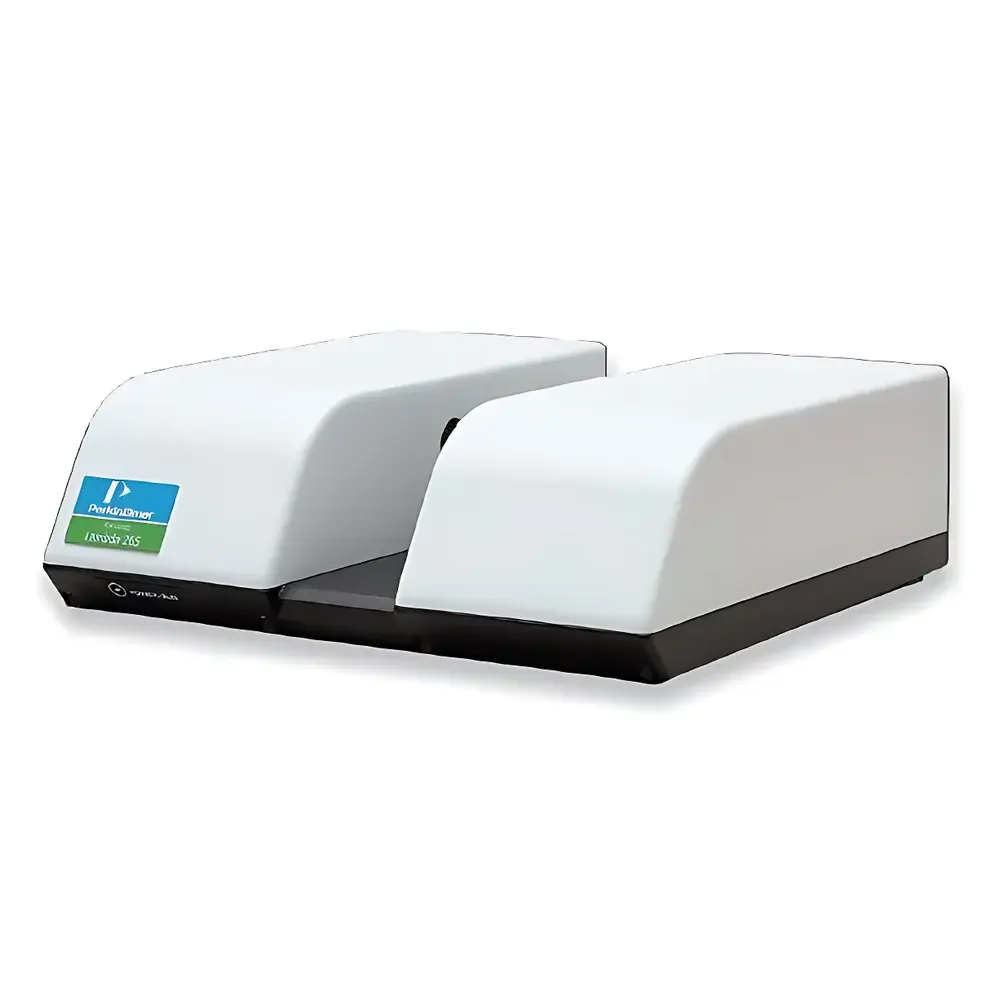
PerkinElmer Lambda 265 UV-Vis Spectrophotometer
| Brand | PerkinElmer |
|---|---|
| Origin | USA |
| Manufacturer Type | Original Equipment Manufacturer (OEM) |
| Import Status | Imported |
| Model | LAMBDA 265 |
| Instrument Architecture | Single-Beam |
| Detector Type | Photodiode Array (PDA) |
| Wavelength Range | 190–1100 nm |
| Automation Level | Automatic Wavelength Scanning |
| Spectral Bandwidth | 2 nm |
| Wavelength Accuracy | ±1 nm |
| Stray Light | <0.03% T at 340 nm |
Overview
The PerkinElmer Lambda 265 UV-Vis Spectrophotometer is a high-performance, single-beam spectrophotometric system engineered for precision absorbance, transmittance, and reflectance measurements across the ultraviolet, visible, and near-infrared spectral regions (190–1100 nm). Utilizing a pulsed xenon lamp and a fixed photodiode array (PDA) detector, the instrument acquires full-spectrum data simultaneously—eliminating mechanical wavelength scanning and enabling rapid, reproducible acquisitions in under two seconds per scan. Its solid-state optical architecture contains no moving parts in the detection path, ensuring long-term stability, minimal drift, and reduced maintenance requirements. Designed for laboratories where throughput, reliability, and space efficiency are critical—such as pharmaceutical quality control, materials science R&D, environmental testing, and academic research—the Lambda 265 delivers traceable, regulatory-compliant performance without compromising on robustness or ease of use.
Key Features
- Simultaneous full-spectrum acquisition (190–1100 nm) via high-density photodiode array detector
- Pulsed xenon light source activated only during measurement—providing >10⁹ flash cycles, low heat load, and zero filament degradation
- Fixed-optics design with no scanning gratings or moving mirrors—enhancing mechanical reliability and signal reproducibility
- Automatic wavelength calibration and real-time performance verification using internal reference standards
- Intelligent accessory recognition: compatible cuvette holders, integrating spheres, fiber-optic probes, and solid-sample reflectance stages auto-configure software parameters upon connection
- Compact footprint (W × D × H: 32 × 42 × 22 cm) optimized for benchtop deployment in regulated or space-constrained environments
- Compliance-ready architecture supporting audit trails, electronic signatures, and user-access controls aligned with FDA 21 CFR Part 11 and GLP/GMP workflows
Sample Compatibility & Compliance
The Lambda 265 supports liquid, solid, and thin-film samples through interchangeable accessories—including 1–100 mm pathlength cuvettes, 6-position autosamplers, 150 mm integrating spheres (for diffuse reflectance/transmission), and variable-angle specular reflectance stages. It meets key international performance standards including ASTM E275 (spectrophotometer characterization), ISO 9001-aligned manufacturing protocols, and USP requirements for UV-Vis instrumentation used in pharmaceutical analysis. All optical components are traceably calibrated against NIST-traceable holmium oxide and didymium filters. The system’s stray light specification (<0.03% T at 340 nm) satisfies stringent method validation criteria for low-absorbance quantitation in nucleic acid and protein assays.
Software & Data Management
Controlled by PerkinElmer’s proprietary UV WinLab™ software, the Lambda 265 provides intuitive workflow-driven operation—from method setup and kinetic acquisition to multivariate analysis and report generation. The software includes embedded tools for colorimetric analysis (CIE L*a*b*, ΔE*), enzyme kinetics modeling (Michaelis-Menten, Lineweaver-Burk), spectral deconvolution, and custom equation-based calculations. All data files are stored in secure, timestamped, encrypted formats with immutable audit trails. User roles, session logs, and electronic signature capture comply with 21 CFR Part 11 Annex 11 requirements. Raw spectral data export supports CSV, ASCII, and JCAMP-DX formats for third-party integration with LIMS or statistical platforms such as JMP or MATLAB.
Applications
- Quantitative analysis of nucleic acids (A260/A280 ratio), proteins (BCA/Lowry assays), and enzymatic reaction kinetics
- Coating thickness and optical density evaluation of anti-reflective, conductive, and decorative thin films
- Heavy metal speciation in environmental matrices (e.g., Cr(VI) by diphenylcarbazide assay; Fe(II)/Fe(III) by phenanthroline method)
- Color consistency validation in food packaging, textile dyes, printing inks, and cosmetic formulations
- Stability-indicating assays for pharmaceutical actives under ICH Q1A–Q5C stress conditions
- Soil organic carbon estimation via permanganate oxidizable carbon (POXC) or humic substance extraction protocols
- Validation of USP monographs requiring UV-Vis compliance—including dissolution testing, impurity profiling, and excipient compatibility studies
FAQ
Does the Lambda 265 support GMP/GLP-compliant data integrity practices?
Yes—the instrument and UV WinLab software provide configurable user permissions, electronic signatures, full audit trails, and data immutability features validated per FDA 21 CFR Part 11 and EU Annex 11.
Can it measure reflectance of opaque solids?
Yes—when paired with the optional 150 mm integrating sphere or 45°/0° specular reflectance stage, it performs absolute and relative reflectance measurements compliant with ASTM E1331 and ISO 2813.
Is routine wavelength calibration required?
No—built-in holmium oxide and neutral density reference checks execute automatically at startup and user-defined intervals, ensuring continuous traceability without manual intervention.
What is the typical warm-up time before measurement?
Zero—pulsed xenon illumination eliminates thermal stabilization delays; the system achieves photometric stability within 30 seconds of power-on.
How is stray light performance verified?
Stray light is validated using the sodium nitrate cutoff filter method per ASTM E387, with documented results stored in the instrument’s calibration history log.





