
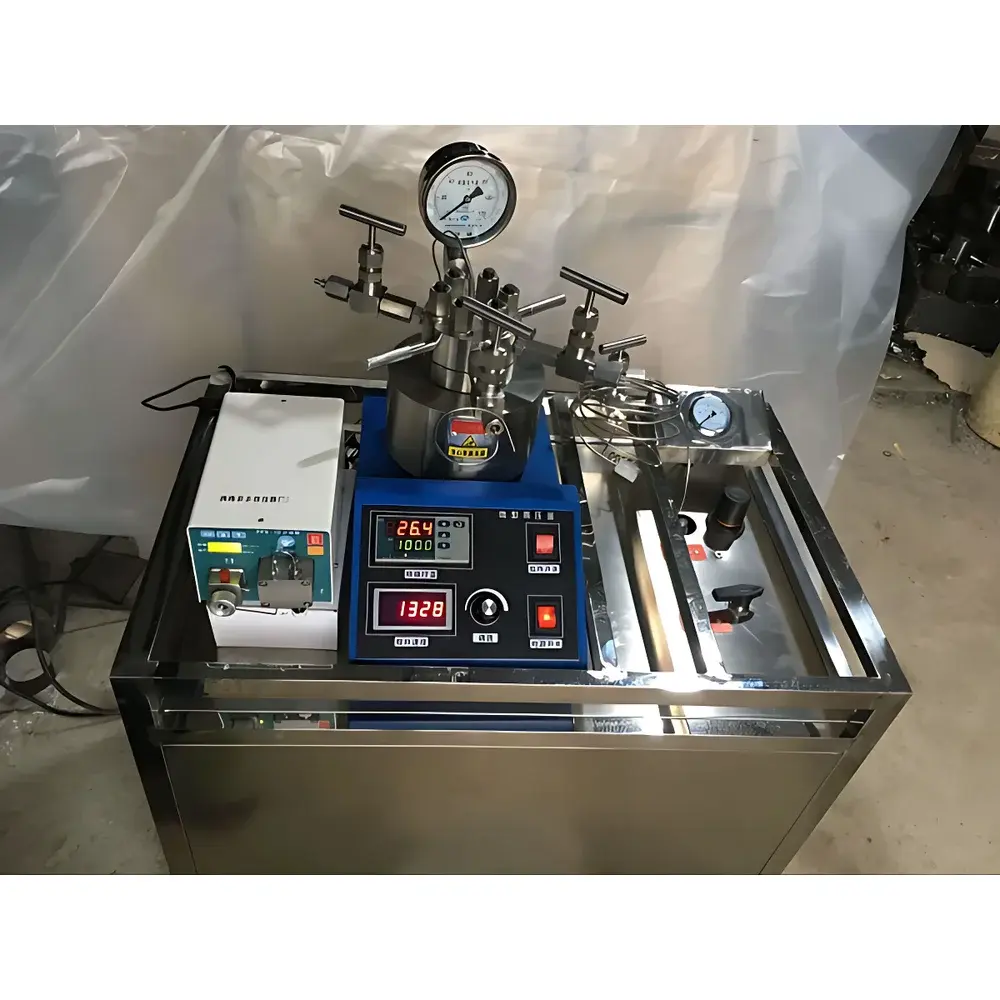
SXIN PSK-500ML High-Temperature High-Pressure Intelligent Integrated Micro Reactor for CO₂ Applications
| Brand | SXIN |
|---|---|
| Origin | Jiangsu, China |
| Manufacturer Type | Authorized Distributor |
| Origin Category | Domestic |
| Model | PSK-500ML |
| Price | USD 5,900 (FOB Jiangsu) |
| Usable Volume | 500 mL |
| Construction Material | Standard T316 Stainless Steel |
| Operating Pressure | Up to 30 MPa |
| Operating Temperature | Up to 350 °C |
| Vacuum Level | ≤1 Pa |
| Optional Liners | PTFE, PPL, 316SS |
| Optional Alloys | Alloy 400, Alloy 600, Alloy C276, Alloy B-3, Titanium |
| Agitation | High-Temperature Magnetic Stirring (standard), Mechanical Stirring (optional) |
| Safety Features | Rupture Disc, Dual-Stage Pressure Relief Valve, Integrated PT100 Temperature Sensor, Digital Pressure Transducer, PID-Controlled Heated Jacket |
Overview
The SXIN PSK-500ML is an intelligent, fully integrated micro-scale reaction system engineered for high-temperature and high-pressure catalytic, kinetic, and process-simulation studies under supercritical and subcritical CO₂ environments. Based on Couette-type sealed-vessel reactor architecture, it employs a precision-machined thick-walled cylindrical pressure vessel with axial thermal uniformity control and real-time monitoring of thermodynamic state variables. The reactor core operates on a dual-zone heating principle—outer jacketed resistive heating combined with internal temperature feedback via calibrated Pt100 sensors—ensuring ±0.5 °C thermal stability across the full 25–350 °C operating range. Its design conforms to ASME BPVC Section VIII Div. 1 requirements for Class I pressure equipment, with all wetted components rated for continuous service at 30 MPa (4350 psi) and validated burst pressure exceeding 45 MPa. This configuration enables rigorous investigation of gas–liquid–solid heterogeneous reactions, CO₂ hydrogenation, carboxylation, and solvent-free synthesis where precise control over p–T–t trajectories is critical for mechanistic insight and scale-up fidelity.
Key Features
- Intelligent PID-controlled heating system with programmable ramp/soak profiles and auto-tuning capability
- High-reliability magnetic drive stirring (rated to 350 °C, 30 MPa) with optional top-entry mechanical agitator for viscous or particulate-laden media
- Modular alloy selection: standard T316SS; upgrade paths to corrosion-resistant alloys including UNS N04400 (Alloy 400), UNS N06600 (Alloy 600), UNS N10276 (C276), UNS N10675 (B-3), and Grade 2 titanium
- Multi-port manifold with ISO-KF and VCR-compatible fittings: dedicated CO₂ inlet, vent line, liquid sampling port (with septum-sealed valve), and auxiliary gas purge channel
- Integrated safety architecture: certified rupture disc (set point adjustable between 25–32 MPa), redundant pressure relief valve, real-time pressure logging, and automatic thermal cut-off at 360 °C
- Full digital instrumentation suite: 0.1 MPa resolution pressure transducer, ±0.2 °C accuracy Pt100 probe, and 0.01 Pa vacuum gauge for pre-reaction degassing validation
Sample Compatibility & Compliance
The PSK-500ML accommodates diverse sample matrices—including aqueous electrolytes, ionic liquids, molten salts, slurries, and polymer melts—without cross-contamination risk, thanks to its removable liner options (PTFE, PPL, or matched-alloy). All fluid-contact surfaces meet ASTM A276 and ASTM B167 specifications. The system complies with ISO 14001 environmental management prerequisites for lab-scale emission control and supports GLP-compliant operation when paired with audit-trail-enabled data acquisition software. It satisfies key regulatory prerequisites for catalyst testing under USP , ASTM D7213 (supercritical fluid processing), and EN 13445-3 Annex C for experimental pressure equipment qualification.
Software & Data Management
The reactor interfaces via RS485/Modbus RTU or optional Ethernet/IP to SXIN’s ReactorControl v3.2 software platform. This Windows-based application provides synchronized logging of pressure, temperature, stir speed, and time-stamped event markers (e.g., valve actuation, alarm triggers). Raw data exports in CSV and HDF5 formats support third-party analysis in MATLAB, Python (Pandas/NumPy), or Aspen Custom Modeler. Audit trail functionality meets FDA 21 CFR Part 11 requirements when configured with user-role authentication, electronic signatures, and immutable log archiving. Remote monitoring and alarm notification (email/SMS) are supported through optional MQTT integration.
Applications
- Kinetic modeling of CO₂ capture and utilization (CCU) reactions, including cycloaddition to epoxides and reductive hydrogenation to methanol/formic acid
- Hydrothermal carbonization and biomass liquefaction under near-critical water–CO₂ mixtures
- Heterogeneous catalysis screening for Fischer–Tropsch synthesis variants using syngas/CO₂ blends
- Supercritical antisolvent (SAS) and particles from gas-saturated solutions (PGSS) nanoparticle synthesis
- Corrosion testing of candidate alloys in CO₂–H₂S–H₂O multiphase environments per NACE TM0177
- Thermodynamic property measurement (pVTx) of novel working fluids for next-generation power cycles
FAQ
What is the maximum allowable working pressure and temperature for continuous operation?
The PSK-500ML is certified for continuous operation at 30 MPa and 350 °C. Short-term excursions up to 32 MPa and 360 °C are permitted for diagnostic or calibration purposes only.
Can the reactor be used with aggressive halogen-containing feedstocks?
Yes—when specified with Alloy C276 or titanium wetted parts, the system demonstrates excellent resistance to chloride-induced stress corrosion cracking and fluorinated acid exposure per ASTM G36 and NACE MR0175/ISO 15156.
Is third-party calibration documentation available?
Each unit ships with NIST-traceable calibration certificates for pressure transducer (±0.1% FS) and Pt100 sensor (±0.15 °C), issued by an ILAC-MRA accredited metrology lab.
How is gas tightness verified prior to first use?
A helium leak test is performed at 1.5× MAWP (45 MPa) with sensitivity better than 1×10⁻⁹ mbar·L/s, documented in the factory test report.
Does the system support automated sequential reaction protocols?
Yes—ReactorControl v3.2 supports script-driven multi-step sequences, including timed gas dosing, temperature ramps, pressure holds, and sampling triggers, with full error recovery logic.



