
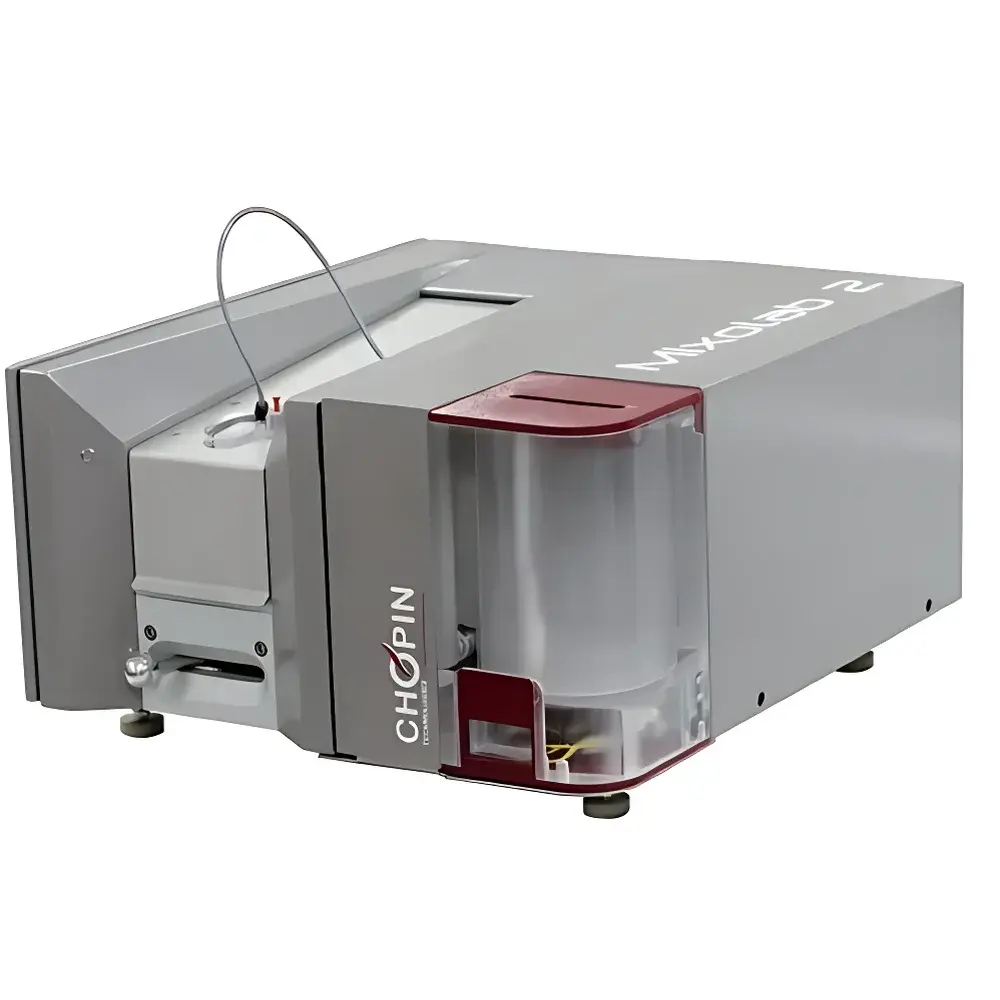
KPM CHOPIN Mixolab 2 Dual-Function Dough Rheology and Starch Gelatinization Analyzer
| Brand | KPM CHOPIN |
|---|---|
| Origin | France |
| Model | Mixolab 2 |
| Compliance | ISO 17718:2013, AACC 54-60-01, ICC 173-1, GOST R 54498-2011, GOST R ISO 17718-2015, GB/T 37511-2019 |
Overview
The KPM CHOPIN Mixolab 2 is a dual-mode, temperature-controlled dough rheometer engineered for standardized functional evaluation of cereal flours and alternative grain powders. It operates on the principle of controlled torque measurement under simultaneous mechanical shearing (via rotating mixing bowl and fixed blade) and programmed thermal profiling (from 30 °C to 90 °C, then cooled to 50 °C). This integrated approach enables concurrent quantification of gluten network development, starch gelatinization kinetics, amylolytic activity, and retrogradation behavior — all within a single, unattended 90-minute test cycle. Unlike conventional standalone instruments (e.g., farinograph, amylograph, or falling number apparatus), the Mixolab 2 captures interdependent physicochemical transitions across three critical processing phases: mixing (hydration & gluten formation), heating (starch swelling & enzyme activation), and cooling (starch recrystallization). Its architecture adheres to the fundamental requirements of cereal science instrumentation: reproducible shear geometry, calibrated thermal ramping (±0.2 °C accuracy), and traceable torque transduction (0.01 N·m resolution).
Key Features
- Dual-phase thermal protocol: Precisely controlled heating ramp (30–90 °C at 7 °C/min) followed by active cooling (90–50 °C at 7 °C/min), synchronized with continuous torque monitoring
- Universal sample compatibility: Validated for wheat (soft/hard), rye, barley, oats, quinoa, buckwheat, legume flours, gluten-free matrices (cassava, potato, rice), and composite blends
- Automated, walk-away operation: Integrated microprocessor controls mixing speed (30–100 rpm), water addition (gravimetric dosing), thermal profile, and data acquisition without manual intervention
- Standardized test protocols: Preloaded methods aligned with ISO 17718:2013 (dough rheology), AACC 54-60-01 (starch gelatinization), and ICC 173-1 (enzyme activity assessment)
- Low sample requirement: Functional analysis achievable with ≤50 g flour and precise water dosing (±0.1 g)
- Modular calibration system: Independent verification of torque, temperature, and water delivery using NIST-traceable reference standards
Sample Compatibility & Compliance
The Mixolab 2 is validated for use with all milled cereal and pseudocereal flours, including those with low or absent gluten content. Its mechanical design accommodates variable hydration demands and particle size distributions typical of wholegrain, ancient grain, and non-wheat matrices. Regulatory compliance extends beyond method-specific standards: test reports support GLP-aligned documentation workflows, and raw torque/time/temperature datasets are exportable in CSV and XML formats compatible with LIMS integration. The instrument satisfies analytical traceability requirements under ISO/IEC 17025 for accredited food testing laboratories and provides audit-ready metadata (operator ID, calibration timestamps, environmental logs) required for FDA 21 CFR Part 11–compliant environments.
Software & Data Management
The proprietary Mixolab Software Suite (v5.x) delivers real-time visualization of torque curves, derivative viscosity profiles, and phase-specific parameter extraction (e.g., C1–C5 points per ISO 17718). Each test generates 12 standardized indices — including water absorption (%), dough development time (min), protein weakening index (ΔC2–C3), gelatinization onset temperature (°C), peak viscosity (Nm·10⁻³), and setback value (Nm·10⁻³) — all calculated via embedded algorithms validated against interlaboratory ring trials. Data security features include role-based user access, electronic signature capture, and immutable audit trails recording every parameter modification. Export options support direct import into statistical process control (SPC) platforms and multivariate analysis tools (e.g., PCA, PLS regression) for predictive modeling of end-product quality attributes.
Applications
- Flour specification verification: Correlating Mixolab-derived indices (e.g., C3–C4 difference) with loaf volume, crumb structure, and crust color in industrial baking trials
- Enzyme dosing optimization: Quantifying α-amylase activity impact on hot-paste viscosity (C4) and retrogradation slope (C5–C4) to prevent over- or under-conditioning
- Wholegrain formulation development: Assessing fiber-mediated water competition effects on gluten hydration kinetics (C1–C2 transition)
- Non-wheat product validation: Establishing functional benchmarks for gluten-free systems where traditional farinograph parameters lack relevance
- Process troubleshooting: Diagnosing batch-to-batch variability in starch damage or protease contamination through deviation in C2 decay rate or C5 rebound magnitude
- Supplier qualification: Generating comparable, method-standardized dossiers for multi-source flour procurement under HACCP and BRCGS Food Safety Standard requirements
FAQ
How does Mixolab 2 differ from a conventional farinograph or amylograph?
It integrates both mixing rheology and thermal-viscous response into one test sequence, eliminating method-dependent artifacts and enabling direct correlation between gluten strength, starch gelatinization enthalpy, and enzymatic degradation kinetics.
Is method customization permitted for proprietary formulations?
Yes — users may define custom thermal ramps, shear rates, and endpoint criteria while retaining full compliance with ISO/AACC reference conditions for comparative reporting.
What maintenance is required to ensure long-term torque calibration stability?
Annual verification using certified torque standards and biweekly temperature probe checks against PT100 reference baths are recommended; no field recalibration of transducers is necessary.
Can raw data be reprocessed with updated algorithms post-acquisition?
Yes — the software supports retrospective reanalysis using newer calculation modules without retesting, preserving original sensor-level time-series records.
Does the system support 21 CFR Part 11 compliance for regulated facilities?
Full electronic record integrity is maintained via encrypted database storage, mandatory user authentication, and tamper-evident audit logs — configurable to meet Part 11 Subpart B requirements.






