
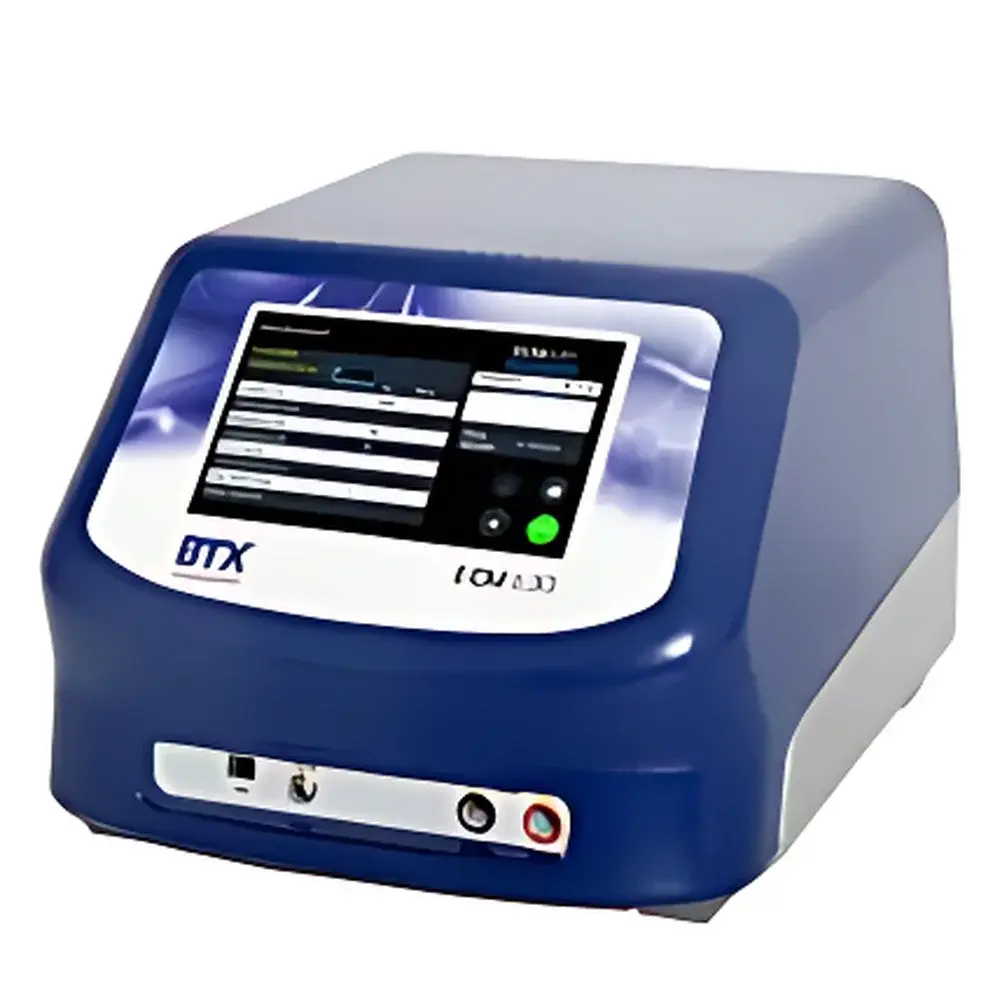
BTX ECM 630 Exponential Decay Wave Electroporation System
| Brand | BTX |
|---|---|
| Origin | USA |
| Manufacturer Type | Authorized Distributor |
| Product Category | Imported Instrument |
| Model | ECM 630 |
| Price Range | USD $13,500 – $40,500 (FOB US Port) |
| Product Type | Electroporation System for Cell Transfection and Transformation |
Overview
The BTX ECM 630 Exponential Decay Wave Electroporation System is an engineered platform for precise, reproducible nucleic acid and macromolecule delivery into prokaryotic and eukaryotic cells. Operating on the principle of exponential decay waveform electroporation, the system applies a time-varying voltage pulse—characterized by an initial peak followed by a rapid, controlled decay—to transiently destabilize the phospholipid bilayer and enable molecular uptake. Unlike square-wave systems optimized for mammalian suspension cells, the ECM 630’s tunable RC circuit architecture delivers high-fidelity control over pulse kinetics (τ = R × C), enabling systematic optimization of electric field strength (V/cm) and pulse duration (ms) across diverse biological matrices—from Gram-negative bacteria and yeast to adherent mammalian lines, plant protoplasts, and insect Sf9 cells. Designed for research-grade transfection, CRISPR-Cas9 plasmid or RNP delivery, and scalable transformation workflows, the ECM 630 meets the technical demands of academic core facilities, bioprocess development labs, and preclinical cell therapy units.
Key Features
- Tunable exponential decay waveform generation with independent adjustment of peak voltage (10–3000 V), capacitance (1–1000 µF), and internal resistance (25–1000 Ω), enabling precise control of time constant (τ) from sub-millisecond to >100 ms.
- Preloaded protocol library with empirically validated settings for E. coli, Bacillus subtilis, Saccharomyces cerevisiae, CHO-K1, HEK293, Jurkat, primary T cells, and plant protoplasts—including dedicated CRISPR editing protocols for ribonucleoprotein (RNP) electroporation.
- User-definable program storage for up to 100 custom protocols, each supporting multi-pulse sequences (up to 5 pulses per run) with inter-pulse delay control.
- Integrated safety architecture: real-time resistance verification prior to pulse initiation, triple-layer arc suppression (hardware-triggered current limiting, optical arc detection, and thermal cutoff), and automatic pulse termination upon current overshoot (>10% deviation from set threshold).
- 7-inch capacitive touchscreen interface with intuitive icon-driven navigation, on-device parameter validation, and visual pulse waveform preview before execution.
Sample Compatibility & Compliance
The ECM 630 supports standard electroporation cuvettes (0.1 cm, 0.2 cm, and 0.4 cm gap widths) and is compatible with commercial and custom-designed electrodes for specialized applications (e.g., needle-type electrodes for in vivo mouse muscle electroporation). It accommodates sample volumes from 10 µL to 100 µL per pulse and operates within ISO 13485-aligned manufacturing controls. While not FDA-cleared as a medical device, the system conforms to IEC 61010-1:2012 for laboratory electrical safety and supports GLP-compliant documentation via audit-trail-enabled data export. Pulse log files include timestamp, operator ID, protocol name, actual delivered voltage/current waveforms (sampled at 100 kHz), and environmental temperature readings—facilitating traceability for regulatory submissions under 21 CFR Part 11 when deployed with validated LIMS integration.
Software & Data Management
All experimental metadata—including user-defined parameters, measured electrical output, and system diagnostics—are automatically recorded in a timestamped .csv log file stored internally and exportable via USB 2.0 port. The ECM 630 does not require external PC software for operation; however, BTX provides optional Python-based SDK (v2.1) for automated protocol sequencing, integration with liquid handlers, and batch analysis of transfection efficiency metrics (e.g., GFP+ % via flow cytometry correlation). Log files are structured to align with FAIR data principles and support downstream statistical analysis in JMP, GraphPad Prism, or R.
Applications
- High-efficiency plasmid transformation of E. coli DH5α and electrocompetent B. subtilis strains (≥10⁹ CFU/µg DNA).
- CRISPR-Cas9 RNP delivery into primary human CD4+ T cells with >85% editing efficiency (indel rate) and >70% viability post-electroporation.
- Stable transfection of suspension-adapted CHO-S cells for monoclonal antibody expression screening.
- Transient expression of membrane proteins in Sf9 insect cells using baculovirus-free plasmid delivery.
- Protoplast transfection of Arabidopsis thaliana and rice cultivars for functional genomics studies.
- Scalable electroporation process development aligned with QbD (Quality by Design) frameworks for cell and gene therapy manufacturing.
FAQ
What types of cells can be processed using the ECM 630?
The system is validated for bacterial, yeast, insect, plant protoplast, and mammalian cell types—including primary and stem-derived cells—with appropriate cuvette selection and protocol tuning.
Does the ECM 630 support GLP/GMP documentation requirements?
Yes: full pulse logs with operator ID, timestamps, and measured electrical parameters are generated per run and support 21 CFR Part 11 compliance when paired with validated electronic signature and audit trail systems.
Can I integrate the ECM 630 into an automated workflow?
Yes: the optional SDK enables RS-232 and USB-HID communication for synchronization with robotic liquid handlers, incubators, and plate readers.
Is training and application support available?
BTX-certified application scientists provide remote and on-site installation qualification (IQ), operational qualification (OQ), and protocol optimization services globally.
What maintenance is required?
Annual calibration verification is recommended; no consumable parts beyond standard cuvettes and electrode assemblies are required under normal use conditions.






