
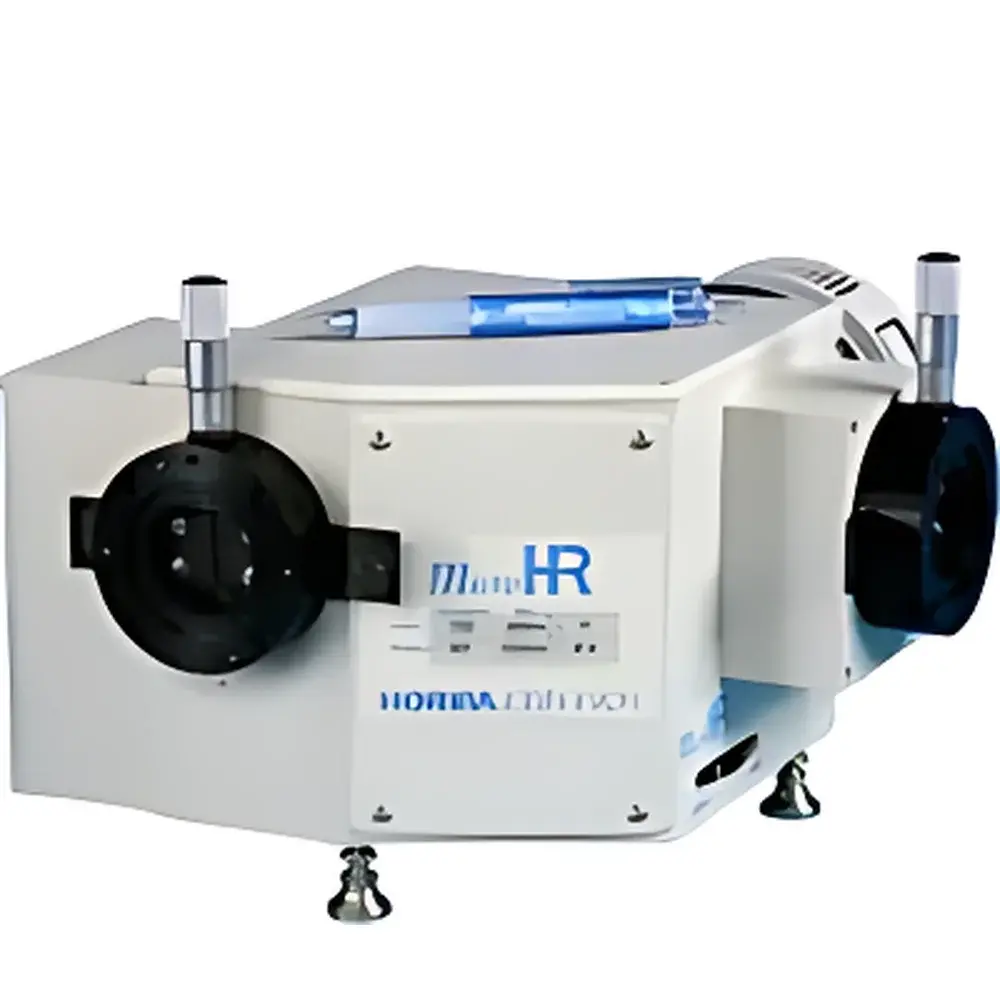
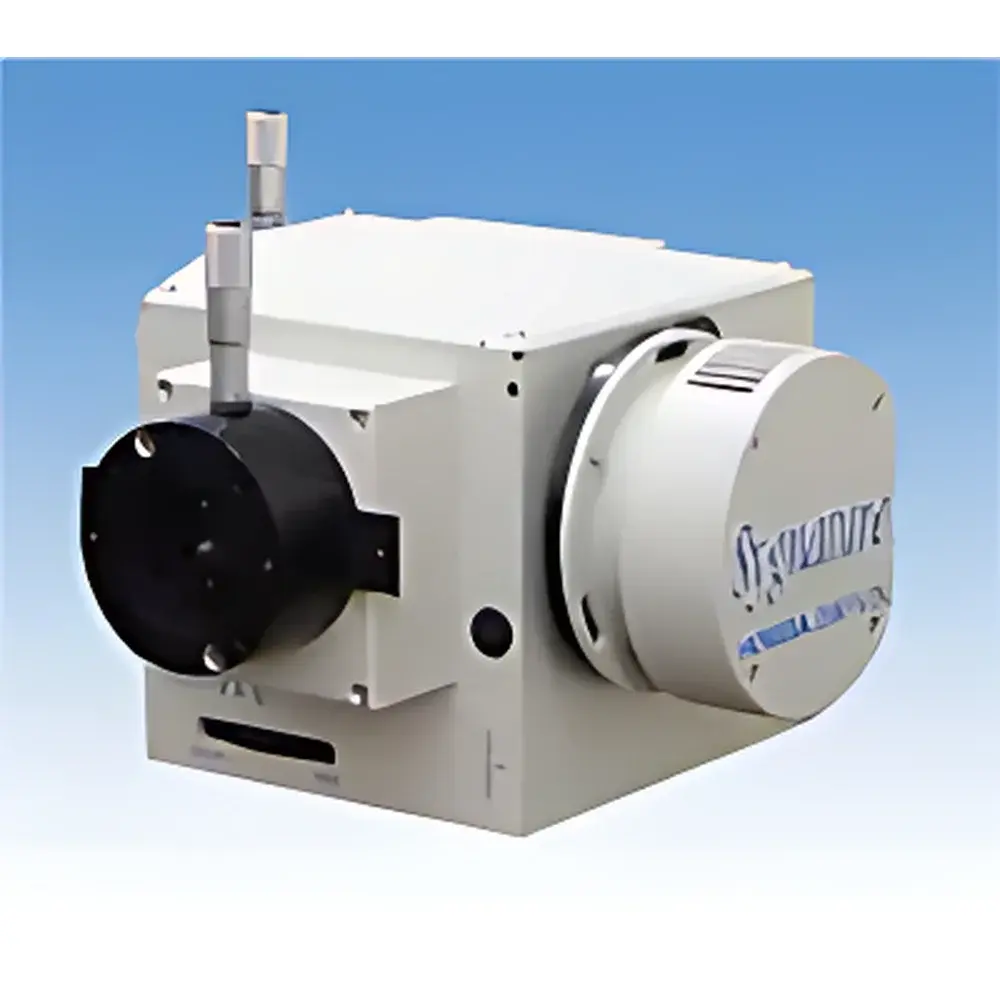
HORIBA MicroHR Compact Multifunctional Imaging Spectrometer
| Brand | HORIBA |
|---|---|
| Origin | USA |
| Manufacturer Type | Authorized Distributor |
| Product Origin | Imported |
| Model | MicroHR |
| Pricing | Available Upon Request |
| Focal Length | 140 mm |
| f-number | f/3.88 |
| Spectral Dispersion | 5.25 nm/mm |
| Grating Dimensions | 32 mm × 32 mm |
| Spectral Range | 180 nm – 20 µm |
| Detector Compatibility | CCD, PMT, and other single-channel detectors |
| Grating Turret | Manual or motorized dual-grating turret |
| Optical Design | Optimized toroidal focusing mirrors |
Overview
The HORIBA MicroHR Compact Multifunctional Imaging Spectrometer is a precision-engineered Czerny–Turner grating spectrometer designed for high-fidelity spectral acquisition across an exceptionally broad wavelength range—from deep ultraviolet (180 nm) to far-infrared (20 µm). Its 140 mm focal length and f/3.88 optical architecture deliver an optimal balance of throughput, resolution, and compactness, making it suitable for both laboratory-based research and field-deployable analytical applications. Unlike conventional benchtop spectrometers, the MicroHR integrates imaging-grade optical performance—enabled by toroidal focusing mirrors—into a mechanically robust, space-efficient platform. This design ensures minimal aberration, high spatial fidelity across the detector plane, and consistent spectral linearity—critical for quantitative spectroscopic analysis where pixel-to-wavelength mapping accuracy directly impacts data integrity.
Key Features
- Modular Detector Integration: Native compatibility with scientific-grade CCD arrays, photomultiplier tubes (PMTs), InGaAs detectors, and other single-channel sensors enables seamless adaptation to diverse detection requirements—including low-light fluorescence, time-resolved laser-induced breakdown spectroscopy (LIBS), and high-dynamic-range reflectance measurements.
- Compact & Transportable Form Factor: With a footprint under 200 mm × 150 mm and total height less than 120 mm, the MicroHR fits within standard optical tables, glove boxes, vacuum chambers, and mobile analytical enclosures—supporting integration into OEM systems and portable diagnostic platforms.
- Dual-Grating Turret Architecture: Equipped with either manual or motorized dual-grating turret options, the system allows rapid, repeatable switching between gratings without realignment. Each 32 mm × 32 mm ruled or holographic grating is independently selectable to optimize resolution, dispersion, or throughput for specific spectral regions (e.g., UV-VIS blazed at 300 nm, NIR blazed at 1200 nm, or MIR blazed at 5 µm).
- Toroidal Mirror-Based Imaging Optics: Replaces conventional spherical mirrors to minimize coma and astigmatism across the full spectral image plane—enhancing point-spread function uniformity and enabling accurate spectral calibration using multi-line emission sources (e.g., Hg-Ar, Ne, or Kr lamps) per ISO/IEC 17025-compliant procedures.
- Vacuum & Purge-Compatible Housing: Optional sealed, purged, or evacuated configurations support operation in oxygen-sensitive UV (6 µm) regimes—ensuring stable signal-to-noise ratios in demanding environmental conditions.
Sample Compatibility & Compliance
The MicroHR accommodates free-space beam coupling and fiber-optic input (via SMA905 or FC/PC adapters), supporting transmission, reflection, emission, and scattering geometries. It complies with CE marking directives (2014/30/EU EMC, 2014/35/EU LVD) and meets RoHS 2011/65/EU material restrictions. When integrated into regulated environments—including pharmaceutical QC labs or environmental monitoring stations—the instrument supports audit-ready configuration management when paired with HORIBA’s LabSpec 6 software (validated per FDA 21 CFR Part 11 requirements for electronic records and signatures). Its mechanical stability and thermal drift compensation (±0.01 nm/°C typical) align with ASTM E275, ISO 13695, and USP specifications for spectrophotometer verification.
Software & Data Management
Controlled via HORIBA’s LabSpec 6 spectroscopy suite (Windows 10/11 compatible), the MicroHR supports real-time spectral acquisition, multi-order suppression algorithms, and pixel-binning optimization for SNR enhancement. The software provides NIST-traceable wavelength calibration routines, automated grating selection logic, and export formats compliant with ANDI/NetCDF, JCAMP-DX, and ASCII CSV standards—facilitating interoperability with LIMS, ELN, and statistical process control (SPC) platforms. Raw spectral data retains full metadata (grating ID, slit width, integration time, detector gain, ambient temperature), satisfying GLP/GMP documentation requirements for method validation and instrument qualification (IQ/OQ/PQ).
Applications
- UV-NIR absorption and transmission spectroscopy of thin films, semiconductors, and optical coatings
- Time-resolved fluorescence lifetime measurements using gated PMT detection
- In situ plasma diagnostics and combustion emission analysis
- Remote or handheld Raman spectroscopy systems (when coupled with notch filters and laser excitation modules)
- Microspectroscopy of biological tissues and microfluidic reaction monitoring
- Calibration reference source characterization for radiometric and photometric standards laboratories
FAQ
What spectral resolution can be achieved with the MicroHR?
Resolution depends on selected grating groove density, entrance slit width, and detector pixel size. Typical resolving power (λ/Δλ) ranges from ~1,200 (with 300 g/mm grating and 50 µm slit) to >8,000 (with 2400 g/mm grating and 10 µm slit), as verified using mercury-argon lamp lines per ISO 13695 Annex B.
Is the MicroHR compatible with cryogenic detectors?
Yes—its kinematic mounting interface and low-outgassing housing allow direct integration with liquid-nitrogen-cooled InSb or MCT detectors; optional cold-finger adapters are available for vacuum-compatible installations.
Can the MicroHR be used in vacuum or inert gas environments?
Standard models operate at ambient pressure; however, vacuum-rated variants (10⁻⁵ mbar) and nitrogen-purged versions are offered for deep-UV or mid-IR applications requiring atmospheric attenuation mitigation.
Does HORIBA provide application-specific firmware or OEM integration support?
Yes—HORIBA offers SDKs (C/C++, Python, .NET), hardware trigger I/O (TTL, LVDS), and custom firmware development services for embedded system integration, including synchronization with pulsed lasers, delay generators, and motion controllers.






