
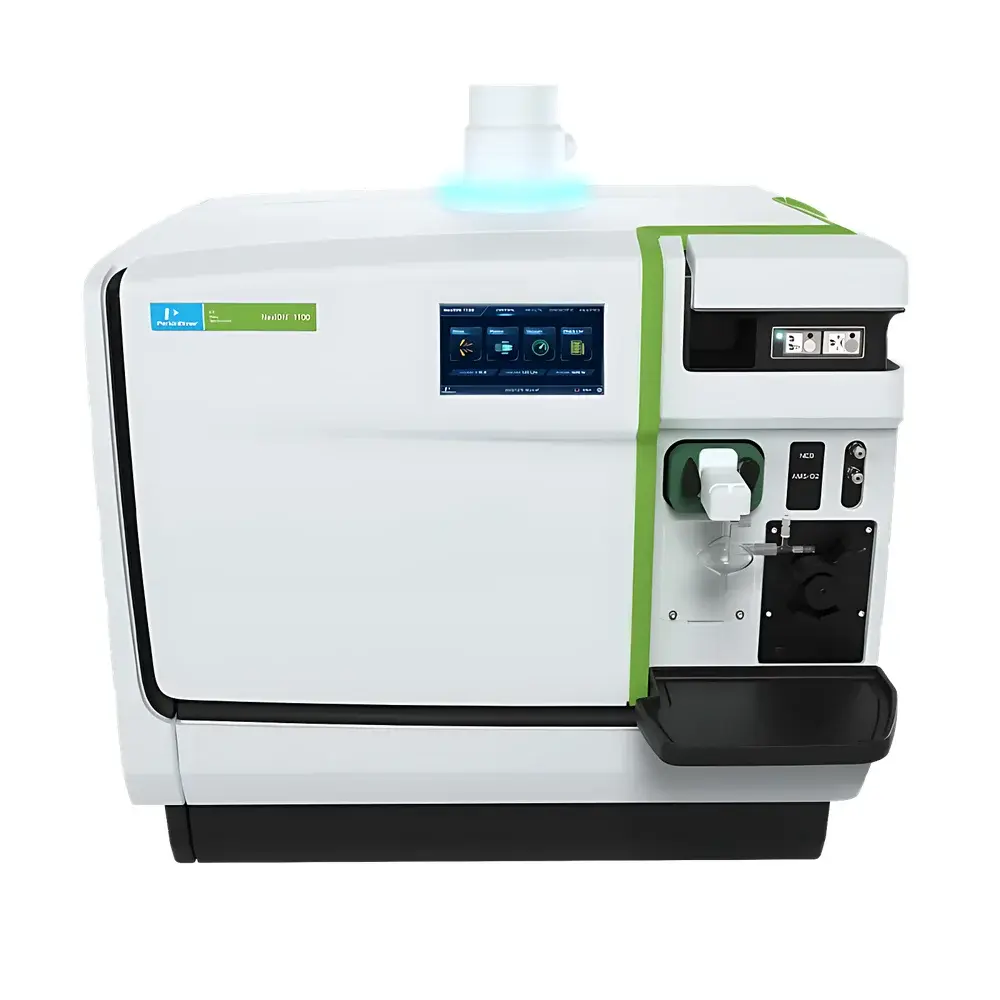
PerkinElmer NexION 1100/1000G Inductively Coupled Plasma Mass Spectrometer
| Brand | PerkinElmer |
|---|---|
| Origin | Singapore |
| Manufacturer Type | Original Equipment Manufacturer (OEM) |
| Origin Category | Imported |
| Model | NexION 1100/1000G ICP-MS |
| Instrument Type | Quadrupole Mass Spectrometer |
| Application Environment | Laboratory |
Overview
The PerkinElmer NexION 1100/1000G ICP-MS is a high-performance, quadrupole-based inductively coupled plasma mass spectrometer engineered for routine and demanding trace elemental analysis in regulated and research laboratories. It operates on the fundamental principle of ionizing sample atoms in a high-temperature argon plasma (~7,000–10,000 K), followed by mass separation using three sequential quadrupole mass filters (Q0, Q1, Q2) and detection via a high-dynamic-range electron multiplier. This triple-quadrupole architecture enables true mass-resolved interference removal—distinct from single-quadrupole instruments relying solely on collision/reaction cell chemistry—thereby delivering enhanced accuracy, specificity, and robustness for complex matrices such as environmental waters, geological digests, clinical biofluids, and high-TDS industrial process streams.
Key Features
- Triple-Quadrupole Interference Management: Q0 (ion deflector) directs ions into Q1 (Universal Reaction Cell™), which supports single-, dual-, or triple-gas channel configurations with real-time gas mixing; Q2 (full-size mass analyzer) provides mass resolution <0.7 amu for precise target ion selection.
- Intelligent Electronic Dilution (EDR): Extends linear dynamic range to 1014, enabling quantification of major, minor, and ultra-trace elements in a single acquisition without manual dilution or reanalysis.
- Advanced Sample Introduction: Full Matrix Introduction (FMI) system integrates online gas-assisted dilution (up to 200×) and handles samples with total dissolved solids (TDS) up to 35%, minimizing cone clogging and signal drift.
- LumiCoil™ RF Generator: 34 MHz free-running solid-state RF source with proprietary air-cooled LumiCoil™ load coil eliminates water/gas cooling requirements, delivers stable plasma impedance matching across variable matrix loads, and ensures >99.5% uptime with zero consumable coil replacements.
- Low-Maintenance Architecture: Three-cone interface combined with QID (Quadrupole Ion Deflector) minimizes maintenance points; only the sampler and skimmer cones require periodic cleaning or replacement—no internal optics or ion optics servicing between scheduled calibrations.
- Integrated Human-Machine Interface: 10.1″ capacitive LCD touchscreen supports hardware control, real-time diagnostics, method editing, result review, and embedded video training modules; external status LED ring provides at-a-glance run progress indication.
Sample Compatibility & Compliance
The NexION 1100/1000G accommodates aqueous solutions, acid digests (HNO3, HCl, HF), organic solvents (with optional oxygen addition), and high-salinity brines. Its FMI system and robust plasma stability support ASTM D5673 (drinking water), ISO 17294-2 (water quality), USP <232>/<233> (elemental impurities in pharmaceuticals), and EPA Methods 200.8 and 6020B. The instrument’s firmware and Syngistix™ software are designed for GLP/GMP environments, supporting 21 CFR Part 11-compliant audit trails, electronic signatures, and secure user access levels.
Software & Data Management
Syngistix™ for ICP-MS v4.0+ features a modern relational database backend optimized for LIMS interoperability via ODBC and RESTful API integration. FastQuant™ data viewer enables rapid post-acquisition review, peak reintegration, background correction, and export to CSV, Excel, or PDF without reopening raw data files. Method templates comply with ISO/IEC 17025 documentation requirements, and all calibration, QC, and sample records include full metadata capture (gas flows, RF power, dwell times, detector voltage). Audit trail logs record operator actions, parameter changes, and data modifications with timestamps and user IDs.
Applications
- Environmental monitoring: Detection of As, Cd, Pb, U, and rare earth elements (REEs) in groundwater, wastewater, and soil extracts at sub-pg/L levels.
- Geochemical research: Isotopic ratio measurement (e.g., Sr, Nd, Hf) with interference-free analysis of oxide and doubly charged species.
- Pharmaceutical quality control: Elemental impurity screening per ICH Q3D guidelines across APIs, excipients, and container closure systems.
- Clinical and nutritional labs: Quantification of essential (Fe, Zn, Se) and toxic (Hg, Tl, Bi) elements in serum, urine, and whole blood with minimal sample prep.
- Materials science: Trace contaminant profiling in high-purity semiconductors, battery cathode materials, and catalyst precursors.
FAQ
What distinguishes the triple-quadrupole design from conventional single-cell ICP-MS instruments?
It provides orthogonal interference removal: Q0 pre-filters ions before entering Q1 (reaction cell), while Q2 performs final mass selection—enabling simultaneous use of reaction chemistry and mass filtering for isobaric and polyatomic interferences.
Can the NexION 1100/1000G operate under regulated GMP conditions?
Yes—Syngistix™ v4.0+ includes 21 CFR Part 11 compliance features including role-based access control, electronic signatures, immutable audit trails, and automated backup protocols.
Is helium-only operation sufficient for most applications?
A single-gas channel with He is adequate for collision-mode applications (e.g., removing ArO+ on Fe); dual/triple channels are recommended for multi-analyte workflows requiring simultaneous He, H2, NH3, or O2 reactions.
How does the LumiCoil™ RF generator improve long-term stability?
Its air-cooled, solid-state design eliminates thermal cycling stress and coolant degradation risks associated with water-cooled systems—resulting in consistent plasma impedance matching over >10,000 hours of continuous operation.
Does the instrument support isotopic ratio measurements?
Yes—high mass stability (<0.025 amu/24 h), low mass bias drift, and integrated standard bracketing routines enable precise isotope ratio analysis for geochronology and tracer studies.
Related Products




