
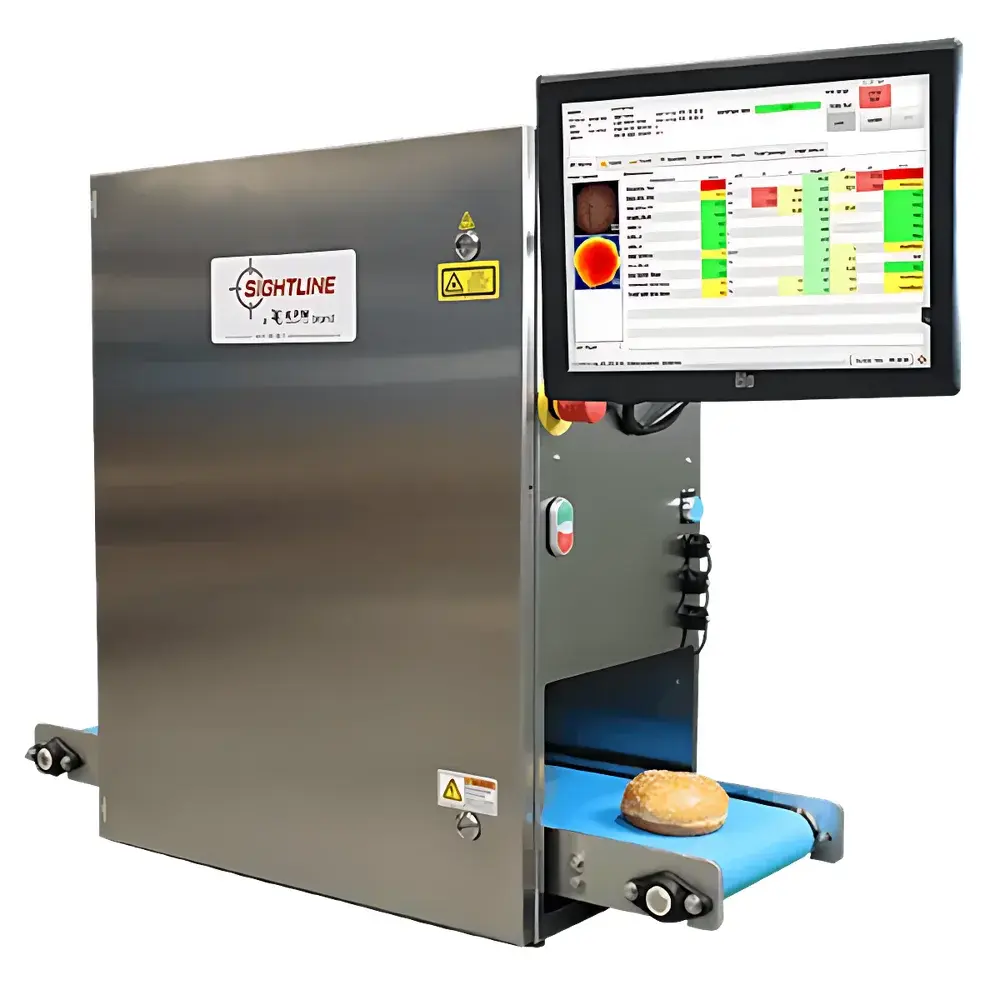
KPM Sightline TV Series Desktop Vision Inspection System for Agricultural Produce, Potatoes, and Bread Crumb Texture Analysis
| Brand | KPM Sightline |
|---|---|
| Origin | Canada |
| Manufacturer Type | Authorized Distributor |
| Origin Category | Imported |
| Model | TV Series |
| Pricing | Upon Request |
Overview
The KPM Sightline TV Series Desktop Vision Inspection System is an engineered solution for non-destructive, quantitative morphological and textural characterization of agricultural commodities and processed food products—including potatoes, fresh vegetables, and leavened bakery goods such as bread loaves and buns. Built upon industrial-grade machine vision architecture, the system employs high-resolution monochrome or RGB area-scan cameras, calibrated optical paths, and programmable multi-angle LED illumination to capture geometrically accurate, repeatable surface and cross-sectional imagery. Unlike manual grading or single-parameter instrumentation, this system implements a multi-modal analysis framework grounded in pixel-level image processing—enabling simultaneous extraction of dimensional, topographic, chromatic, and microstructural features without physical contact or sample preparation. Its core measurement paradigm integrates geometric metrology (e.g., height mapping via structured light or stereo triangulation), colorimetric profiling (CIE L*a*b* space), and texture-based segmentation (using grayscale co-occurrence matrix, Gabor filtering, and watershed-based pore detection algorithms). Designed for integration into QC laboratories and R&D pilot lines, the TV Series complies with foundational principles of GLP-aligned data integrity and supports audit-ready metadata logging.
Key Features
- Modular desktop platform with adjustable sample stage, precision Z-axis height control, and integrated lighting dome for uniform diffuse illumination
- 100+ configurable measurement algorithms—expandable via firmware updates—including peak/mean/edge height, min/max/mean diameter, aspect ratio, roundness, slope gradient (long-side vs. short-side), surface area, volumetric estimation (via height-map integration), and specific volume calculation
- Dual-mode imaging capability: standard surface inspection mode and optional crumb texture analysis module for internal microstructure quantification
- Crumb texture analysis utilizes high-magnification macro-lens imaging combined with directional backlighting to resolve pore architecture in baked goods; delivers pore count, total pore area, max pore area, max pore diameter, mean pore diameter, and size-binned pore statistics (small/medium/large categories)
- Optional peripheral interface support for external transducers: digital load cells (mass), thermistors (surface temperature), and humidity sensors—synchronized timestamping ensures correlated multimodal data acquisition
- Calibration traceability to NIST-traceable standards for dimensional and color metrics; validation protocols aligned with ASTM E308 (color measurement) and ISO 11037 (food texture imaging)
Sample Compatibility & Compliance
The TV Series accommodates solid, semi-rigid, and porous food matrices with minimal operator intervention: whole or halved potatoes (50–200 mm diameter), cut vegetable sections (e.g., bell peppers, carrots), and intact or sliced bakery products (loaf dimensions up to 300 × 120 × 120 mm). Samples are placed directly on the motorized stage; no fixturing or coating is required. The system meets CE marking requirements for electrical safety and electromagnetic compatibility (EN 61326-1). Data handling workflows support 21 CFR Part 11 compliance when deployed with validated software configuration—including electronic signatures, audit trails, and role-based access control. All image and metric outputs are stored in vendor-neutral TIFF/PNG + CSV formats, facilitating third-party statistical analysis (e.g., JMP, Minitab) and LIMS integration.
Software & Data Management
The proprietary SightLine Vision Suite provides a Windows-based GUI with intuitive workflow templates, real-time preview, batch processing queues, and customizable report generation (PDF/Excel). Each measurement session automatically logs acquisition parameters (exposure time, lens aperture, illumination intensity), environmental metadata (ambient temperature/humidity if connected), and raw image stacks with embedded EXIF tags. Version-controlled algorithm libraries allow method transfer across instruments; IQ/OQ documentation packages are available for regulated environments. Raw images are stored losslessly; processed metrics include uncertainty estimates derived from repeatability studies per ISO 5725-2. Export modules support direct ingestion into enterprise QA dashboards via OPC UA or RESTful API endpoints.
Applications
- Quality assurance of potato cultivars: quantifying internal defects (hollow heart, brown center), tuber shape uniformity, and skin blemish coverage
- Bakery R&D: correlating crumb pore metrics (mean pore diameter, pore density distribution) with dough formulation variables (yeast activity, hydration, proofing time)
- Process validation: monitoring consistency of slicing thickness, crust-to-crumb ratio, and surface scoring geometry across production shifts
- Regulatory submission support: generating objective, reproducible texture descriptors for USP (physical characterization of dosage forms) analogues in functional food development
- Supplier qualification: standardized visual grading of incoming produce lots against contractual specifications for size, color homogeneity, and surface defect thresholds
FAQ
Is the crumb texture analysis module hardware- or software-based?
It requires both: a dedicated high-resolution macro-imaging subassembly (including telecentric lens and collimated backlight) plus licensed firmware enabling pore segmentation and statistical reporting.
Can the system be validated for GMP environments?
Yes—full IQ/OQ documentation, calibration certificates, and 21 CFR Part 11-compliant software configuration packages are available upon request.
What is the typical throughput for full crumb analysis of a standard loaf?
Approximately 90 seconds per sample, including auto-alignment, image capture, and metric computation—scalable to 40+ samples/hour in batch mode.
Does the system support custom algorithm development?
KPM Sightline offers collaborative method development services under NDA, leveraging their SDK for Python-based plugin integration and third-party library embedding (e.g., OpenCV, scikit-image).
How is geometric accuracy verified during routine operation?
Daily verification uses certified step-height gauges and color reference tiles; annual recalibration is performed by KPM-certified field engineers using traceable photogrammetric targets.



