
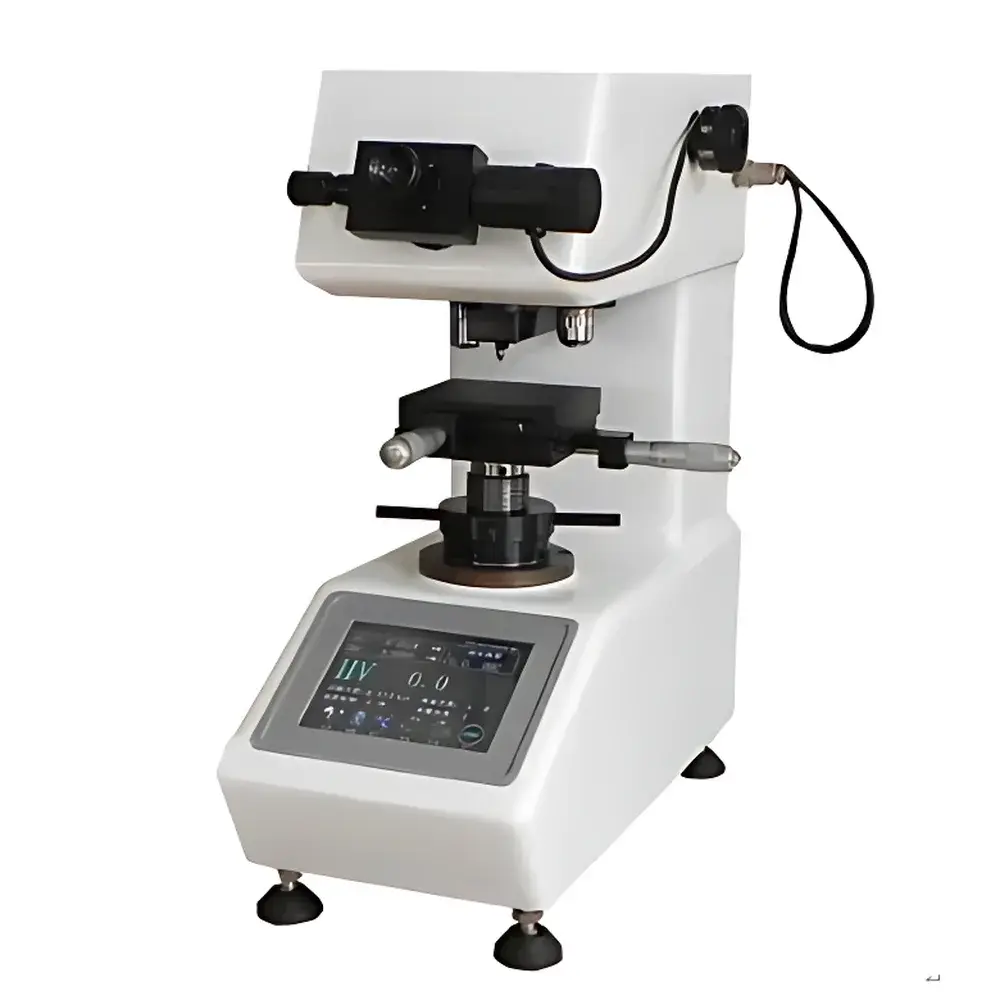
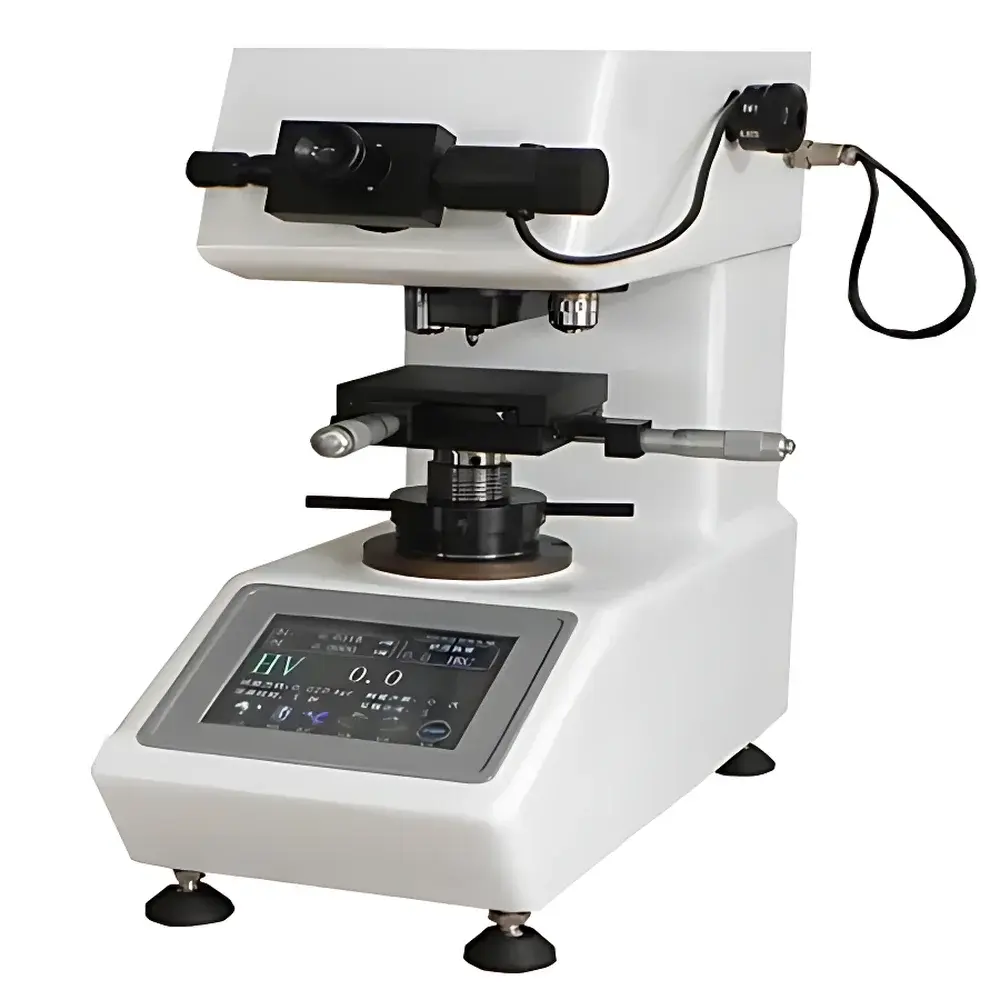
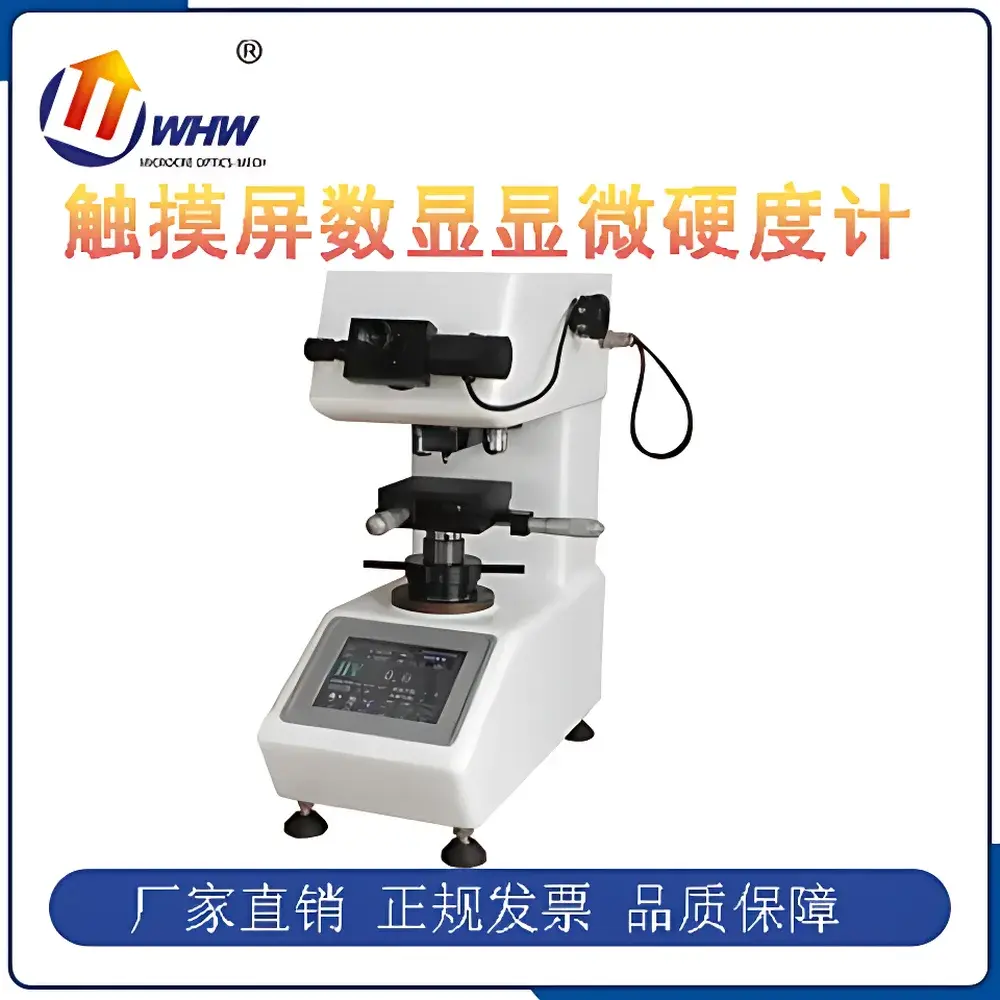
YANRUN HVS-1000M / HVS-1000MZ Touchscreen Digital Microhardness Tester
| Brand | YANRUN |
|---|---|
| Origin | Shanghai, China |
| Manufacturer Type | OEM Manufacturer |
| Region of Origin | Domestic (China) |
| Model | HVS-1000M / HVS-1000MZ |
| Price Range | USD 4,100 – 4,780 (FOB Shanghai) |
| Instrument Type | Microhardness Tester |
| Hardness Measurement Range | 0–6000 HV |
| Test Forces | 8-step loading: 0.098 N, 0.245 N, 0.490 N, 0.981 N, 1.961 N, 2.942 N, 4.903 N, 9.807 N |
| Equivalent GF Scale | 10 gf, 25 gf, 50 gf, 100 gf, 200 gf, 300 gf, 500 gf, 1000 gf |
| Test Space | 55 mm (H) × 110 mm (D) |
| Compliance Standard | GB/T 4340.1–2012 (ISO 6507-1 equivalent) |
| Optical Magnification | 100× (observation), 400× (measurement) |
| Minimum Detection Unit | 0.0318 µm |
| X-Y Stage Travel | 25 mm × 25 mm (standard) |
| Force Application Speed | 0.05 mm/s |
| Dwell Time | 0–60 s (1 s increments) |
| Data Storage | Up to 30 test records on-device |
| Integrated Thermal Printer | Yes |
| Power Supply | AC 220 V / 50 Hz |
Overview
The YANRUN HVS-1000M and HVS-1000MZ are precision-engineered microhardness testers designed for quantitative indentation-based hardness evaluation of metallic, ceramic, thin-film, and composite materials at the microstructural level. These instruments operate on the principle of Vickers hardness testing—applying a precisely controlled diamond pyramid indenter under defined loads to produce a geometrically reproducible impression on the sample surface. The diagonal lengths of the resulting impression are measured optically and converted into HV values using standardized algorithms per ISO 6507-1 and GB/T 4340.1–2012. The HVS-1000MZ variant adds motorized turret functionality for automated objective/indenter switching, enhancing repeatability in multi-point or multi-load test sequences. Both models support Knoop hardness testing via optional Knoop indenter installation—enabling high-resolution assessment of brittle, thin, or anisotropic specimens where crack propagation or plastic deformation must be minimized.
Key Features
- 5.6-inch full-color capacitive touchscreen interface with intuitive navigation inspired by industrial human-machine interaction paradigms—eliminating reliance on external PCs for basic operation.
- Integrated digital encoder system for direct, contactless measurement of indenter displacement; ensures sub-micron positional resolution (0.0318 µm) and eliminates parallax error inherent in analog eyepiece-based systems.
- Opto-mechanical co-alignment architecture: objective lens, indenter holder, optical path, and coaxial illumination share a rigid monolithic baseplate—maximizing optical throughput and minimizing alignment drift over thermal cycles.
- Eight-step force selection via front-panel rotary switch (HVS-1000M) or software-controlled actuation (HVS-1000MZ), covering the full ASTM E384-compliant microload range from 10 gf to 1000 gf (0.098 N to 9.807 N).
- Automated force application cycle: load → dwell (0–60 s, adjustable in 1 s increments) → unload—all executed at constant velocity (0.05 mm/s) to ensure compliance with ISO 6507-1 loading rate requirements.
- Onboard thermal printer and internal memory (30 test records) provide immediate documentation traceability without external peripherals—critical for GLP-compliant lab environments.
Sample Compatibility & Compliance
The HVS-1000 series accommodates specimens up to 55 mm in height and 110 mm in lateral clearance from the indenter axis—making it suitable for cross-sectioned metallurgical mounts, coated substrates, MEMS devices, and miniature mechanical components. Its 25 mm × 25 mm (standard) or 50 mm × 50 mm (optional) X-Y motorized stage enables systematic grid-based hardness mapping across heterogeneous microstructures. All hardness calculations adhere to GB/T 4340.1–2012, which is technically aligned with ISO 6507-1:2018 and ASTM E384–22. Optional Knoop testing satisfies ASTM E384 Annex A2 requirements for anisotropic material characterization. The instrument’s mechanical construction—aluminum alloy cast body with precision-ground guideways—ensures long-term dimensional stability under routine laboratory conditions.
Software & Data Management
The included HMAS professional microhardness analysis software (v2.0) extends functionality beyond standalone operation. It supports real-time video capture, automated multi-point indentation sequencing, statistical reporting (mean, SD, CV%), and cross-scale hardness conversion (HV ↔ HK ↔ HRA/HRC/HBW). Raw image data and metadata—including load, dwell time, operator ID, timestamp, and environmental notes—are stored in vendor-neutral CSV and TIFF formats. Audit trail capabilities include user login logs and parameter change history—facilitating compliance with FDA 21 CFR Part 11 when deployed in regulated QC/QA workflows. Software calibration routines verify encoder linearity and optical magnification against NIST-traceable reference standards.
Applications
- Quality control of heat-treated steels, case-hardened gears, and turbine blade coatings.
- Thin-film hardness profiling (e.g., PVD/CVD TiN, DLC, Al₂O₃) using low-force Knoop indentation to avoid substrate interference.
- Grain-level hardness mapping in duplex stainless steels, nickel superalloys, and weld HAZ (heat-affected zone) analysis.
- Failure analysis of brittle ceramics and semiconductor wafers where conventional macro-hardness methods induce fracture.
- Research-grade indentation studies requiring high spatial resolution (≤1 µm step size) and repeatable load-dwell-unload protocols.
FAQ
Is the HVS-1000MZ compatible with ASTM E384 for Knoop hardness testing?
Yes—when equipped with a certified Knoop indenter and calibrated per ASTM E384 Section 7, the system meets all procedural and reporting requirements for microindentation Knoop testing.
Can the instrument be integrated into a LIMS environment?
Yes—the HMAS software supports ODBC-compliant database export and configurable XML output, enabling bidirectional data exchange with validated LIMS platforms under 21 CFR Part 11 audit controls.
What is the uncertainty budget for HV measurements at 100 gf load?
Based on type B evaluation per ISO/IEC Guide 98-3, combined standard uncertainty is ≤±1.8% (k=2) for homogeneous reference blocks within the 100–800 HV range, assuming proper calibration and environmental stabilization.
Does the system support automated hardness mapping across large-area samples?
Yes—via HMAS software scripting, users can define custom coordinate grids, assign variable test loads/dwell times per location, and generate contour plots with interpolation algorithms compliant with ISO 18265 Annex C.
Are replacement parts and calibration services available internationally?
YANRUN maintains ISO 17025-accredited calibration laboratories in Shanghai and partners with regional metrology service providers across APAC, EMEA, and North America for traceable recalibration and preventive maintenance.



