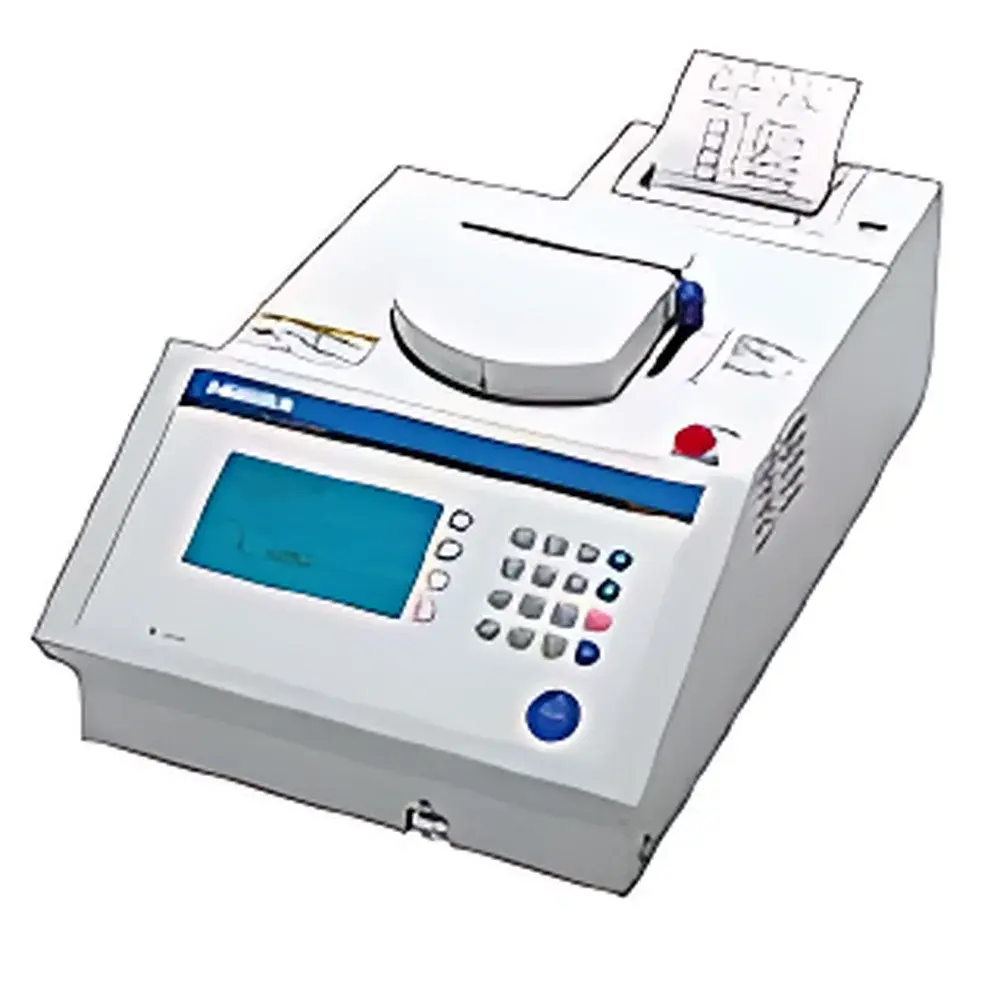
HORIBA SLFA-20 Energy-Dispersive X-ray Fluorescence Sulfur Analyzer
| Brand | HORIBA |
|---|---|
| Origin | Japan |
| Model | SLFA-20 |
| Detection Principle | Energy-Dispersive X-ray Fluorescence (ED-XRF) |
| Detection Limit | 20 ppm (3σ) |
| Measurement Range | 0–5 wt% (extended to 0–90 wt% with matrix correction) |
| Repeatability | ≤15 ppm (at 1 wt% S) |
| Analysis Time | 1–600 s (user-selectable) |
| Sample Volume | 4–10 mL |
| Dimensions | 250 × 407 × 138 mm |
| Weight | 8 kg |
| Operating Temperature | 5–40 °C |
| Relative Humidity | ≤80% RH at 5–31 °C, linearly decreasing to 50% RH at 40 °C |
| Spectral Range | 0–10 keV |
| Output Interface | RS-232C |
| Power Supply | AC 100–240 V ±10%, 50/60 Hz |
| Power Consumption | 80 VA |
Overview
The HORIBA SLFA-20 is a dedicated energy-dispersive X-ray fluorescence (ED-XRF) sulfur analyzer engineered for precise, rapid, and non-destructive total sulfur quantification in petroleum products—from light distillates such as kerosene and gasoline to heavy residual fuels and lubricants. Designed to meet the stringent regulatory requirements of global fuel specifications—including ASTM D4294, ISO 8754, and IP 336—the SLFA-20 operates on the fundamental principle of ED-XRF: incident X-rays excite sulfur atoms (atomic number Z = 16) in the sample, inducing characteristic Kα (2.307 keV) and Kβ (2.464 keV) fluorescent emissions. These photons are collected by a high-resolution silicon drift detector (SDD), enabling direct intensity-to-concentration conversion via fundamental parameter (FP) algorithms or empirical calibration. Unlike combustion-based methods (e.g., UV fluorescence or microcoulometry), the SLFA-20 requires no gas supply, chemical reagents, or sample digestion—reducing operational complexity while maintaining trace-level sensitivity and robust inter-laboratory reproducibility.
Key Features
- Optimized ED-XRF optics with Peltier-cooled SDD for stable spectral resolution (<145 eV FWHM at Mn Kα) and low electronic noise
- Real-time spectral acquisition and on-the-fly background subtraction across 0–10 keV range, supporting qualitative verification of matrix composition
- Five user-configurable calibration curves stored internally; automatic curve selection based on preliminary count rate estimation
- Dynamic measurement time control: selectable durations from 1 s (screening mode) to 600 s (high-precision mode), with real-time statistical convergence monitoring
- Continuous sample chamber access during analysis—enabling hot-swapping of liquid samples without interrupting instrument stabilization or vacuum cycling
- Integrated temperature and humidity sensors with auto-compensation logic to mitigate environmental drift in detector gain and peak position
- Compliance-ready data logging: timestamped spectra, raw counts, net peak intensities, and uncertainty estimates recorded per analysis
Sample Compatibility & Compliance
The SLFA-20 accepts standard 4–10 mL liquid samples in disposable polypropylene or quartz cuvettes sealed with Mylar® or Kapton® film—ensuring minimal X-ray absorption and consistent geometry. It accommodates heterogeneous matrices including biodiesel blends, cracked naphthas, marine fuels (ISO 8217), and refinery intermediates. Calibration supports multi-point standardization using certified reference materials (CRMs) traceable to NIST SRM 2721 or equivalent. Instrument validation aligns with ASTM D4294 Annex A1 (precision statements), ISO/IEC 17025 clause 5.9 (method validation), and EPA Method IO-3.2 (for fuel sulfur compliance). Data integrity conforms to FDA 21 CFR Part 11 requirements when operated with HORIBA’s optional audit-trail-enabled software package.
Software & Data Management
Control and analysis are executed via HORIBA’s proprietary SLFA Manager software (Windows OS), featuring intuitive workflow navigation, spectral overlay comparison, and automated report generation in PDF or CSV format. All raw spectral files (.spe) are saved with embedded metadata (operator ID, sample ID, date/time, ambient conditions, calibration ID). The software supports GLP-compliant electronic signatures, user role-based access control (administrator/operator/auditor), and full audit trail export—including all parameter modifications, calibration updates, and result approvals. RS-232C interface enables integration into LIMS environments through standardized ASTM WK12749 or ASTM E1382 protocols.
Applications
- Refinery QC/QA: Real-time monitoring of hydrotreater effluent, FCC feedstocks, and finished gasoline/diesel batches
- Marine fuel compliance: Verification of <0.10 wt% sulfur in ECA zones per IMO MARPOL Annex VI Regulation 14
- Research & development: Screening of desulfurization catalysts, oxidative desulfurization efficiency, and sulfur speciation modeling inputs
- Contract laboratories: Accredited testing for ISO/IEC 17025 scope under ISO 8754 and ASTM D4294
- Field deployment: Portable operation with integrated battery option (optional accessory) for on-site terminal or barge inspections
FAQ
What sulfur concentration ranges does the SLFA-20 support with certified accuracy?
The instrument delivers validated performance from 0.5 ppm to 5.0 wt% sulfur under ASTM D4294 conditions; extended-range analysis up to 90 wt% is feasible using matrix-matched standards and FP correction, though not covered by standard method precision statements.
Can the SLFA-20 analyze solid or viscous samples?
It is optimized for homogeneous liquids; solids require homogenization into slurries or pressed pellets using binder-free techniques, with method validation required per ISO 20884 Annex B.
Is vacuum or helium purge required for low-sulfur measurements?
No—air-path operation is sufficient due to optimized low-energy X-ray optics and SDD quantum efficiency above 1 keV; helium purging is optional for enhanced light-element sensitivity below 1 keV.
How frequently must the instrument be recalibrated?
Daily verification with a check standard is recommended; full multi-point calibration is required after detector replacement, major maintenance, or when drift exceeds ±5% of mid-range CRM value over 24 hours.
Does the system support remote diagnostics or firmware updates?
Yes—via secure HTTPS-enabled web interface (optional network module), allowing HORIBA service engineers to perform health checks, log review, and version-controlled firmware upgrades without onsite visit.