
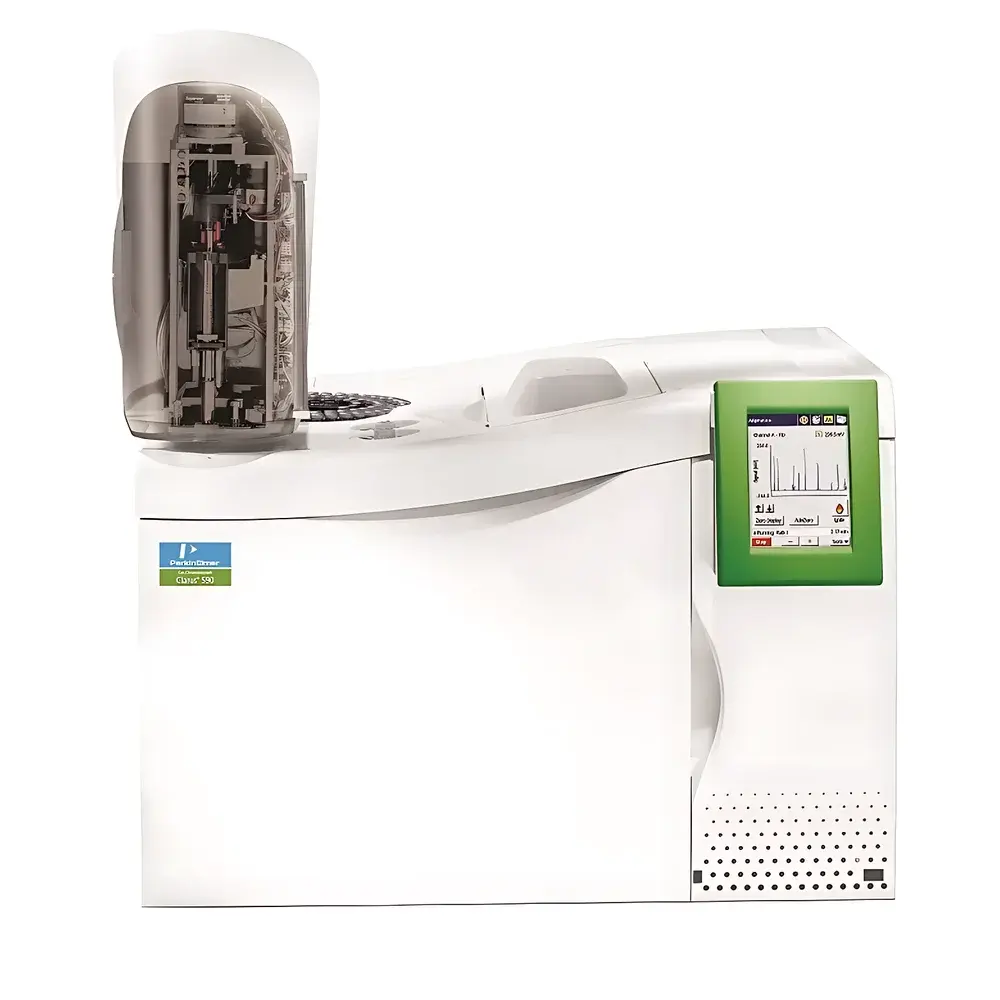
PerkinElmer Clarus 590/690 Gas Chromatograph System
| Brand | PerkinElmer |
|---|---|
| Origin | USA |
| Manufacturer Type | Original Equipment Manufacturer (OEM) |
| Import Category | Imported Instrument |
| Model | Clarus 590 / Clarus 690 |
| Instrument Type | Laboratory Gas Chromatograph |
| Application Scope | Universal (Food, Pharmaceuticals, Petrochemicals, Environmental Analysis) |
| Software Platform | TotalChrom™ Chromatography Data System (CDS) |
| Regulatory Compliance Support | 21 CFR Part 11, GLP/GMP Audit Trail Capabilities |
| Automation Platform | TurboMatrix™ MultiPrep Autosampler (Liquid, Headspace, SPME) |
| Flow Control Technology | Swafer™ Micro-Channel Pneumatic Control |
| Detector Options | FID, TCD, ECD, NPD, FPD, PID |
| Inlet Types | Split/Splitless, PTV, Cold On-Column, Packed Column |
| Column Oven | Patented concentric exhaust design (Clarus 690) |
Overview
The PerkinElmer Clarus 590 and Clarus 690 Gas Chromatograph Systems are engineered for precision, reproducibility, and operational flexibility in regulated and high-throughput laboratory environments. Built upon the proven Clarus platform, these instruments employ conventional capillary gas chromatography with programmable temperature-controlled ovens, electronically controlled pneumatic (EPC) inlet and detector modules, and industry-standard column compatibility (0.1–0.53 mm ID fused-silica capillaries). The systems operate on the fundamental principle of differential partitioning of volatile and semi-volatile analytes between a mobile phase (inert carrier gas—typically helium, hydrogen, or nitrogen) and a stationary phase coated inside a fused-silica column. Separation occurs as compounds elute at characteristic retention times under precisely controlled thermal and flow conditions. Designed for universal application deployment—from residual solvent analysis in pharmaceuticals to hydrocarbon profiling in refinery streams—the Clarus 590/690 platforms integrate hardware robustness with software traceability, enabling compliance-ready operation across ISO/IEC 17025, USP , ASTM D3606/D5186, and EPA Method 8260/8021 workflows.
Key Features
- Ultra-wide linear dynamic range FID (107) with digitally stabilized electrometer, enabling simultaneous quantitation of major and trace components without attenuation or re-injection.
- Swafer™ micro-channel pneumatic control architecture: fully programmable, pressure- and temperature-compensated carrier gas flow regulation; supports column backflush, heart-cutting, and detector switching without manual hardware reconfiguration.
- TurboMatrix™ MultiPrep autosampler: unified platform supporting liquid injection, static/dynamic headspace, and SPME—configurable with optional sample mixing, dilution, derivatization, barcode reading, and needle wash-in-place functionality.
- Patented concentric-exhaust oven (Clarus 690): achieves sub-ambient cooling to ~30 °C without liquid nitrogen or mechanical chillers—critical for VOC retention time stability and method transfer fidelity.
- Multi-language 7-inch capacitive touchscreen interface (English, Spanish, French, German, Italian, Russian, Japanese, Chinese) with real-time dual-channel chromatogram display, one-touch status overview, and automated maintenance logging (e.g., septum replacement alerts).
- High-inertness split/splitless inlet with standardized deactivation protocols and removable liner design—minimizes adsorption and degradation of active compounds (e.g., amines, acids, organometallics).
Sample Compatibility & Compliance
The Clarus 590/690 accommodates diverse sample matrices—including aqueous extracts, organic solvents, polymer leachates, headspace vapors, and solid-phase microextraction fibers—without hardware modification. Inlet temperature range extends to 450 °C; detector operating temperatures support up to 450 °C (FID), 400 °C (TCD), and 350 °C (ECD/NPD). All systems ship with full 21 CFR Part 11-compliant TotalChrom™ CDS, featuring electronic signatures, audit trail logging, role-based access control, and data integrity safeguards per ALCOA+ principles. Method validation packages align with ICH Q2(R2), USP , and ISO/IEC 17025 requirements. Optional Arnel-branded petrochemical application kits include pre-validated methods for simulated distillation (ASTM D2887), refinery gas analysis (ASTM D1945), transformer oil dissolved gas analysis (ASTM D3612), and hydrocarbon group-type analysis (ASTM D5186).
Software & Data Management
TotalChrom™ serves as both instrument control engine and enterprise-grade chromatographic data management system. Its workflow-centric architecture supports method development, sequence execution, peak integration, calibration curve generation, report templating, and electronic batch record (EBR) export. Integrated flow calculator eliminates iterative manual tuning: users input column dimensions and target linear velocity, and the software computes optimal inlet pressure, flow rate, and oven ramp profiles. Audit trails record all user actions—including parameter edits, data reprocessing, and report approvals—with immutable timestamps and operator IDs. Data encryption, automatic backup scheduling, and LDAP/Active Directory integration ensure secure multi-site deployment. For laboratories transitioning from legacy GC platforms, TotalChrom offers seamless import of historical .cdf and .ch files.
Applications
- Pharmaceutical QC: Residual solvent testing (ICH Q3C) using TurboMatrix headspace with automated vial pressurization and equilibration; validated for Class 1–3 solvents in APIs and finished dosage forms.
- Petrochemical analysis: Simulated distillation of crude oils and fractions; hydrocarbon type analysis (PIONA) via dual-column parallel detection; natural gas composition (C1–C6) with TCD/FID dual detection.
- Environmental monitoring: EPA Method 8260D-compliant analysis of volatile organic compounds (VOCs) in soil/water; TO-17 thermal desorption coupling via TurboMatrix TD.
- Food & flavor: Fatty acid methyl ester (FAME) profiling; off-flavor compound screening (e.g., geosmin, 2-methylisoborneol); ethanol quantitation in beverages (AOAC 989.02).
- Materials safety: VOC emission testing from packaging films (ISO 16000-9), adhesives, and automotive interior components using SPME-GC/FID.
FAQ
What distinguishes the Clarus 690 from the Clarus 590?
The Clarus 690 features an enhanced column oven with patented concentric exhaust cooling, achieving faster ramp rates (up to 120 °C/min) and sub-ambient stabilization (~30 °C) without cryogens—optimized for high-sample-volume VOC labs requiring maximum daily throughput.
Is TotalChrom compatible with third-party GC instruments?
No—TotalChrom is licensed exclusively for PerkinElmer GC and GC/MS platforms. It does not support instrument control or data acquisition from non-PerkinElmer hardware.
Can the TurboMatrix MultiPrep perform simultaneous liquid and headspace injections within one sequence?
Yes—via dual-probe configuration and independent syringe control, the MultiPrep executes alternating injection modes without manual intervention or sequence interruption.
Does the Swafer technology require field service for configuration changes?
No—Swafer modules are software-reconfigurable through TotalChrom; flow paths, pressure setpoints, and valve timing are modified via intuitive graphical interface without physical hardware adjustment.
Are inert inlet liners and Ultra Clean™ gas filters included standard or optional?
Deactivated liners and Ultra Clean™ hydrocarbon/oxygen/moisture traps are available as configurable options; baseline configurations include standard quartz liners and standard-grade gas purifiers.
Related Products





