
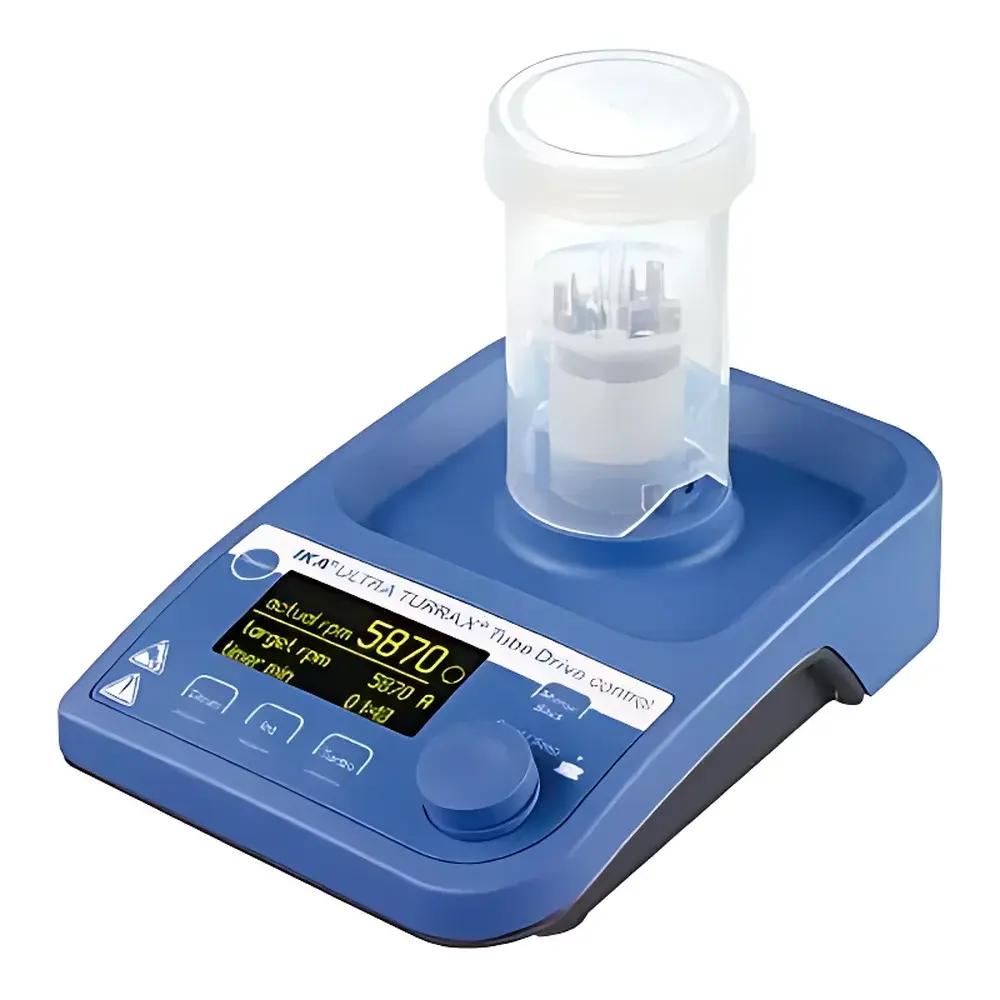
IKA ULTRA-TURRAX UTTD Controlled Tube Homogenizer
| Brand | IKA |
|---|---|
| Origin | Germany |
| Model | ULTRA-TURRAX UTTD |
| Input Power | 20 W |
| Output Power | 17 W |
| Speed Range | 400–8000 rpm |
| Speed Control Resolution | 10 rpm steps |
| Speed Accuracy | ±3% |
| Max. Viscosity | 5000 mPa·s |
| Timer | Yes, OLED-displayed |
| Reversibility | Yes |
| Dimensions | 122 × 54 × 178 mm |
| Weight | 0.9 kg |
| Ambient Temperature Range | 5–40 °C |
| Relative Humidity Limit | 80 % |
| Protection Class | IP20 (DIN EN 60529) |
| Supply Voltage | 100–240 V AC, 50/60 Hz |
| DC Output | 24 V =, 800 mA |
| Noise Level (no dispersing tool) | 50 dB(A) |
| Sample Volume Options | 2–15 mL (small tube), 15–50 mL (large tube) |
| Material | Chemically resistant polymer tubes |
| Sterilization | Gamma-irradiated tubes available |
| Safety | 24 V low-voltage drive, leak-proof collection tray, sealed tube operation, anti-lock protection |
| Connectivity | USB interface for remote control and data logging |
| Display | High-resolution OLED with multilingual menu |
| Programmable protocols | Yes |
| Directional control | Adjustable forward/reverse rotation |
| Instant mode | Turbo button for momentary operation |
| Compliance | Designed for GLP-compliant workflows |
Overview
The IKA ULTRA-TURRAX UTTD Controlled Tube Homogenizer is an engineered solution for high-integrity sample preparation in regulated and research-intensive laboratory environments. Unlike conventional open-beaker homogenizers or vortex mixers, the UTTD operates exclusively within fully sealed, disposable or reusable polymer tubes—eliminating aerosol generation, operator exposure to biohazardous, toxic, or malodorous substances, and cross-contamination between samples. Its core mechanism relies on high-shear rotor-stator dispersion combined with programmable rotational agitation and optional bidirectional motion, enabling simultaneous dispersion, homogenization, emulsification, and fine grinding of suspended solids—all within a single, closed-tube format. The system employs a brushless DC motor delivering consistent torque across its full speed range (400–8000 rpm), with precise digital speed control at 10-rpm increments and real-time feedback via OLED display. With a maximum process viscosity tolerance of 5000 mPa·s and a 24 V DC drive architecture, the UTTD prioritizes both operational safety and mechanical reproducibility—critical attributes for method transfer across QC, clinical diagnostics, and preclinical research settings.
Key Features
- Sealed-tube processing architecture compliant with biosafety level 2 (BSL-2) handling requirements
- Programmable protocol library supporting repeatable, parameter-locked workflows (time, speed, direction, pause intervals)
- OLED interface with multilingual navigation (English, German, French, Spanish, Chinese) and real-time numeric display of all active parameters
- USB interface enabling remote initiation, monitoring, and timestamped data export for traceability
- Dual-volume tube compatibility: standardized 2–15 mL and 15–50 mL chemically resistant polymer tubes, optionally gamma-sterilized and fitted with micro-porous vented caps
- Integrated leak-collection tray preventing fluid ingress into the instrument housing
- Adjustable forward/reverse rotation sequences to optimize particle deagglomeration and suspension stability
- Turbo-mode “boost” button for transient high-shear activation without altering stored protocols
- Low-voltage 24 V DC motor drive—reducing electrical hazard risk and enabling safe use in humid or controlled-access laboratories
- IP20-rated enclosure (DIN EN 60529) suitable for standard laboratory ambient conditions (5–40 °C, ≤80% RH)
Sample Compatibility & Compliance
The UTTD accommodates a broad spectrum of sample matrices—including viscous tissue lysates, fibrous plant extracts, nanoparticle suspensions, microbial cultures, blood-derived fractions, and cosmetic emulsions—without requiring tool cleaning between runs. Tube-based containment ensures full compliance with ISO 15195:2018 (reference measurement laboratories), supports adherence to CLIA and CAP requirements for diagnostic sample integrity, and aligns with FDA 21 CFR Part 11 principles when paired with validated third-party data acquisition software. Gamma-irradiated, DNase/RNase-free tubes meet stringent demands in molecular biology and translational oncology applications. The absence of shared wetted parts between samples eliminates carryover risk—making the UTTD particularly suited for high-throughput screening in immunology, toxicology, and pharmaceutical formulation development where inter-sample contamination must be excluded by design.
Software & Data Management
While the UTTD operates as a standalone instrument, its native USB interface allows integration into laboratory information management systems (LIMS) or electronic lab notebooks (ELN) via standard CDC ACM serial emulation. Timestamped logs capture start/stop times, actual vs. setpoint speed, total runtime, and directional sequence events—enabling retrospective verification of execution fidelity. When deployed in GxP-regulated environments, users may implement supplementary validation packages to satisfy ALCOA+ data integrity criteria (Attributable, Legible, Contemporaneous, Original, Accurate, Complete, Consistent, Enduring, Available). Firmware updates are delivered via IKA’s secure portal, with version history and change logs maintained per ISO/IEC 17025:2017 clause 7.7.2.
Applications
- Clinical microbiology: Homogenization of sputum, stool, and wound swab specimens prior to culture or NAAT analysis
- Pharmaceutical R&D: Preparation of uniform nanoparticle dispersions for IV formulation studies
- Food safety testing: Rapid release of pathogens from solid food matrices (e.g., meat, cheese, produce)
- Tumor biology: Mechanical dissociation of fresh-frozen tumor biopsies into single-cell suspensions for flow cytometry
- Immunodiagnostics: Consistent lysis of whole blood or PBMCs while preserving surface antigen integrity
- Cosmetic stability testing: Emulsion breakdown assessment under controlled shear profiles
- Toxicology: Extraction of lipophilic compounds from adipose tissue homogenates
- Veterinary pathology: Standardized processing of avian or porcine tissue samples under BSL-2 containment
FAQ
Can the UTTD be used for RNA extraction protocols without degradation?
Yes—when operated below 6000 rpm with chilled tubes and appropriate lysis buffers, the UTTD delivers rapid, reproducible homogenization while minimizing thermal and mechanical RNA shearing.
Is calibration required before first use?
No routine user calibration is needed; speed accuracy (±3%) and timer precision are factory-verified and documented in the Certificate of Conformance supplied with each unit.
Are replacement tubes supplied sterile?
Sterile, gamma-irradiated tubes are available as catalog items (e.g., IKA order no. 0030260100); non-sterile versions require autoclaving or chemical sterilization prior to aseptic applications.
Does the UTTD support continuous operation modes?
No—it is designed exclusively for batch processing; all protocols execute as discrete timed cycles with audible and visual completion indicators.
Can it interface with LIMS using HL7 or ASTM E1384 standards?
Native support is limited to ASCII-based serial communication; HL7/ASTM integration requires middleware configuration through qualified IT validation partners.



