
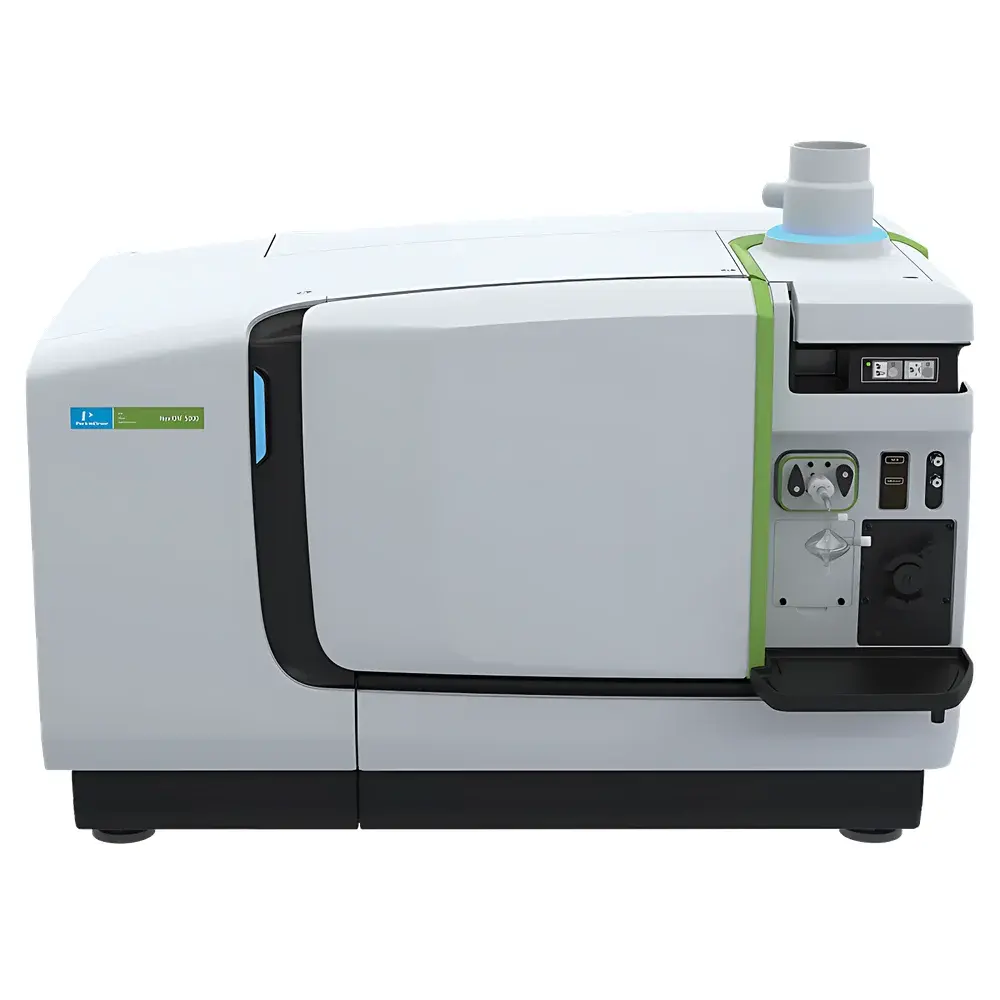
PerkinElmer NexION 5000 Multi-Quadrupole ICP-MS
| Brand | PerkinElmer |
|---|---|
| Origin | Singapore |
| Manufacturer Type | Original Equipment Manufacturer (OEM) |
| Import Status | Imported |
| Model | NexION 5000 |
| Instrument Type | Quadrupole-based ICP-MS |
| Application Environment | Laboratory |
Overview
The PerkinElmer NexION 5000 is the world’s first commercially available multi-quadrupole inductively coupled plasma mass spectrometer (ICP-MS), engineered to address persistent polyatomic and isobaric interferences that limit sensitivity, accuracy, and reliability in ultra-trace elemental analysis. Unlike conventional triple-quadrupole (QQQ) ICP-MS systems—comprising two mass-filtering quadrupoles flanking a reaction/collision cell—the NexION 5000 integrates four independently operated quadrupole stages: Q0 (Quadrupole Ion Deflector), Q1 (First Mass Analyzer), Q2 (Universal Cell Quadrupole), and Q3 (Second Mass Analyzer). This architecture enables true tandem-in-space mass filtering with sequential mass selection before, within, and after the reaction zone—effectively decoupling ion transmission, reaction control, and final mass discrimination. The system operates on the fundamental principle of coupling high-temperature argon plasma ionization (≥7,000 K) with multi-stage quadrupole mass separation under ultra-high vacuum (<1 × 10⁻⁸ Torr), delivering sub-part-per-quadrillion (sub-fg g⁻¹) detection limits and background-equivalent concentrations (BECs) improved by up to two orders of magnitude over legacy triple-quadrupole platforms.
Key Features
- Four-stage quadrupole architecture: Q0 provides energy-dependent ion deflection and neutral/photon rejection via 90° electrostatic bending; Q1 delivers unit-mass or higher resolution (<0.3 amu full width at half maximum) with extended pre-quadrupole for enhanced high-energy ion focusing;
- Q2 — the industry-exclusive Universal Cell Technology — is a fully tunable quadrupole-based reaction cell capable of dynamic mass-bandwidth adjustment, axial field control, and gas-agnostic operation (He, H₂, O₂, NH₃, CH₄, etc.), enabling selective reaction pathways while suppressing secondary reactions;
- Q3 provides final mass analysis with identical resolution performance to Q1, ensuring consistent mass fidelity across the entire analytical sequence;
- Second-generation Triple Cone Interface (TCI) with OmniRing™ technology combined with Q0 ensures long-term signal stability (>48 h continuous operation without recalibration);
- LumiCoil™ RF generator employs air-cooled, solid-state radiofrequency technology—eliminating water cooling requirements, maintenance cycles, and coil replacement;
- SEMI S2/S8 compliance-ready configuration supports integration into semiconductor cleanroom environments, including emergency stop circuitry and ESD-safe housing.
Sample Compatibility & Compliance
The NexION 5000 accepts liquid samples introduced via standard nebulizers (e.g., PFA microflow, Apex Q) or laser ablation systems (e.g., UP213, NWR213), supporting direct analysis of aqueous standards, digested geological matrices, organic solvents (naphtha, gasoline, salad oil), and high-purity reagents (e.g., HNO₃, HCl, HF at 10 ppt metal impurity levels). It complies with ISO/IEC 17025:2017 for testing laboratories, supports audit-ready data integrity per FDA 21 CFR Part 11 (electronic signatures, audit trails, user access controls), and meets GLP/GMP documentation requirements for regulated pharmaceutical and semiconductor material certification workflows. Method validation aligns with ASTM D5600 (trace metals in fuels), USP / (elemental impurities in pharmaceuticals), and ISO 17294-2 (water quality—determination of elements by ICP-MS).
Software & Data Management
Syngistix™ for ICP-MS software provides integrated method development, real-time interference correction mapping, kinetic energy discrimination (KED) and reaction mode optimization, isotope ratio calculation (e.g., ⁸⁷Rb/⁸⁷Sr, ²³⁸U/²³⁸Pu), and automated drift correction using internal standards (e.g., ¹¹⁵In, ²⁰³Tl). All raw and processed data are stored in vendor-neutral .raw format compliant with ASTM E1381 and E1489 standards. Audit trail logs record every parameter change, calibration event, and user action with timestamp, operator ID, and reason-for-change metadata—fully traceable for regulatory inspections.
Applications
- Ultra-trace impurity profiling in high-purity metals (Au, Ag, Cu, Sn, REEs) at ≤10 ppt levels;
- Seawater analysis for trace elements (e.g., Fe, Co, Ni, Cd, Pb) at sub-ppt (≤0.1 ng L⁻¹) concentrations;
- Direct analysis of S, P, Cl in hydrocarbons and polar organics without derivatization or matrix removal;
- Isotopic ratio measurements for geochronology and nuclear forensics with precision ≤0.05% RSD (n = 10);
- High-throughput screening of catalysts, battery materials, and electronic-grade precursors for transition metal contaminants;
- Regulatory compliance testing of excipients and active pharmaceutical ingredients per ICH Q3D guidelines.
FAQ
How does the four-quadrupole design improve interference removal compared to triple-quadrupole ICP-MS?
The independent mass filtering at Q0, Q1, and Q3—combined with mass-resolved reaction control in Q2—enables orthogonal elimination of isobaric overlaps (e.g., ⁴⁰Ar³⁵Cl⁺ on ⁷⁵As⁺) and polyatomic species (e.g., ⁴⁰Ca⁴⁰Ar⁺ on ⁸⁰Se⁺) that cannot be resolved by single-cell or dual-quadrupole architectures.
Can the NexION 5000 operate without external water cooling?
Yes—the LumiCoil™ RF generator is entirely air-cooled and requires no chiller, deionized water loop, or periodic coil replacement, reducing total cost of ownership and footprint.
Is the system compatible with laser ablation sample introduction?
Yes—fully supported via Syngistix LA module with time-resolved acquisition, depth profiling, and spatially resolved quantification using certified NIST glass standards.
Does the instrument support 21 CFR Part 11 compliance out-of-the-box?
Yes—when deployed with Syngistix Enterprise Edition and configured with role-based user accounts, electronic signatures, and immutable audit trails.
What is the typical mass resolution achievable across all quadrupoles?
All mass-analyzing quadrupoles (Q1 and Q3) deliver ≤0.3 amu resolution at 10% peak height, configurable for unit-mass or high-resolution modes depending on application requirements.



