
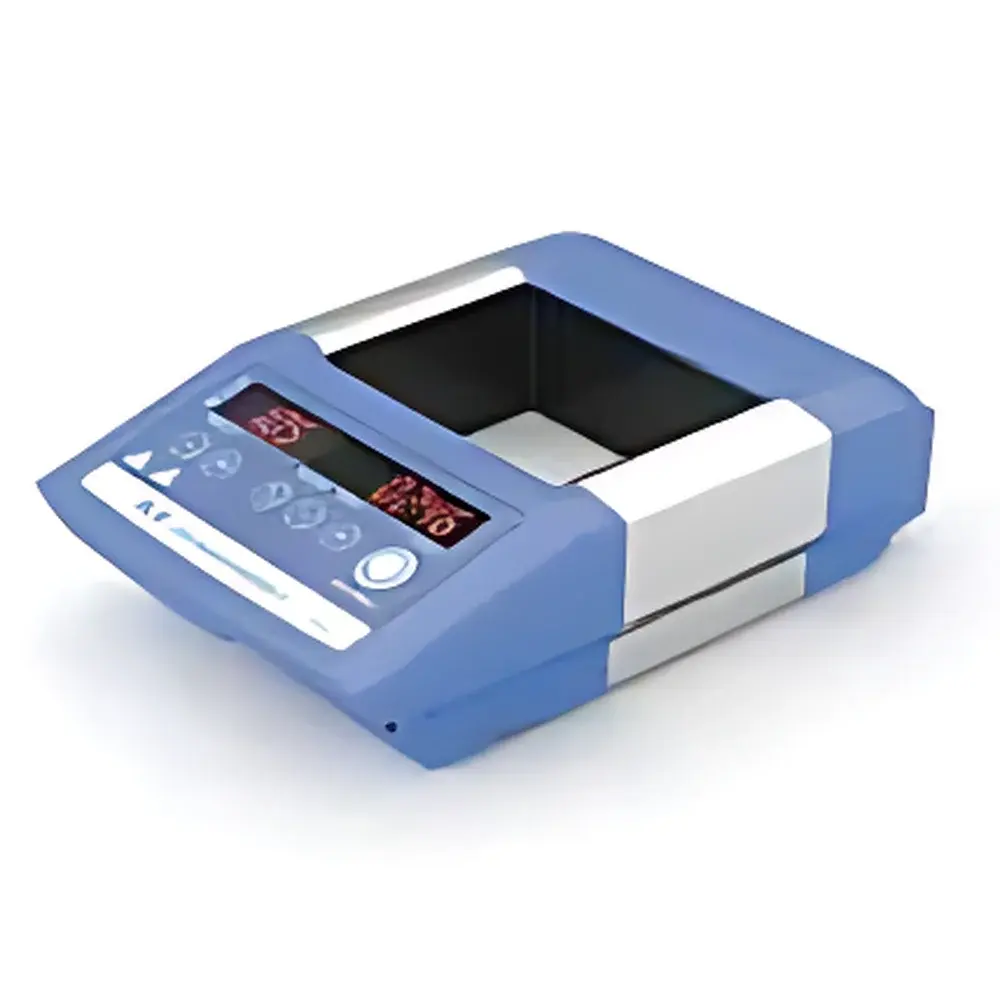
IKA Dry Block Heater 1 Metal Bath
| Brand | IKA |
|---|---|
| Origin | Germany |
| Model | Dry Block Heater 1 |
| Heating Blocks | 1 |
| Heating Power | 165 W |
| Temperature Range | Ambient +5 °C to 120 °C |
| Temperature Stability (37 °C) | ±0.2 K |
| Temperature Stability (60 °C) | ±0.2 K |
| Temperature Resolution | 0.1 K |
| Heating Rate | Up to 5 K/min |
| Block Dimensions | 96 × 76 mm |
| Housing Material | Aluminum Alloy |
| Safety Cut-off | 150 °C |
| Timer Range | 1 s – 99 h 59 min |
| Display | Digital LED |
| External Sensor Interface | DIN 12878 (PT-1000 compatible) |
| Accuracy (DIN 12878) | ≤ ±(0.15 + 0.002× |
| Protection Rating | IP21 |
| Operating Ambient | 5–40 °C, ≤80% RH |
| Input Voltage | 220–240 V / 115 V, 50/60 Hz |
| Power Consumption | 165 W |
| Net Weight | 1 kg |
| Overall Dimensions | 151 × 73 × 228 mm |
| Compliance | DIN EN 60529, DIN 12878 |
Overview
The IKA Dry Block Heater 1 is a precision-engineered metal bath designed for stable, reproducible thermal control of small-volume samples in life science, clinical diagnostics, and analytical laboratories. Operating on the principle of conductive heat transfer via a solid aluminum heating block, it eliminates reliance on liquid media—thereby minimizing contamination risk, evaporation loss, and maintenance overhead. Unlike water baths or air ovens, this dry block system delivers rapid thermal equilibration and high spatial uniformity across the block surface, making it especially suitable for temperature-sensitive protocols such as enzymatic assays, nucleic acid denaturation, immunoassay incubation, and endpoint thermal characterization (e.g., melting point or coagulation testing). Its compact footprint, single-block architecture, and integrated PT-1000 sensor interface enable direct sample-in-tube temperature monitoring—ensuring that displayed setpoints reflect actual sample thermal conditions rather than ambient block surface readings.
Key Features
- Precision temperature control from ambient +5 °C to 120 °C with stability of ±0.2 K at both 37 °C and 60 °C—validated per DIN 12878 calibration requirements.
- Digital LED display with 0.1 K resolution and real-time feedback of current temperature, setpoint, elapsed time, and countdown timer status.
- Integrated DIN 12878-compliant external probe port supporting PT-1000 sensors for direct intra-vessel temperature measurement—critical for assay validity in GLP/GMP-regulated environments.
- Programmable timer with dual functionality: countdown mode (1 second to 99 hours 59 minutes) and elapsed time logging—enabling unattended operation and traceable process documentation.
- Fixed safety cut-off at 150 °C prevents thermal runaway; audible end-of-cycle alert ensures operator awareness without visual monitoring.
- Aluminum alloy heating block (96 × 76 mm) offers excellent thermal conductivity and corrosion resistance; compatible with interchangeable blocks for PCR tubes (0.2–2.0 mL), microplates (96-well), cuvettes, and Greiner tubes.
- Robust electrical design compliant with DIN EN 60529 (IP21 ingress protection), rated for continuous use under standard laboratory conditions (5–40 °C, ≤80% RH).
Sample Compatibility & Compliance
The Dry Block Heater 1 accommodates standardized labware including 0.2 mL and 0.5 mL PCR tubes, 96-well microplates, 1–10 mL test tubes, and optical cuvettes—without requiring custom adapters. Its thermal uniformity profile supports applications governed by ISO 15197 (in vitro diagnostic devices), USP (sterile compounding), and CLSI EP10-A3 (evaluation of qualitative test methods). While not FDA 21 CFR Part 11–certified out-of-the-box, its deterministic timer logic, non-volatile parameter retention, and error-code logging (e.g., E1 = sensor fault, E2 = overtemperature) support audit-ready workflows when integrated into validated SOPs. All specifications adhere to European harmonized standards for laboratory equipment safety and electromagnetic compatibility (EN 61326-1).
Software & Data Management
This model operates as a standalone instrument with no embedded firmware-based data export capability (no USB or RS232 interface). However, its deterministic timer and digital display facilitate manual entry into electronic lab notebooks (ELNs) or LIMS systems. For regulated environments, users may implement external validation protocols—including periodic calibration against NIST-traceable reference thermometers—and document temperature stability profiles per ASTM E2251-22 (Standard Practice for Calibration of Thermometers). The absence of network connectivity aligns with security-conscious lab infrastructure policies where air-gapped instrumentation is mandated.
Applications
- Thermal activation of restriction enzymes and ligases in molecular cloning workflows.
- Controlled DNA denaturation and annealing steps in PCR setup and hybridization protocols.
- Incubation of cell cultures during transfection or viability assays requiring precise sub-physiological temperatures.
- Standardized coagulation time measurements (e.g., prothrombin time, fibrinogen assays) per CLSI H21-A5 guidelines.
- Urea nitrogen quantification (BUN) via enzymatic colorimetry requiring strict 37 °C incubation.
- Validation of thermal stability thresholds for monoclonal antibodies and recombinant proteins.
- In situ hybridization (ISH) pre-treatment steps involving controlled denaturation of tissue sections.
FAQ
Does the Dry Block Heater 1 support external data logging?
No—this model lacks USB, RS232, or analog output interfaces. Temperature and timer data must be recorded manually or via external thermal data loggers connected to the PT-1000 input.
Can I use third-party heating blocks with this unit?
Only IKA-certified blocks with DIN 12878 mechanical and thermal interface compliance are supported. Non-OEM blocks may compromise temperature uniformity and void warranty.
What is the recommended recalibration interval?
Per ISO/IEC 17025, annual verification against a certified reference thermometer is advised; more frequent checks are required if used in GxP environments or following mechanical shock.
Is the device suitable for overnight incubations?
Yes—the timer supports up to 99 h 59 min, and the fixed safety circuit ensures fail-safe shutdown regardless of duration.
How does the PT-1000 sensor improve accuracy versus block-surface sensing?
It measures temperature directly inside the sample vessel, compensating for thermal lag and gradient effects inherent in conductive heating—essential for kinetic assays where ±0.3 K deviation alters reaction rates significantly.



