
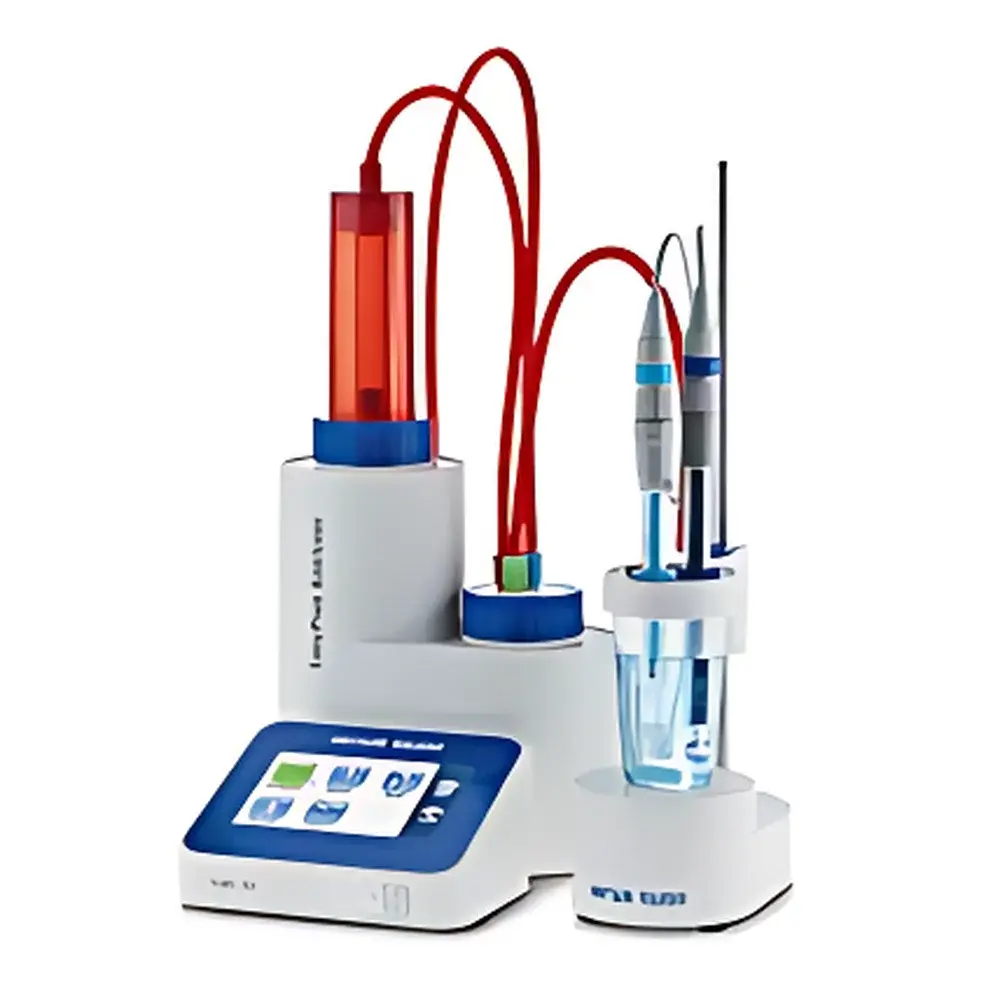
METTLER TOLEDO Easy Na Sodium Analyzer
| Brand | METTLER TOLEDO |
|---|---|
| Origin | Switzerland |
| Model | Easy Na |
| Measurement Principle | Potentiometric Standard Addition Method (Sodium-Selective Electrode, Non-Calibration Required) |
| Compliance | Designed for GB 28050–2011 nutritional labeling requirements |
| Software Integration | EasyDirect™ Data Acquisition Software |
| Reagent System | NaCl-based ISA (no AgNO₃ required) |
| Target Matrix | Food & Beverage samples (liquid, homogenized, or acid-digested) |
Overview
The METTLER TOLEDO Easy Na Sodium Analyzer is a dedicated potentiometric instrument engineered for rapid, reliable quantification of sodium ion (Na⁺) concentration in food and beverage matrices. Unlike chloride-based indirect methods—such as argentometric titration, which infer sodium content from Cl⁻ and introduce error in the presence of non-NaCl chlorides—the Easy Na directly measures Na⁺ activity using a solid-state sodium-selective electrode. It employs the standard addition method (SAM), eliminating the need for electrode calibration, slope verification, or daily standardization. This approach ensures traceable accuracy across variable sample ionic strengths without reliance on external calibration curves. The system is purpose-built to support regulatory compliance with nutritional labeling standards, including China’s GB 28050–2011, and aligns with international best practices for ion-selective measurement under ISO 11292 (food analysis—determination of sodium) and AOAC Official Method 984.27 (sodium in foods). Its compact benchtop architecture requires no fume hood, dedicated plumbing, or high-voltage infrastructure—making it deployable in QC labs, R&D kitchens, and contract testing facilities alike.
Key Features
- Direct Na⁺ quantification via potentiometric standard addition—no electrode calibration, no drift correction, no slope monitoring
- Eliminates interference from non-sodium chlorides (e.g., KCl, CaCl₂), avoiding systematic overestimation common in AgNO₃ titration
- Reagent economy: replaces costly, light-sensitive silver nitrate (AgNO₃) with stable, low-hazard sodium chloride (NaCl) standard solution and proprietary ionic strength adjuster (ISA)
- Built-in algorithm automatically calculates concentration from ≥3 standard additions, applying robust linear regression and detection limit estimation per IUPAC guidelines
- Integrated temperature compensation (±0.1 °C resolution) and automatic sample volume recognition via pre-programmed vial geometry
- Self-diagnostics for electrode response stability, liquid junction potential deviation, and ISA depletion alerts
Sample Compatibility & Compliance
The Easy Na accepts aqueous extracts, homogenized slurries, acid-digested preparations, and clarified beverages—provided total suspended solids < 5 g/L and pH is maintained between 4.0 and 10.5 using optional buffer adjustment. It has been validated per AOAC 984.27 for dairy products, canned vegetables, sauces, infant formula, and ready-to-eat meals. All measurements meet GLP data integrity requirements: each result includes timestamp, operator ID, sample ID, electrode serial number, ambient temperature, ISA lot number, and full standard addition curve metadata. Audit trails are immutable and exportable in CSV/Excel format, satisfying FDA 21 CFR Part 11 electronic record requirements when used with validated EasyDirect™ software configuration.
Software & Data Management
EasyDirect™ software provides full lifecycle data governance: automated acquisition, secure storage, configurable reporting templates, and role-based access control. Upon connection, the analyzer initiates background logging—even if the software GUI is closed—ensuring zero data loss during high-throughput operation. Users may export raw potential values (mV), calculated concentrations (mg Na/100 g or mg Na/100 mL), confidence intervals (95%), and residual plots. Advanced functions include batch statistical summaries (mean, SD, CV%, recovery %), trend charting across production lots, and integration with LIMS via ASTM E1384-compliant XML export. All reports carry digital signatures and comply with ISO/IEC 17025 clause 7.8.2 on result reporting.
Applications
- Nutritional labeling verification for prepackaged foods per GB 28050–2011, EU Regulation (EC) No 1169/2011, and FDA 21 CFR 101.9
- Process control in salt-reduction initiatives—monitoring reformulated soups, snacks, bread, and meat products
- Raw material screening of cheese brines, soy sauce, fish sauce, and vegetable purees
- QC release testing of dietary supplements and electrolyte beverages
- Method transfer validation against reference techniques (IC, AAS, ICP-OES) in multi-lab studies
FAQ
Does the Easy Na require daily electrode calibration?
No. It operates exclusively on the standard addition method and does not use calibration curves or fixed-slope assumptions.
Can it measure sodium in high-fat or viscous samples like peanut butter or margarine?
Yes—after appropriate solvent extraction (e.g., hot water + ultrasonication) and centrifugation/filtration to remove particulates and emulsified lipids.
Is EasyDirect™ software compliant with 21 CFR Part 11?
Yes—when deployed with enabled audit trail, electronic signatures, and system validation documentation per METTLER TOLEDO’s IQ/OQ/PQ protocols.
What is the typical measurement time per sample?
Under routine conditions (3-point standard addition), analysis completes in ≤90 seconds—including electrode immersion, equilibration, and calculation.
How does it handle matrix effects from phosphates or carbonates?
The ISA formulation suppresses activity coefficient variation; the SAM algorithm inherently corrects for unknown background interference, provided the added standards induce ≥10 mV potential shift.






