
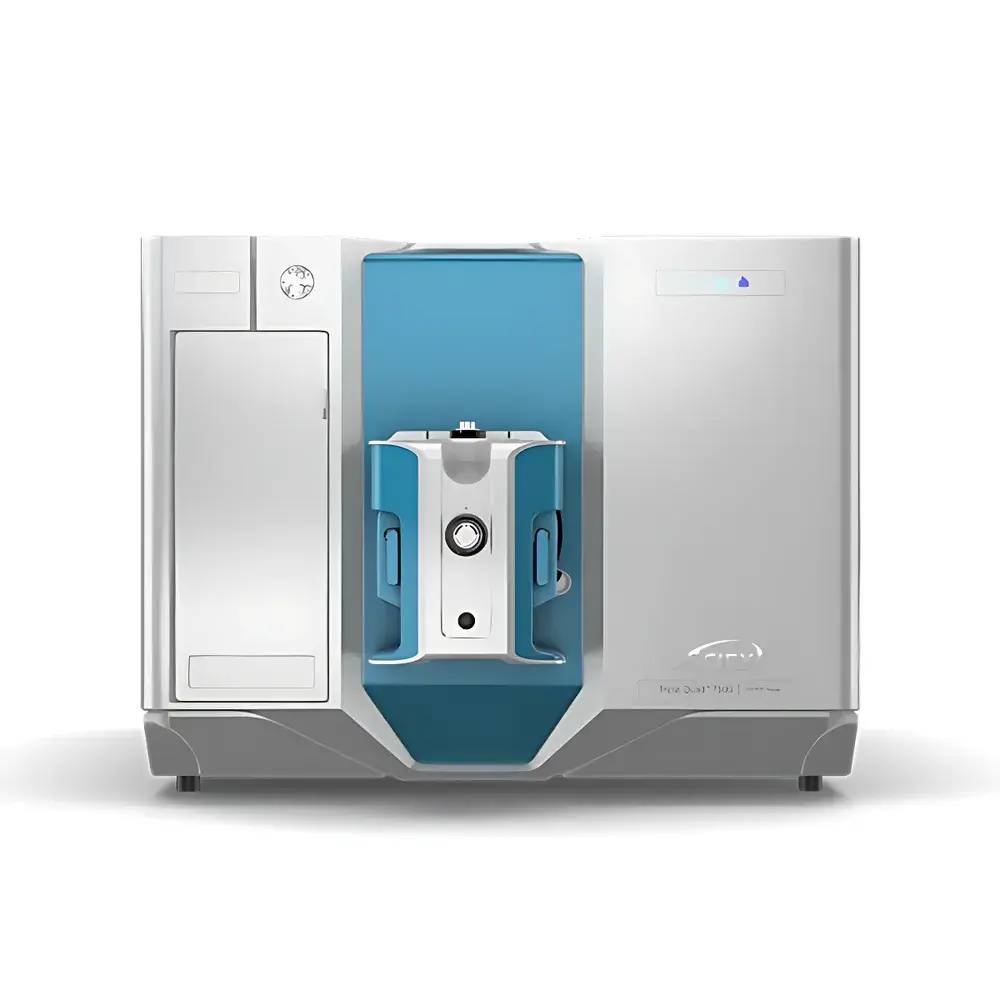
SCIEX Triple Quad™ 7500 LC-MS/MS System – QTRAP® Ready
| Brand | SCIEX |
|---|---|
| Origin | USA |
| Model | SCIEX 7500 |
| Instrument Type | Rapid Liquid Chromatography–Tandem Mass Spectrometry (LC-MS/MS) |
| Configuration | Triple Quadrupole with QTRAP®-Ready Architecture |
| Flow Rate Compatibility | 1 µL/min to 3 mL/min |
| Polarity Switching Speed | ≤5 ms |
| Dynamic Range | 6 decades (linear) |
| Software Platform | SCIEX OS |
| Regulatory Compliance | Designed for GLP/GMP environments |
Overview
The SCIEX Triple Quad™ 7500 LC-MS/MS System – QTRAP® Ready is a high-performance liquid chromatography–tandem mass spectrometry platform engineered for ultra-sensitive, robust, and reproducible quantitative analysis in regulated and research laboratories. Built upon a triple quadrupole architecture enhanced with QTRAP® hybrid functionality, it combines the precision and linear dynamic range of MRM (Multiple Reaction Monitoring) quantification with the qualitative power of linear ion trap scanning—all within a single acquisition cycle. Its core measurement principle relies on electrospray ionization (ESI), quadrupole mass filtering, collision-induced dissociation (CID) in a pressurized RF-only collision cell, and subsequent mass analysis using either the third quadrupole (for MS/MS) or the linear ion trap (for MS³, EPI, ER, and full-scan modes). This dual-mode capability enables trace-level quantitation down to low attomole levels while simultaneously acquiring structural confirmation data—eliminating the need for method re-injection or instrument reconfiguration.
Key Features
- OptiFlow™ Pro Ion Source: A pressure- and geometry-optimized ESI interface supporting seamless operation across flow rates from 1 µL/min (nano-LC) to 3 mL/min (conventional HPLC), without mechanical realignment of spray needle or probe position.
- E Lens™ Technology: An electrodynamic lens assembly that improves ion transmission efficiency across wide flow regimes, delivering up to 10× higher sensitivity compared to conventional ESI sources at microflow conditions.
- D Jet™ Ion Guide: A dual-stage RF-driven ion funnel that increases ion capture efficiency while maintaining robustness against matrix effects and source contamination—critical for high-throughput bioanalytical and environmental applications.
- QTRAP®-Ready Architecture: Hardware-enabled compatibility with linear ion trap scanning modes—including Enhanced Product Ion (EPI), MRM³, Enhanced Resolution (ER), and Information-Dependent Acquisition (IDA)—without sacrificing MRM sensitivity or duty cycle.
- High-Energy Detector System: Enables polarity switching in ≤5 ms with stable gain response across six orders of magnitude, ensuring accurate quantitation of co-eluting analytes with opposite ionization efficiencies.
- SCIEX OS Software Platform: A unified, workflow-centric software environment supporting method development, acquisition control, processing, reporting, and data archival. Fully compliant with 21 CFR Part 11 requirements, including role-based access control, electronic signatures, and immutable audit trails.
Sample Compatibility & Compliance
The SCIEX 7500 system accommodates diverse sample matrices—including plasma, serum, urine, tissue homogenates, food extracts, environmental water, and pharmaceutical formulations—across regulated and discovery workflows. It meets the instrumental performance criteria outlined in ASTM D7894, ISO/IEC 17025, and USP for LC-MS method validation. The system is routinely deployed in laboratories adhering to GLP (Good Laboratory Practice) and GMP (Good Manufacturing Practice) standards. While not registered as a medical device in China, it complies with IEC 61010-1 safety standards and electromagnetic compatibility (EMC) directives (CE marking). All firmware and software updates are validated per internal change control procedures aligned with FDA guidance on computerized systems used in regulated environments.
Software & Data Management
SCIEX OS serves as the central hub for end-to-end data lifecycle management. It integrates seamlessly with laboratory information management systems (LIMS) via standard APIs and supports vendor-neutral data formats (e.g., mzML, .wiff). Method templates can be locked, version-controlled, and exported for cross-laboratory harmonization. Processing algorithms include peak integration with adaptive baseline correction, isotopic pattern deconvolution, and automated calibration curve fitting with weighting options (e.g., 1/x, 1/x²). Raw data files are stored with embedded metadata—including instrument configuration, sequence logs, and user actions—ensuring full traceability. Audit trail records are tamper-evident and exportable in PDF/A format for regulatory submissions.
Applications
This system is extensively applied in pharmacokinetic/pharmacodynamic (PK/PD) studies, clinical toxicology screening, residue analysis in agriculture and food safety, environmental contaminant monitoring (e.g., PFAS, pesticides, pharmaceuticals in wastewater), and biomarker verification in translational research. Its ability to perform simultaneous quantitative and qualitative analysis makes it particularly valuable in forensic toxicology (e.g., detecting novel psychoactive substances), anti-doping laboratories (WADA-compliant workflows), and biopharmaceutical characterization (e.g., ADC payload quantitation). The MRM³ mode provides orthogonal selectivity for complex biological matrices where isobaric interferences compromise conventional MRM specificity.
FAQ
Is the SCIEX 7500 compatible with existing SCIEX software licenses?
Yes—SCIEX OS replaces Analyst™ software and supports migration of legacy methods and libraries through built-in import utilities.
Can the system operate under GxP-compliant data integrity requirements?
Yes—SCIEX OS includes configurable audit trail, electronic signature enforcement, and user permission tiers validated per 21 CFR Part 11 Annex 11 guidelines.
What maintenance intervals are recommended for optimal performance?
Source cleaning is advised every 2–4 weeks depending on sample load; vacuum system inspection every 6 months; and annual preventive maintenance by certified SCIEX Field Service Engineers.
Does QTRAP® functionality require additional hardware beyond the base 7500 configuration?
No—the QTRAP®-Ready designation indicates factory-installed hardware enabling trap-based scanning; only software activation and licensing are required.
How does the 7500 compare to previous-generation SCIEX triple quads in terms of dwell time flexibility?
It supports sub-10-ms dwell times across >1,000 transitions per second, enabling high-multiplexed assays without compromising cycle time or sensitivity.






