
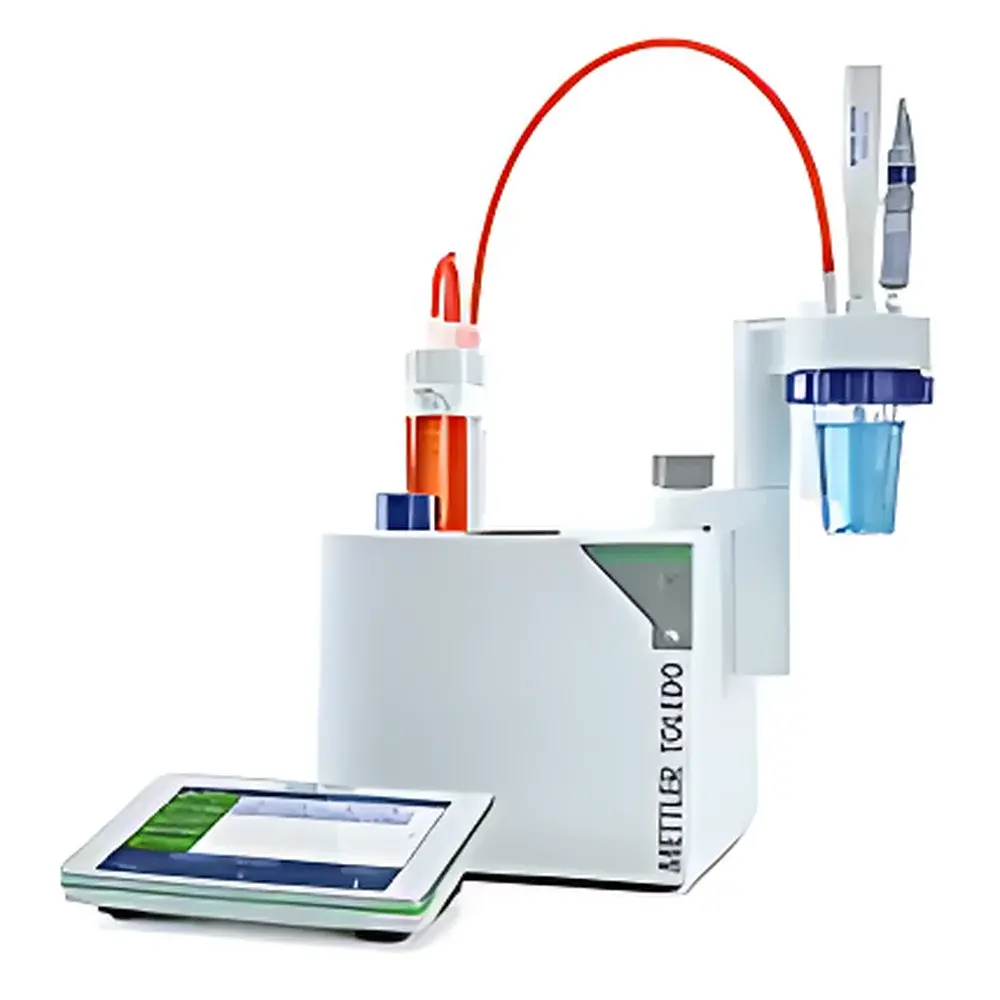
METTLER TOLEDO T5 Excellence Series Automatic Potentiometric Titrator
| Brand | METTLER TOLEDO |
|---|---|
| Origin | Switzerland |
| Model | T5 |
| Instrument Type | General-purpose Automatic Potentiometric Titrator |
| Measurement Range | −2000 to +2000 mV |
| Meter Accuracy | ±0.2 mV |
| Meter Resolution | 0.01 mV |
| Electrode & Burette Auto-Recognition | Yes |
| SmartSample™ Integration | Yes |
| GLP-Compliant Reporting | Yes |
| Language Support | English, German, French, Spanish, Italian, Russian, Polish, Korean, Portuguese, Chinese |
| USB/RS-232 Connectivity | Yes |
| Barcode Reader Compatibility | Yes |
| Built-in StatusLight™ Indicator | Yes |
| Touchscreen Control Terminal | High-resolution, multi-angle adjustable, cable-connected |
Overview
The METTLER TOLEDO T5 Excellence Series Automatic Potentiometric Titrator is a precision-engineered electrochemical analysis platform designed for laboratories requiring robust, reproducible, and compliant titration workflows. Based on potentiometric endpoint detection—measuring the potential difference between a reference and indicator electrode as titrant is added—the T5 delivers high-fidelity data across acid-base, redox, complexometric, non-aqueous, precipitation, and coulometric Karl Fischer titrations. Its architecture integrates electrochemical measurement principles with digital control logic, enabling accurate stoichiometric determination of analytes in diverse matrices—from pharmaceutical actives and polymer additives to food acids and environmental water samples. The system operates under thermodynamically stable conditions, ensuring Nernstian response fidelity and minimizing drift during extended analyses.
Key Features
- StatusLight™ Visual Feedback System: A color-coded LED ring integrated into the touchscreen terminal provides real-time status indication (e.g., ready, running, error, maintenance required), improving operational transparency without requiring screen interaction.
- Modular Touchscreen Control Terminal: A high-resolution, glare-resistant capacitive touchscreen mounted on an adjustable articulating arm enables ergonomic positioning at any workstation height or angle—reducing operator fatigue during prolonged use.
- Plug-and-Play Electrode & Burette Recognition: Each electrode and burette contains an embedded RFID chip storing calibration history, serial number, nominal concentration, and expiry date. The T5 automatically reads and validates this information upon connection, preventing misconfiguration and enforcing traceability.
- SmartSample™ Sample Management: Integrated RFID reader identifies sample vials equipped with SmartChip tags, capturing sample ID, weight (via wireless balance integration), preparation date, and analyst ID—eliminating manual transcription errors and supporting full chain-of-custody documentation.
- Dual-Driver Architecture: One built-in burette drive plus three external drive slots (two configured for waste handling) support flexible method sequencing and simultaneous reagent dispensing in multi-step protocols.
- GLP-Compliant Audit Trail: All user actions—including method execution, parameter changes, calibration events, and result approvals—are timestamped, user-logged, and stored in an immutable audit trail compliant with FDA 21 CFR Part 11 requirements when paired with appropriate system configuration and electronic signature policies.
Sample Compatibility & Compliance
The T5 accommodates a broad range of sample types and volumes, including aqueous solutions, organic solvents, suspensions, and viscous liquids, using standard 50–250 mL titration vessels. It supports electrodes compatible with ISO 8655 (burettes), ASTM E2087 (pH and redox electrodes), and USP (titration validation). The instrument meets IEC 61010-1 safety standards and carries CE marking for EMC and low-voltage directive compliance. Its firmware architecture allows configuration for GMP/GLP environments, including password-protected user roles (administrator, analyst, reviewer), method locking, and electronic signature enforcement per regulatory expectations.
Software & Data Management
The T5 runs METTLER TOLEDO’s dedicated titration software, which includes pre-validated application packages for common assays (e.g., total acidity in wine, chloride in wastewater, water content via Karl Fischer). Methods are structured using a task-list paradigm—up to 10 discrete steps per method—with conditional branching based on intermediate results. Data export is supported in CSV, PDF, and XML formats; raw measurement logs include mV vs. volume, first/second derivative curves, and equivalence point calculations. USB host ports enable direct printing to PCL-compatible printers or connection to barcode scanners for automated sample registration. All method files and reports are digitally signed and encrypted to preserve integrity during transfer or archival.
Applications
The T5 serves as a primary analytical tool in quality control laboratories across pharmaceuticals (USP , EP 2.2.20), food & beverage (AOAC 960.12, ISO 9297), chemicals (ASTM D664, D2896), and environmental testing (EPA 167.1). Typical applications include: determination of free fatty acids in oils, assay of sodium thiosulfate in disinfectant formulations, quantification of chloride in concrete admixtures, moisture content in hygroscopic APIs via volumetric Karl Fischer, and redox titration of iron in ore extracts. Its flexibility extends to research settings where custom endpoint algorithms (e.g., inflection point, fixed potential, or derivative threshold) can be defined and validated.
FAQ
Does the T5 support both volumetric and coulometric Karl Fischer titration?
Yes—the T5 is compatible with V20S volumetric Karl Fischer modules and C20S coulometric modules via standardized interface protocols, enabling seamless method migration and shared data management.
Can the T5 be integrated into a LIMS environment?
Yes—through its RS-232 and USB virtual COM port interfaces, the T5 supports bidirectional communication with LIMS systems using ASTM E1384 or HL7-compliant middleware configurations.
Is method validation documentation available?
METTLER TOLEDO provides IQ/OQ documentation templates and risk-based validation guides aligned with ICH Q2(R2) and ISO/IEC 17025 requirements, intended for laboratory-specific PQ execution.
What security measures protect method integrity?
Methods can be locked, digitally signed, and assigned to specific user groups with read-only or edit permissions; unauthorized modifications trigger automatic version rollback and audit log entries.
How is electrode calibration managed across multiple users?
Calibration data—including buffer assignments, slope, offset, and temperature compensation—is stored on the electrode chip and auto-loaded per session, eliminating inter-user calibration discrepancies.
Related Products




