
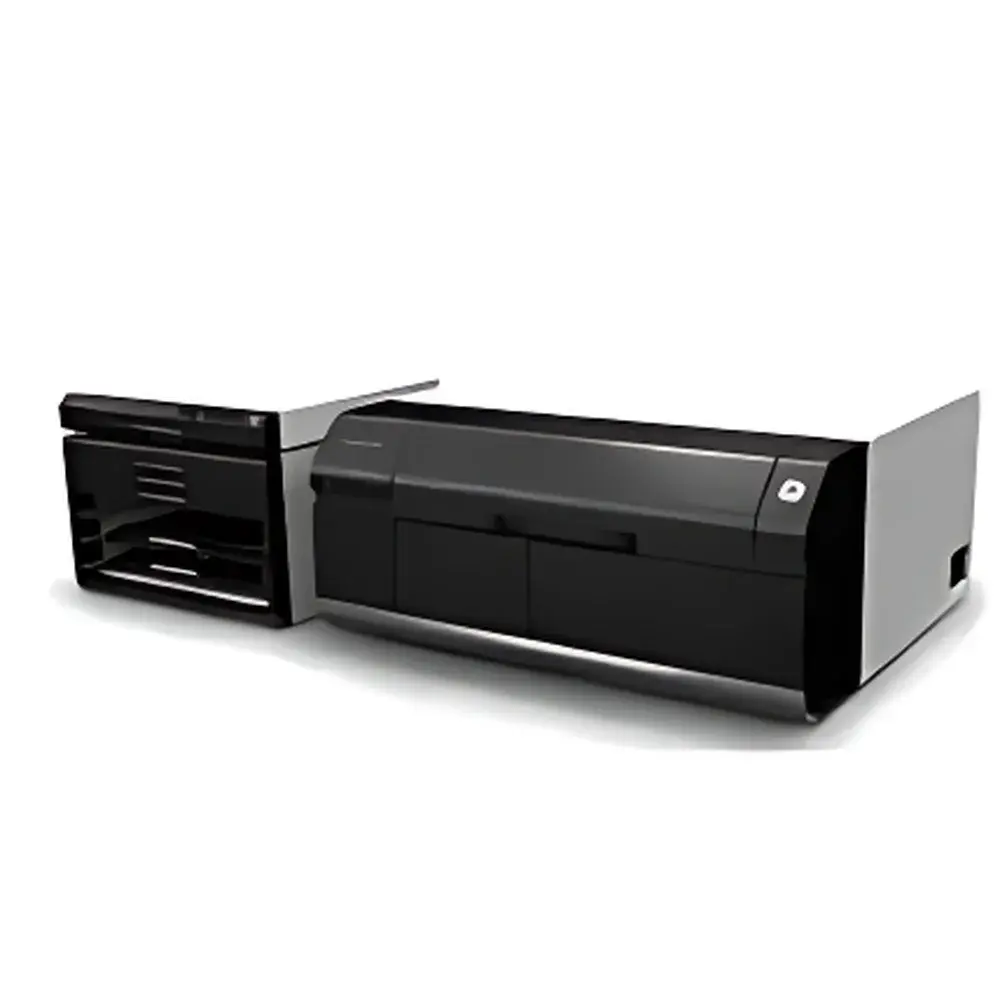
Cytiva Amersham Typhoon Multi-Photon Laser Scanner
| Brand | Cytiva |
|---|---|
| Origin | USA |
| Model | Amersham Typhoon |
| Detection Modes | Fluorescence, Phosphor Imaging, Chemiluminescence, Digital Radiography |
| Laser Wavelengths | 488 nm (LD), 532 nm (SHG), 635 nm (LD), 685 nm (LD), 785 nm (LD) |
| Isotope Compatibility | ³H, ¹¹C, ¹⁴C, ¹²⁵I, ¹⁸F, ³²P, ³³P, ³⁵S, ⁹⁹ᵐTc and other ionizing radiation sources |
| Dynamic Range | > 5 decades |
| Bit Depth | 16-bit |
| Imaging Area | 40 × 46 cm |
| Pixel Resolution Options | 10, 25, 50, 100, 200 µm (pre-scan at 1000 µm) |
| Standard Filters | IP 390BP, Cy2 525BP20, Cy3 570BP20, Cy5 670BP30, IRshort 720BP20, IRlong 825BP30, LPR660 |
| Sample Platforms | Fluorescence stage, Multi-sample stage, Phosphor Imaging (IP) stage |
| Dimensions (W×H×D) | 900 × 400 × 800 mm |
| Power Supply | 100–240 VAC ±10%, 50/60 Hz |
| Operating Temperature | 15–30 °C |
| Relative Humidity | 20–70% RH (non-condensing) |
Overview
The Cytiva Amersham Typhoon Multi-Photon Laser Scanner is a high-performance, multi-modal optical imaging platform engineered for quantitative molecular detection across diverse life science applications. Based on confocal laser scanning architecture with galvanometric mirror positioning and precision photomultiplier tube (PMT) detection, the system delivers high signal-to-noise ratio imaging through simultaneous or sequential excitation at multiple discrete wavelengths. Its modular optical design supports fluorescence (visible and near-infrared), phosphor storage imaging (PSI), chemiluminescence, and digital radiography—enabling seamless transition between detection modalities without hardware reconfiguration. Originally developed under GE Healthcare’s Amersham Biosciences division and now maintained and supported by Cytiva, the Typhoon platform adheres to ISO 13485–compliant manufacturing standards and meets essential requirements of IEC 61010-1 for laboratory equipment safety.
Key Features
- Multi-laser excitation capability with five integrated solid-state lasers (488 nm, 532 nm, 635 nm, 685 nm, and 785 nm), enabling broad spectral coverage from visible to far-red/NIR domains
- Adjustable pixel resolution from 10 µm to 200 µm, with optional pre-scan at 1000 µm for rapid sample localization and ROI selection
- 16-bit analog-to-digital conversion ensures linear dynamic range exceeding five orders of magnitude (>10⁵), critical for accurate quantification in differential expression studies
- Dedicated phosphor imaging mode optimized for high-sensitivity detection of radioisotopes including ³H, ¹⁴C, ³²P, ³⁵S, ¹²⁵I, and ⁹⁹ᵐTc—fully compliant with ALARA principles and institutional radiation safety protocols
- Interchangeable sample stages: fluorescence-optimized glass plate stage, multi-gel rack stage for parallel electrophoresis analysis, and phosphor-imaging (IP) cassette holder with vacuum-assisted flat-field registration
- Integrated optical filter wheel with motorized positioning for precise emission band selection; standard set includes Cy2, Cy3, Cy5, IRshort, IRlong, and LPR660 filters
Sample Compatibility & Compliance
The Typhoon scanner accommodates a wide range of sample formats including polyacrylamide gels, nitrocellulose and PVDF membranes, microarrays, blots, autoradiography films, phosphor imaging plates (e.g., GE Healthcare Storage Phosphor Screens), and stained histological sections. It supports common staining methods such as Coomassie Brilliant Blue, silver nitrate, SYPRO Ruby, and fluorescent dyes (e.g., Alexa Fluor, IRDye). All operational parameters—including laser power, PMT gain, pixel dwell time, and scan speed—are programmable and stored with image metadata to satisfy GLP and GMP documentation requirements. The instrument conforms to FDA 21 CFR Part 11 for electronic records and signatures when used with compatible Cytiva ImageQuant TL software featuring audit trail, user access control, and electronic signature modules.
Software & Data Management
Controlled via Cytiva ImageQuant TL software, the Typhoon platform provides an intuitive, workflow-driven interface for acquisition, processing, and analysis. The software supports batch acquisition across multiple samples and modality combinations, automated background subtraction, spot volume integration, normalization against internal standards or total lane intensity, and export to standardized formats (TIFF, PNG, XML-based .gel files). Raw data integrity is preserved through lossless 16-bit TIFF output, while processed results can be exported to Excel, CSV, or MIAME-compliant MAGE-TAB for integration into LIMS or ELN systems. Version-controlled software updates are distributed through Cytiva’s secure support portal, with validation documentation available upon request for regulated environments.
Applications
- Quantitative Western blotting using near-infrared fluorescent secondary antibodies (e.g., LI-COR Odyssey-compatible workflows)
- Two-dimensional difference gel electrophoresis (2-D DIGE) with CyDye labeling and cross-channel normalization
- Phosphorimaging of Northern/Southern blots, metabolic labeling experiments, and DNA sequencing gels
- Chemiluminescent detection of HRP- or AP-conjugated probes with extended exposure flexibility and low-noise PMT readout
- Visible-light fluorescence imaging of ethidium bromide-, SYBR Gold-, or GelRed-stained nucleic acid gels
- Radioisotope-based assays requiring regulatory compliance for tracer handling and decay correction algorithms
FAQ
Does the Typhoon support dual-color NIR fluorescence imaging?
Yes—the system integrates both 685 nm and 785 nm lasers with matched long-pass and bandpass filters, enabling simultaneous or sequential detection of two NIR fluorophores (e.g., IRDye 680RD and IRDye 800CW) with minimal spectral crosstalk.
Can I use third-party phosphor screens with the Typhoon?
The instrument is calibrated for GE Healthcare Storage Phosphor Screens (e.g., MS, HP, and CR types); while other brands may function mechanically, optimal sensitivity and linearity require vendor-specific calibration curves.
Is remote operation supported?
ImageQuant TL software supports networked acquisition and monitoring via TCP/IP; however, laser activation and high-voltage PMT control require local administrative privileges for safety interlock compliance.
What maintenance is required for long-term stability?
Annual optical alignment verification and PMT gain calibration are recommended; laser output power is monitored continuously and logged for trend analysis. No consumables beyond standard filters and cleaning supplies are required.
How does the Typhoon handle data traceability in regulated labs?
When configured with ImageQuant TL’s 21 CFR Part 11 option, the system enforces role-based access, electronic signatures, immutable audit trails, and automatic backup of acquisition parameters with each image file.





