
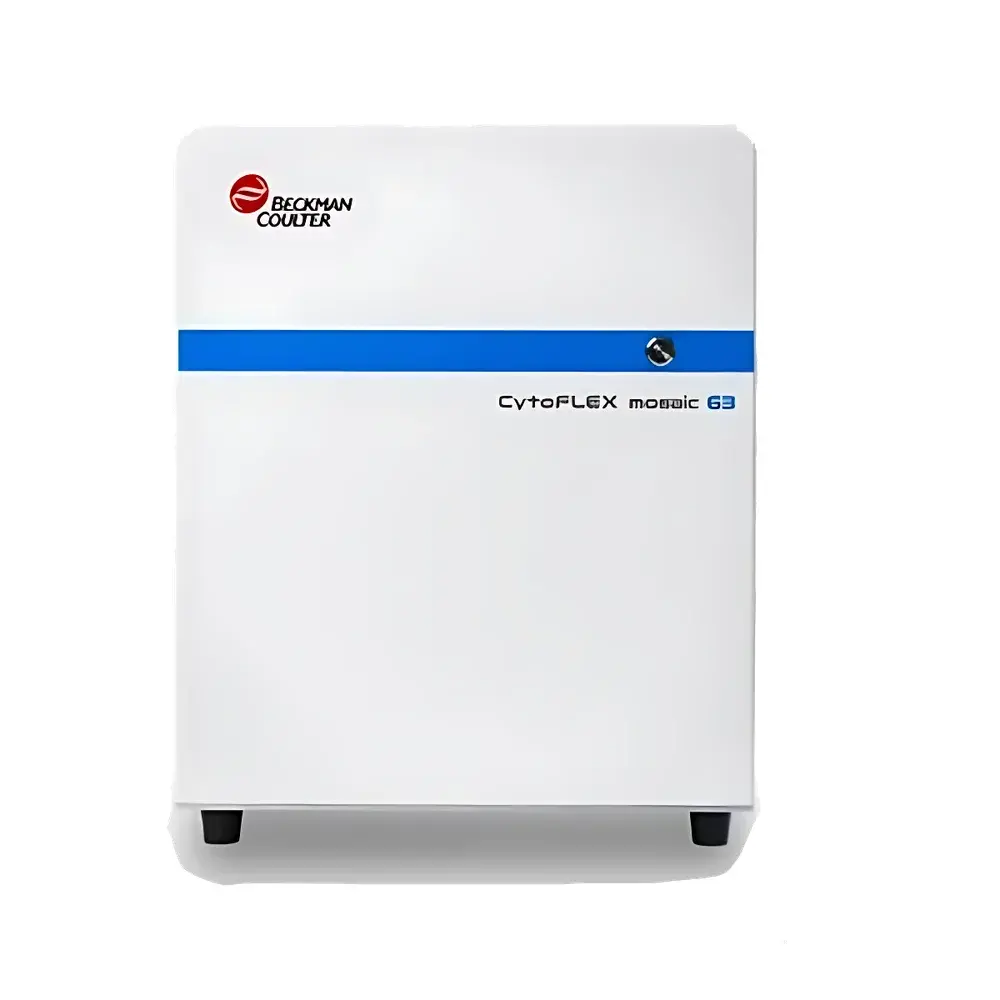
Beckman Coulter CytoFLEX Mosaic Spectral Flow Cytometer
| Brand | Beckman Coulter |
|---|---|
| Origin | Jiangsu, China |
| Manufacturer Type | Authorized Distributor |
| Regional Classification | Domestic (China-manufactured) |
| Model | CytoFLEX Mosaic |
| Technology Pathway | Spectral Flow Cytometry |
| Product Type | Spectral Flow Cytometer |
| Primary Use Case | Research |
| Detection Channels | 88 |
| Automated Sample Loading | Yes |
| Sorting Capability | Optional |
| Autofluorescence Compensation Channels | Up to 10 |
Overview
The Beckman Coulter CytoFLEX Mosaic is a dual-mode spectral flow cytometer engineered for high-parameter, high-fidelity cell analysis in academic and translational research laboratories. Unlike conventional filter-based systems, the CytoFLEX Mosaic employs full-spectrum detection—capturing emitted light across continuous wavelength ranges (typically 365–800 nm) using high-quantum-efficiency back-thinned CCD or sCMOS detectors. This architecture eliminates spectral overlap constraints imposed by fixed optical filters, enabling deconvolution of highly multiplexed fluorochrome panels via computational unmixing. The instrument integrates two parallel optical pathways: one optimized for traditional fluorescence intensity measurement (filter-based mode), and another configured for spectral acquisition and real-time unmixing—allowing seamless, software-controlled switching between modalities in under five minutes. Designed as a direct extension of the globally deployed CytoFLEX platform, the Mosaic retains the same compact footprint, low maintenance requirements, and robust fluidics architecture while expanding analytical depth through spectral resolution. Its core application domain includes deep immunophenotyping, rare event detection (e.g., circulating tumor cells, antigen-specific T cells), and longitudinal monitoring of heterogeneous cell populations where conventional compensation fails.
Key Features
- Dual-mode operation: Switch between conventional filter-based and spectral acquisition modes without hardware reconfiguration
- 88-channel spectral detection with 40-color panel design with minimal spillover error
- Two validated unmixing algorithms: Enhanced Poisson-based algorithm (optimized for resolution and speed) and Least Squares Minimization (LSM) for cross-validation and method transfer
- Up to 10 dedicated autofluorescence reference channels acquired from unstained controls—enabling pixel-level background subtraction and improved signal-to-noise ratio for dim markers
- Real-time unmixing accuracy verification: System automatically flags channels exhibiting poor fit residuals or inconsistent spectral signatures during acquisition
- Integrated automated sample loader compatible with standard 96-well plates and 12×75 mm tubes
- Optional droplet-based cell sorting module available for index-sorting and downstream single-cell applications
Sample Compatibility & Compliance
The CytoFLEX Mosaic accepts suspension samples in common formats including PBS- or culture medium-based preparations, whole blood (with optional lysing protocols), PBMCs, dissociated tissues, and microbeads for calibration. It complies with ISO 13485:2016 quality management standards for medical device manufacturing and meets electromagnetic compatibility (EMC) requirements per IEC 61326-1. While primarily intended for research use (RUO), its data output structure supports alignment with GLP documentation workflows, including audit-trail-enabled acquisition logs and timestamped metadata export. Instrument control software adheres to FDA 21 CFR Part 11 principles for electronic records and signatures when deployed in regulated environments with appropriate IT validation.
Software & Data Management
Data acquisition and analysis are performed using CytExpert 2.10+, a Windows-based application that maintains backward compatibility with legacy CytoFLEX files while introducing native spectral visualization tools—including t-SNE, UMAP, and PhenoGraph clustering modules. Raw spectral data are stored in HDF5 format with embedded metadata (laser power, detector gain, sample ID, operator name, acquisition date/time). The software supports one-click export to Cytobank for cloud-based dimensionality reduction and collaborative annotation. All unmixing parameters—including reference spectra libraries, autofluorescence templates, and algorithm selection—are version-controlled and exportable as JSON configuration files for inter-laboratory reproducibility. Batch processing pipelines allow automated QC checks across multi-day experiments, flagging deviations in CV% of reference bead signals or shifts in autofluorescence baselines.
Applications
- High-dimensional immune profiling: Identification and functional characterization of rare subsets (e.g., tissue-resident memory T cells, regulatory B cells) in human peripheral blood and solid tumor digests
- Viral infection dynamics: Simultaneous tracking of host cell activation markers, viral antigens, and cytokine secretion at single-cell resolution
- Stem cell differentiation trajectories: Monitoring co-expression of lineage-specific transcription factors and surface receptors over time
- Exosome and extracellular vesicle phenotyping: Discrimination of subpopulations based on size-normalized spectral signatures and lipid raft-associated markers
- Drug mechanism-of-action studies: Multiparametric assessment of apoptosis, cell cycle arrest, and signaling pathway modulation within heterogeneous cultures
FAQ
Can the CytoFLEX Mosaic be used for clinical diagnostics?
No—it is designated for research use only (RUO) and has not received FDA clearance or CE-IVD marking.
Is spectral unmixing performed during acquisition or post-hoc?
Both options are supported: real-time unmixing during acquisition for immediate feedback, and offline batch processing with adjustable reference spectra and regularization parameters.
How does the system handle autofluorescence in primary human samples?
It acquires up to 10 independent autofluorescence channels from matched unstained controls, enabling per-cell, per-channel subtraction rather than global compensation matrices.
What file formats are generated?
FCS 3.1 for compatibility with third-party tools; raw spectral data in HDF5; unmixing reports in PDF/CSV; and CytExpert project files (.cyt) with full parameter history.
Does it support bead-based absolute counting?
Yes—compatible with AccuCount™ and TruCount™ beads, with integrated gating strategies for volumetric calculation and concentration reporting.




