
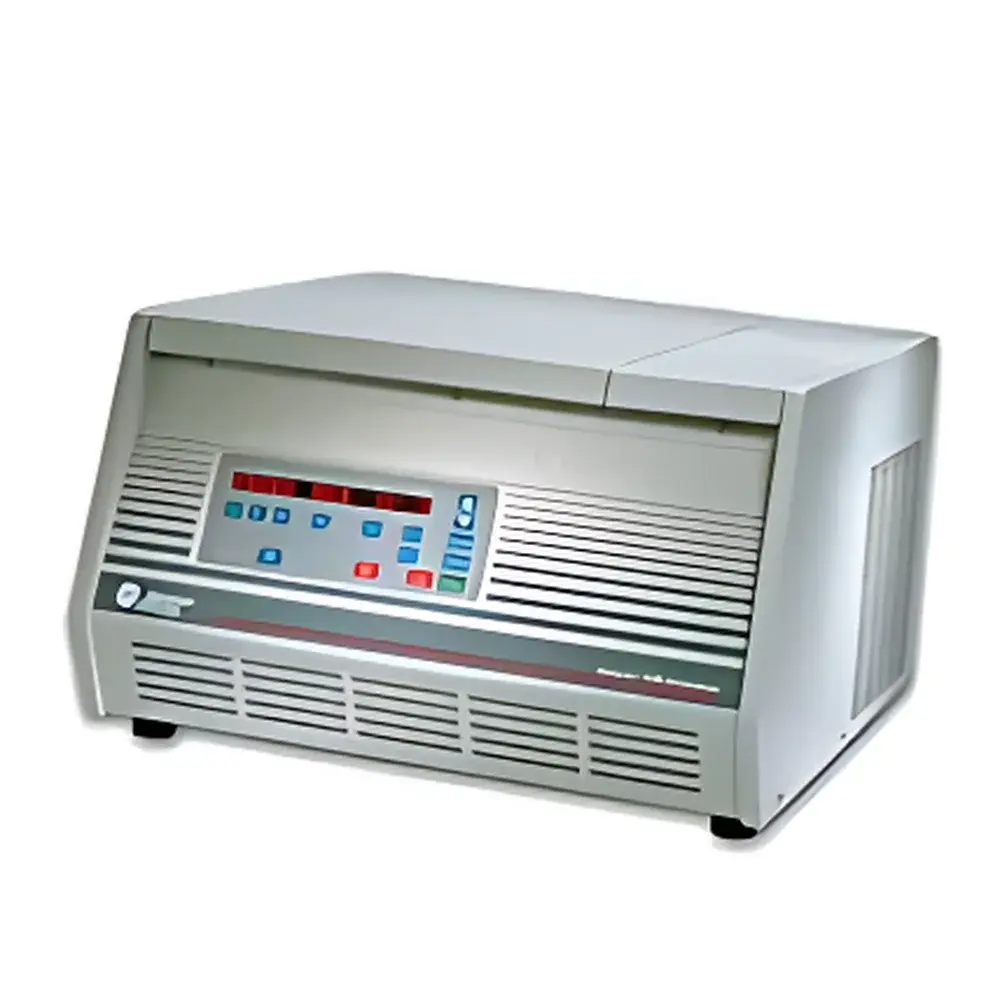
Beckman Coulter Allegra 25R Benchtop High-Speed Refrigerated Centrifuge
| Brand | Beckman Coulter |
|---|---|
| Origin | USA |
| Model | Allegra 25R |
| Instrument Type | Benchtop Centrifuge |
| Speed Range | 15,000 rpm (rotor-dependent) / 5,700 rpm (rotor-dependent) |
| Max RCF | 25,160 × g / 6,130 × g |
| Max Capacity | 6 × 250 mL or 4 × 500 mL |
| Temperature Range | −20 °C to +40 °C |
| Dimensions (W × D × H) | 40.5 × 65 × 68.5 cm |
| Drive System | Brushless Induction Motor |
| Door Operation | Automatic Lid Locking |
| Sample Volume Range | 0.25 mL to 500 mL |
| Primary Application Domain | Nucleic Acid Purification, Bacterial & Cellular Pellet Recovery, Clarification of Lysates |
Overview
The Beckman Coulter Allegra 25R is a refrigerated benchtop high-speed centrifuge engineered for reproducible, temperature-controlled separation in molecular biology and cell culture laboratories. It operates on the principle of sedimentation under controlled gravitational force (RCF), enabling rapid pelleting of nucleic acids, cellular organelles, bacteria, and subcellular particles. Its dual-speed capability—supporting both high-RCF protocols (up to 25,160 × g) and lower-speed, high-capacity runs (e.g., 6,130 × g at 5,700 rpm)—makes it uniquely suited for multi-step workflows such as plasmid DNA purification, viral particle concentration, and post-lysis clarification. The integrated refrigeration system maintains precise thermal control from −20 °C to +40 °C, critical for preserving labile biomolecules during extended runs or heat-sensitive sample preparation.
Key Features
- Brushless induction motor ensures maintenance-free operation, low vibration, and consistent rotational stability across speed ranges—eliminating carbon brush wear and associated particulate contamination.
- Automated lid locking mechanism engages only when rotor balance and door closure are verified, complying with IEC 61010-2-020 safety standards for centrifuge equipment.
- Intelligent temperature management includes pre-cool function, real-time chamber monitoring, and active refrigerant circulation—even at low speeds—to minimize thermal drift during sensitive nucleic acid isolation.
- Acoustically optimized enclosure reduces operational noise to ≤59 dBA at 15,000 rpm, supporting placement in shared lab environments without acoustic interference.
- Intuitive interface with programmable memory slots (up to 99 methods), time/temperature/speed ramping profiles, and instant recall of validated protocols for GLP-compliant routine operations.
Sample Compatibility & Compliance
The Allegra 25R accommodates a broad spectrum of tube formats—from microcentrifuge tubes (0.25 mL) to large-volume bottles (500 mL)—via interchangeable rotors including fixed-angle, swing-bucket, and specialized nucleic acid–optimized heads (e.g., F2402H, S25A). Its mechanical design conforms to ISO 13485 manufacturing quality requirements, and its firmware supports audit trails and user-access logging per FDA 21 CFR Part 11 guidelines when integrated with compliant LIMS or ELN platforms. All rotors are certified to ASTM F1842 for burst resistance and undergo full traceable calibration per Beckman Coulter’s ISO/IEC 17025-accredited service protocol.
Software & Data Management
While the Allegra 25R operates via embedded front-panel controls, it supports optional connectivity through Beckman Coulter’s CentriLog™ software (v3.2+), enabling remote method deployment, run history export (CSV/XML), and electronic signature capture for SOP adherence. Data integrity safeguards include timestamped event logs (door open/close, temperature excursions, rotor ID verification), automatic error flagging for imbalance or overspeed conditions, and password-protected parameter editing tiers aligned with role-based access control (RBAC) frameworks.
Applications
- DNA/RNA purification workflows requiring high-yield pelleting of silica-bound nucleic acids or ethanol-precipitated fragments.
- Bacterial cell harvesting (E. coli, Bacillus spp.) prior to lysis, with RCF settings optimized to retain membrane integrity for downstream protein expression studies.
- Clarification of mammalian cell lysates prior to chromatography or ultracentrifugation—particularly where cold retention of enzyme activity or phosphoprotein stability is essential.
- Preparative isolation of extracellular vesicles and virus-like particles using swing-bucket rotor gradients (e.g., sucrose or iodixanol).
- Routine QC testing in biomanufacturing environments, including sterility filter challenge validation and buffer exchange verification.
FAQ
What rotor configurations are validated for use with the Allegra 25R?
The instrument supports Beckman Coulter–certified rotors only, including the S25A (swinging bucket, max 4 × 500 mL), F2402H (fixed-angle, max 24 × 2.0 mL), and GH-3.8 (high-capacity horizontal, max 6 × 250 mL). Third-party rotors are not supported and void warranty coverage.
Does the Allegra 25R meet GLP/GMP documentation requirements?
Yes—when operated with CentriLog™ and configured with user authentication, electronic signatures, and immutable audit trails, it satisfies core data integrity expectations outlined in WHO TRS 992 Annex 11 and EU GMP Annex 11.
Can the centrifuge maintain −20 °C while running at maximum speed?
Yes—the compressor and airflow architecture are rated for continuous operation at −20 °C across the full speed range; however, ambient lab temperature must remain ≤25 °C and relative humidity <70% for sustained performance.
Is rotor calibration required annually?
Per Beckman Coulter Service Bulletin SB-25R-004, rotor recalibration is recommended every 12 months or after 1,000 runs—whichever occurs first—and must be performed by an authorized service engineer using traceable torque and RCF verification tools.



