
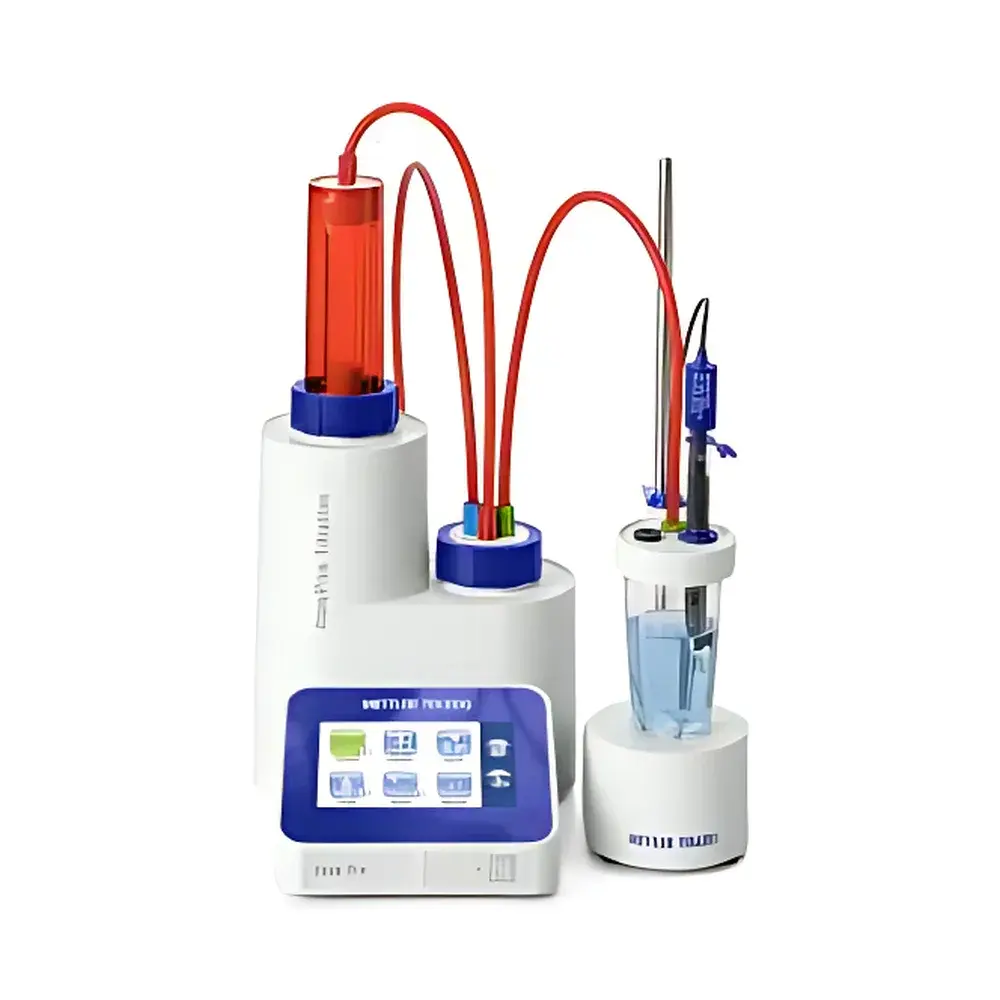
METTLER TOLEDO EasyPlus ET18 Automatic Potentiometric Titrator
| Brand | METTLER TOLEDO |
|---|---|
| Origin | Switzerland |
| Model | ET18 |
| Instrument Type | General-purpose Potentiometric Titrator |
| pH Measurement Range | 1–14 |
| pH Meter Accuracy | ±0.2 |
| pH Resolution | 0.01 |
| Burette Precision | ±0.3% (v/v) |
| Compliance | Designed for GLP-compliant routine titration workflows |
Overview
The METTLER TOLEDO EasyPlus ET18 is a compact, entry-level automatic potentiometric titrator engineered for routine acid-base titrations in quality control, teaching laboratories, and production environments where robustness, ease of use, and regulatory traceability are essential. It operates on the fundamental principle of potentiometric endpoint detection—measuring the potential difference between a pH-sensitive indicator electrode and a stable reference electrode as titrant is incrementally added. The system identifies endpoints either by fixed-pH termination (e.g., pH 7.0 for neutralization) or by first-derivative inflection point detection (equivalence point), delivering reproducible results without manual interpretation. Its architecture integrates a precision burette drive mechanism, a calibrated pH measurement circuit, and an embedded microcontroller optimized for deterministic titration logic—ensuring consistent delivery volume, stable electrode signal acquisition, and real-time slope-based endpoint recognition.
Key Features
- Intuitive application-driven interface with pre-configured titration methods for common analyses—including total acidity (Titratable Acidity, TA), alkalinity (m-value and p-value), free fatty acid (FFA) determination in oils, and active ingredient quantification in cleaning agents.
- iTitrate intelligent method setup wizard guides users step-by-step through parameter selection (e.g., titrant concentration, sample volume, endpoint pH, drift threshold), minimizing configuration errors and reducing method development time.
- Dual-electrode support: Compatible with METTLER TOLEDO’s InLab® Routine Pro pH composite electrodes for aqueous samples and InLab® Micro Non-Aqueous electrodes for low-dielectric media such as edible oils and organic solvents.
- Integrated USB host port enables direct connection to METTLER TOLEDO USB-P25 thermal printers for immediate hardcopy reporting with timestamp, operator ID, and result metadata.
- Firmware supports audit trail logging (operator actions, method changes, calibration events) aligned with basic GLP documentation requirements—no external software required for traceability.
Sample Compatibility & Compliance
The ET18 accommodates liquid samples across diverse matrices: beverages (juice, beer, milk), dairy products, surfactant solutions, industrial cleaners, edible oils, and potable or wastewater. Its pH measurement circuit meets IEC 61000-4 electromagnetic compatibility standards and complies with ISO/IEC 17025-relevant instrumentation validation practices when used with certified reference materials (e.g., NIST-traceable pH buffers). While not inherently 21 CFR Part 11 compliant out-of-the-box, the instrument’s firmware-generated reports—when paired with EasyDirect™ Titration software on a validated Windows workstation—support electronic signature, user access control, and immutable data archiving suitable for regulated QC environments.
Software & Data Management
Data export is supported via USB mass storage mode: titration curves (.csv), summary reports (.pdf), and raw electrode potential logs (.txt) can be retrieved directly from the instrument’s internal memory. When connected to a PC running EasyDirect™ Titration software (v3.2+), the ET18 enables centralized method library management, automated report generation with customizable templates, statistical batch evaluation (mean, RSD, confidence intervals), and integration into LIMS via ODBC or CSV export. All generated files include embedded metadata: date/time stamp, operator login, electrode serial number, titrant batch ID, and environmental temperature recorded at start.
Applications
- Food & Beverage: Quantification of titratable acidity in fruit juices (expressed as citric or malic acid %), lactic acid in fermented dairy, and buffering capacity in beer wort.
- Chemical Manufacturing: Determination of NaOH or HCl concentration in process streams; assay of amine content in surfactants; neutralization value testing of fatty acids.
- Environmental Testing: Alkalinity profiling of surface water (m-value = methyl orange endpoint at pH ≈ 4.3; p-value = phenolphthalein endpoint at pH ≈ 8.3) per APHA Standard Methods 2320B.
- Pharmaceutical Excipients: Assay of sodium carbonate or sodium bicarbonate in buffer formulations using hydrochloric acid titration with potentiometric endpoint confirmation.
- Education: Ideal platform for undergraduate analytical chemistry labs—demonstrating stoichiometric equivalence, electrode response kinetics, and method validation principles under instructor supervision.
FAQ
Does the ET18 support non-aqueous titrations?
Yes—when paired with METTLER TOLEDO’s InLab® Micro Non-Aqueous pH electrode and appropriate solvent-compatible titrants (e.g., tetrabutylammonium hydroxide in toluene), it performs accurate FFA determination in edible oils per AOCS Cd 3d-63.
Can I validate the burette delivery accuracy according to ISO 8655?
Yes—the ET18’s 10 mL glass burette conforms to ISO 8655-3 Class A tolerances; users may perform gravimetric verification using distilled water and an analytical balance (±0.1 mg readability) following ISO 8655-6 procedures.
Is method transfer possible from higher-end METTLER TOLEDO titrators?
Predefined methods created in LabX™ or EasyDirect™ software can be exported as .etm files and imported into the ET18 via USB, preserving titrant definitions, endpoint criteria, and calculation formulas.
What maintenance is required for long-term reliability?
Daily: Electrode rinsing with deionized water and storage in 3 mol/L KCl solution. Weekly: Burette tip inspection and piston lubrication with silicone-free grease. Annually: Calibration verification using certified pH buffers and volumetric standardization with potassium hydrogen phthalate.




