
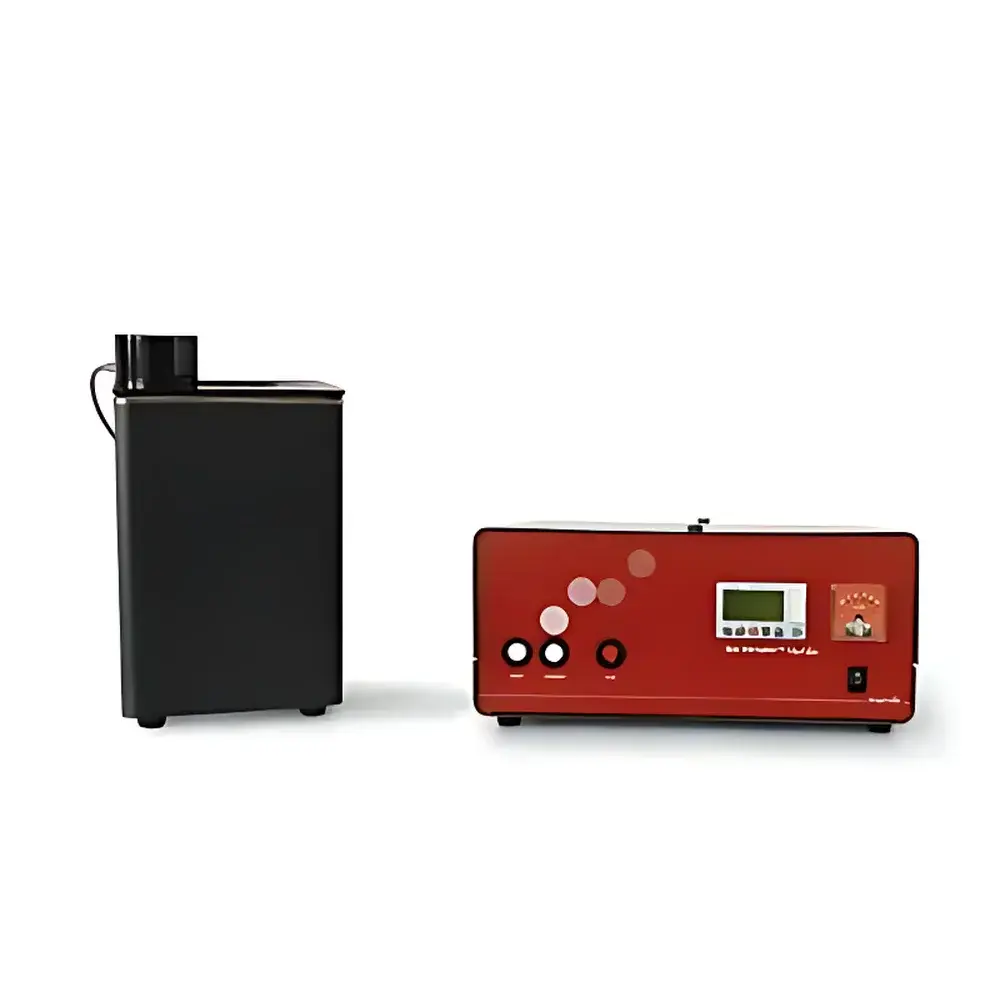
Diagenode UCD300 Non-Contact Ultrasonic Cell Disruptor
| Brand | Diagenode |
|---|---|
| Origin | Belgium |
| Model | UCD300 |
| Operating Frequency | 20 kHz |
| Ultrasonic Power Output | 155 W / 310 W (dual-step adjustable) |
| Sample Volume Range | 5 µL – 20 mL |
| Maximum Throughput | ≥24 samples per run |
| Processing Chamber Volume | 750 mL |
| Dimensions (Controller) | 150 × 300 × 195 mm (W×D×H) |
| Dimensions (Processing Chamber) | 350 × 260 × 150 mm (W×D×H) |
| Weight | 20 kg |
| Timer Range | 0–60 sec or 0–15 min (on/off cycles) |
| Compatible Vessels | PCR tubes, 1.5 mL, 10 mL, 15 mL, and 50 mL centrifuge tubes |
| Fragmentation Range (DNA) | 2 kb – <500 bp |
| Rotation Speed | Programmable constant-speed rotation during sonication |
| Compliance | CE-marked |
Overview
The Diagenode UCD300 Non-Contact Ultrasonic Cell Disruptor is an engineered solution for high-efficiency, reproducible, and contamination-free cell lysis and nucleic acid shearing in molecular biology and epigenetics workflows. Unlike conventional probe-based sonicators, the UCD300 employs a bath-type, non-contact ultrasonic architecture operating at a stable 20 kHz frequency. Energy is transmitted through water coupling into sealed sample vessels—eliminating cross-contamination, aerosol generation, and probe-induced sample heating. The system integrates synchronized sample rotation with precisely timed, dual-power ultrasonic bursts (155 W or 310 W), ensuring uniform energy distribution across all samples within the processing chamber. This design conforms to core principles of acoustic cavitation physics, where controlled bubble nucleation and collapse generate localized shear forces sufficient to disrupt cellular membranes and fragment chromatin or genomic DNA without denaturation. It is routinely deployed in ChIP-seq, ATAC-seq, RNA-seq library prep, and bacterial/fungal cell lysis protocols requiring high inter-run consistency and minimal operator intervention.
Key Features
- Non-contact ultrasonic lysis: No probe insertion required—samples remain fully sealed in standard labware (PCR tubes, 1.5–50 mL centrifuge tubes)
- Dual-power output control: Selectable 155 W or 310 W ultrasonic intensity for scalable lysis efficiency across diverse sample types (e.g., Gram-positive bacteria vs. mammalian nuclei)
- Programmable multi-timer: Independent on/off cycle timers (0–15 min range) and burst duration timer (0–60 sec) enable precise duty-cycle optimization to prevent thermal accumulation
- Integrated sample rotation: Motor-driven carousel maintains constant rotational speed during sonication, mitigating standing-wave node formation and improving lysis homogeneity
- Acoustically damped processing chamber: 750 mL capacity with double-walled water bath and noise-suppressing enclosure meets ISO 10816-3 vibration emission standards
- Digital controller with intuitive interface: Real-time parameter display, power-level feedback, and memory for ≥10 user-defined protocols
Sample Compatibility & Compliance
The UCD300 accommodates a broad spectrum of biological matrices—including cultured mammalian cells, yeast, bacteria, plant tissues, and isolated nuclei—without protocol revalidation. Its compatibility with common consumables (e.g., Axygen, Eppendorf, Sarstedt tubes) reduces supply-chain dependency. All vessel-specific accessories—including 1.5 mL tube holders (12-position), 15 mL Falcon tube reflector rods, and custom-fit adapters—are manufactured from inert, USP Class VI-certified polymers. The instrument complies with CE Directive 2014/30/EU (EMC) and 2014/35/EU (LVD), and its operational parameters align with ASTM E2500-13 guidance for qualification of laboratory equipment. When paired with Diagenode’s optional CITE software, the system supports 21 CFR Part 11-compliant electronic records, including full audit trails for power settings, cycle counts, timestamps, and operator ID logging.
Software & Data Management
While the UCD300 operates as a standalone benchtop unit with embedded digital controls, it is compatible with Diagenode’s CITE (Control, Integration, Tracking, and Export) software suite via USB or RS-232 interface. CITE enables remote method deployment, batch protocol scheduling, real-time monitoring of sonication status, and export of timestamped operation logs in CSV or PDF format. All exported data include metadata fields compliant with MIAME and MINSEQE reporting standards. For laboratories under GxP regulation, CITE provides role-based access control, electronic signatures, and immutable log archiving—facilitating internal audits and regulatory inspections under FDA, EMA, or PMDA frameworks.
Applications
- Chromatin fragmentation for ChIP-seq and CUT&RUN assays
- Nucleosome positioning analysis via MNase-seq or ATAC-seq sample prep
- High-yield genomic DNA shearing for long-read and short-read NGS library construction
- Preparation of soluble protein extracts from recalcitrant microbial strains
- Isolation of extracellular vesicles and ribonucleoprotein complexes
- Standardized lysis for QC/QA in biomanufacturing and vaccine development workflows
FAQ
Does the UCD300 require water degassing prior to use?
Yes—optimal cavitation efficiency demands dissolved air removal. Diagenode recommends 10–15 minutes of pre-sonication in empty bath mode or vacuum-assisted degassing before sample loading.
Can I process viscous or high-density lysates (e.g., tissue homogenates) in the UCD300?
Viscosity >10 cP may attenuate acoustic transmission. We recommend diluting such samples to ≤5% w/v solids concentration and verifying fragmentation efficiency via Bioanalyzer or TapeStation post-processing.
Is temperature control integrated into the system?
The UCD300 does not feature active refrigeration, but its dual-water-bath design and programmable duty cycling minimize thermal drift. For thermosensitive applications, users may circulate chilled water (4–10 °C) via external chiller connected to the bath inlet/outlet ports.
How often should the ultrasonic transducers be calibrated?
Transducer output stability is verified annually using traceable hydrophone-based power mapping per ISO 18530. Diagenode-certified service engineers perform this calibration onsite or at authorized service centers.
What maintenance is required for long-term reliability?
Routine tasks include weekly descaling of the water bath with 10% acetic acid, biannual inspection of O-ring integrity on lid seals, and annual verification of rotation motor torque and timer accuracy.




