
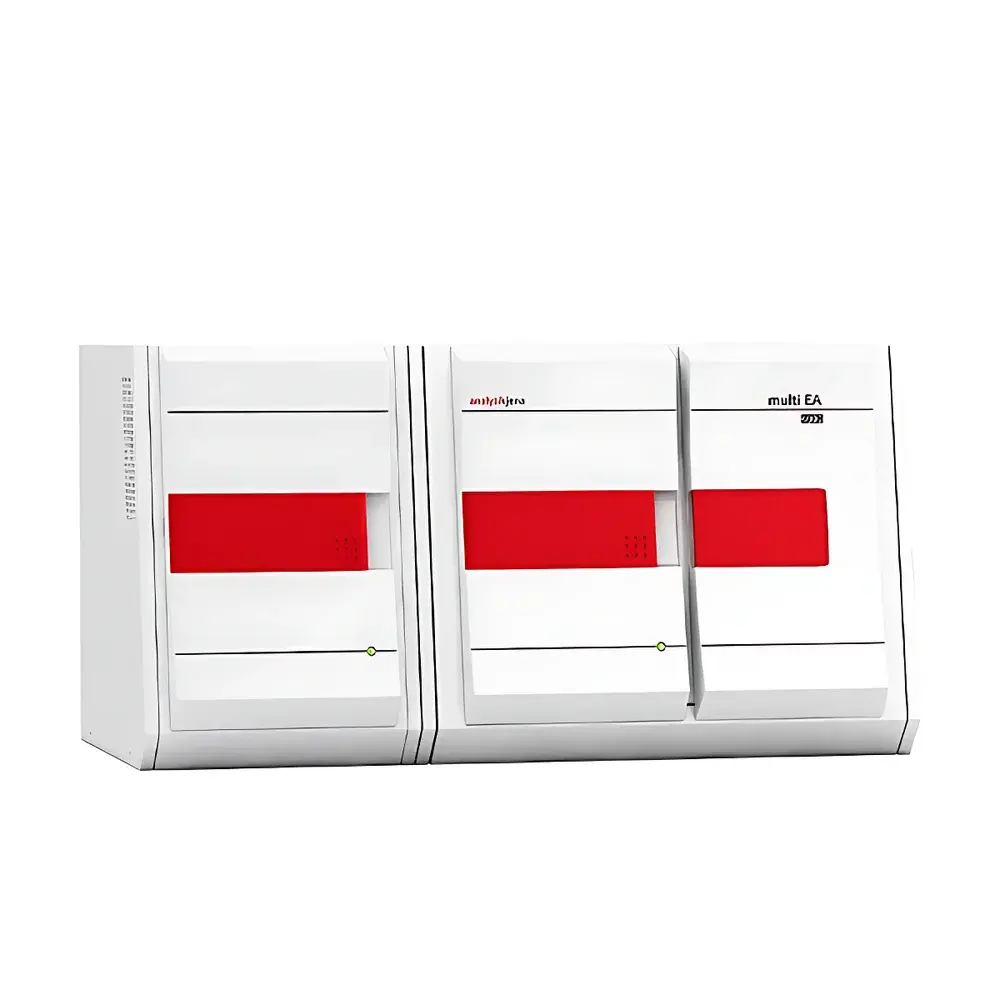
Analytik Jena multi EA 4000 C Carbon, Sulfur, Nitrogen and Chlorine Elemental Analyzer
| Brand | Analytik Jena |
|---|---|
| Origin | Germany |
| Model | multi EA 4000 C |
| Measurement Principle | High-Temperature Combustion (HTC) coupled with NDIR and Coulometric detection |
| Detection Elements | Total Carbon (TC), Total Sulfur (TS), Total Nitrogen (TN), Total Chlorine (Cl) |
| Sample Types | Solid organic & inorganic matrices (soils, sediments, sludges, solid waste, coal, polymers) |
| Detection Range | ppm to wt% (element-dependent) |
| Combustion Temperature | up to 1,350 °C |
| Combustion Tube Material | Composite ceramic |
| Detectors | Dual-channel NDIR for CO₂/SO₂ |
| Automation | Integrated autosampler (up to 60 positions), self-diagnostic system, automatic calibration verification |
| Compliance | Designed to meet ASTM D5373, D7359, ISO 1171, ISO 29541, EN 15407, USP <28>, EPA Method 9096A |
| Software | multiWin v5.0 with 21 CFR Part 11 compliance mode, audit trail, electronic signatures, GLP/GMP reporting templates |
Overview
The Analytik Jena multi EA 4000 C is a high-performance, modular elemental analyzer engineered for the simultaneous or sequential determination of total carbon (TC), total sulfur (TS), total nitrogen (TN), and total chlorine (Cl) in solid heterogeneous samples. It employs high-temperature combustion (HTC) at up to 1,350 °C within a corrosion-resistant composite ceramic furnace tube—ensuring complete oxidation of refractory matrices including soils, sediments, fly ash, municipal solid waste, coal, coke, and halogenated polymers. The evolved gases (CO₂, SO₂, NOₓ, HCl) are quantitatively separated via selective gas conditioning and detected using dual-channel non-dispersive infrared (NDIR) spectroscopy for carbon and sulfur, coulometric titration for chlorine, and an optional chemiluminescence detector for nitrogen. This orthogonal detection architecture delivers trace-level sensitivity (sub-ppm LODs) and robust linearity across five orders of magnitude—from low-ppm concentrations in environmental samples to high-wt% levels in industrial feedstocks—without manual dilution or method switching.
Key Features
- Modular combustion platform supporting C/S/Cl analysis as standard, with field-upgradable TN capability via chemiluminescence module
- Composite ceramic combustion tube—resistant to halogen-induced corrosion and thermal shock, extending service life beyond 2,000 analyses under routine operation
- Dual NDIR cells calibrated against certified reference materials (CRMs); real-time background compensation minimizes drift from moisture or CO interference
- Coulometric chlorine detection with electrochemical regeneration—eliminates consumable reagents and provides stoichiometric quantification per IEC 60404-8-10
- Integrated 60-position autosampler with programmable sample weight normalization, crucible handling, and ash residue management
- Self-diagnostic system continuously monitors furnace temperature stability, gas flow integrity, detector baseline noise, and combustion efficiency—triggering actionable alerts before performance deviation occurs
Sample Compatibility & Compliance
The multi EA 4000 C accommodates sample masses from 0.01 g to 1.0 g in standard quartz or ceramic crucibles, with automated oxygen injection control to optimize combustion stoichiometry for high-halogen or high-sulfur matrices. It meets regulatory requirements for environmental and industrial testing, including ASTM D5373 (carbon/sulfur in coal), ASTM D7359 (total halogens in petroleum), ISO 29541 (chlorine in waste), EN 15407 (carbon in soils), and EPA Method 9096A (halogens in solid waste). Instrument qualification follows IQ/OQ/PQ protocols aligned with ISO/IEC 17025:2017, and its software architecture supports full 21 CFR Part 11 compliance—including role-based access control, electronic signatures, immutable audit trails, and secure data archiving for GLP and GMP environments.
Software & Data Management
Controlled by multiWin v5.0 software, the system provides method-driven workflow automation—from sample registration and calibration sequence execution to result validation and report generation. All analytical parameters (combustion temperature ramp, oxygen pulse duration, gas flow rates, detector integration times) are stored with metadata and version-controlled. Raw chromatograms and detector signals are retained in native format with timestamped acquisition logs. Reporting modules generate customizable PDF/CSV outputs compliant with LIMS interfaces, including uncertainty estimation per GUM (Guide to the Expression of Uncertainty in Measurement) and ISO/IEC 17025 clause 7.7. Data integrity safeguards include write-protected archives, automatic backup to network storage, and configurable retention policies.
Applications
The multi EA 4000 C serves laboratories requiring regulatory-grade elemental quantification across sectors: environmental labs use it for TC/TS/Cl profiling in contaminated soils per EU Soil Framework Directive monitoring; cement and metallurgical QA/QC departments apply it for raw material certification (e.g., Cl content in limestone per EN 196-2); polymer manufacturers rely on it for halogen screening in flame-retardant compounds per RoHS 2011/65/EU; and energy research facilities deploy it for fuel characterization (coal rank assessment, sulfur speciation in biomass co-firing studies). Its ability to handle unprocessed, high-moisture, or abrasive samples without pretreatment significantly reduces labor-intensive digestion steps common in wet-chemistry alternatives.
FAQ
What sample preparation is required prior to analysis?
Minimal preparation: air-drying and homogenization are sufficient for most solid matrices. No acid digestion, fusion, or solvent extraction is needed.
Can the instrument analyze liquid or paste-like samples?
Yes—using dedicated liquid injection accessories (e.g., high-temperature ceramic micro-injector) and modified combustion protocols; method validation per ISO 17294-2 is recommended.
How often must the combustion tube be replaced?
Under typical environmental testing conditions (≤500 samples/month), the composite ceramic tube achieves ≥2,000 analyses before replacement; lifetime is extended by automated ash removal and oxygen flow optimization.
Is TN analysis available as a factory-installed option?
Yes—the chemiluminescence module for nitrogen detection can be integrated at time of order or retrofitted onsite with firmware update and hardware calibration.
Does the system support remote diagnostics and service support?
Yes—multiWin v5.0 includes secure remote access capability (with user-configurable firewall rules) enabling Analytik Jena Field Application Specialists to perform real-time troubleshooting and preventive maintenance guidance.





