
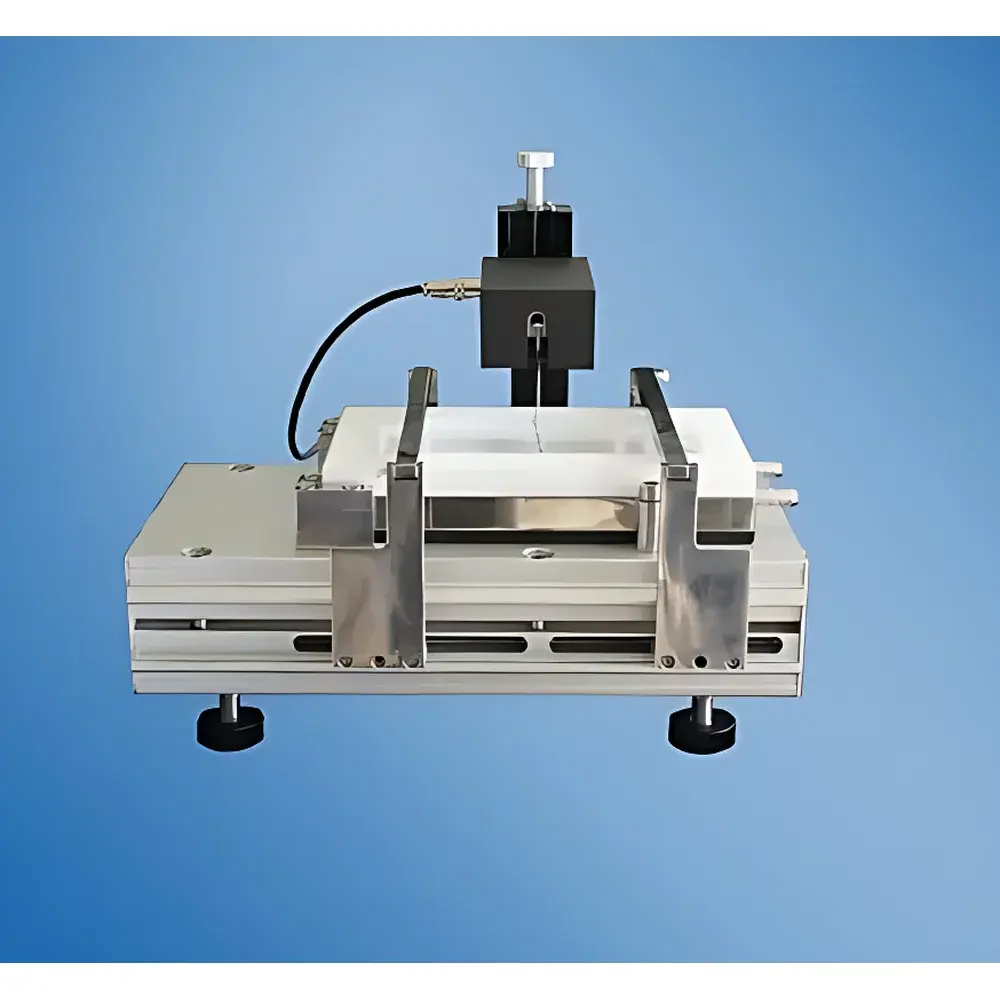
JMP2000A Interfacial Dilatational Rheometer
| Origin | Beijing, China |
|---|---|
| Manufacturer Type | Distributor |
| Origin Category | Domestic |
| Model | JMP2000A |
| Price Range | USD 7,000–14,000 |
| Instrument Type | Interfacial Rheometer |
| Bearing Type | Mechanical Bearing |
| Minimum Rotational Speed | 10⁻⁴ rpm |
| Frequency Range | 10⁻³–628 rad/s |
| Maximum Rotational Speed | 3000 rpm |
| Maximum Torque | 200 mN·m |
| Torque Resolution | < 100 nN·m |
| Surface Tension Range | 0–150 mN/m |
| Resolution | < 0.01 mN/m |
| Measurement Method | Wilhelmy Plate |
| Trough Configuration | Langmuir-type |
| Trough Dimensions | 80 mm × 200 mm × 8 mm (W × L × H) |
| Max Active Area | 96.6 cm² |
| Min Active Area | 19.32 cm² |
| Barrier Type | Leakproof / Barrier / Custom Hollow Barrier |
| Power Supply | AC 220 V ±10%, 50 Hz |
| Max Power Consumption | < 150 W |
| Operating Temperature | Ambient |
| Operating Humidity | 30–85% RH |
| Constant-Speed Compression | Period 1–1000 s, Area Change 0–80% |
| Sinusoidal Mode | Period 1–300 s, Amplitude 5–15% |
| Exponential Mode | Period 100–1000 s, Area Change 0–80% |
| Step-Change Mode | Duration 1–10 s, Area Change 10–30% |
Overview
The JMP2000A Interfacial Dilatational Rheometer is a precision-engineered instrument designed for quantitative characterization of dilatational viscoelastic properties at fluid–fluid (oil/water) and fluid–gas (air/water) interfaces. It operates on the Langmuir trough principle, integrating dual-barrier compression mechanics with real-time interfacial tension monitoring via the Wilhelmy plate method. Unlike conventional rotational rheometers measuring bulk shear response, the JMP2000A applies controlled area modulation—via constant-speed, sinusoidal, exponential, or stepwise barrier motion—to induce interfacial dilation and quantify the resulting stress relaxation and phase lag. This enables direct determination of dilatational elasticity (ε), dilatational viscosity (K), complex dilatational modulus (ε* = ε′ + iε″), and interfacial relaxation spectra—critical parameters in surfactant science, biomembrane modeling, and colloidal stabilization.
Key Features
- Fully integrated dual-microcontroller architecture: PC-hosted Windows-based control software (compatible with Windows 2000/XP) synchronizes with embedded firmware for deterministic timing and sub-millisecond command execution.
- High-fidelity mechanical actuation: Precision-ground mechanical bearings support stable, low-vibration barrier translation across the full operational range—from ultra-slow creep (10⁻⁴ rpm equivalent) to rapid transient compression (≤10 s step).
- Multi-mode interfacial deformation: Supports four distinct operational modes—steady-state compression, small-amplitude oscillatory dilatation (SAOD), macroscopic transient deformation, and interfacial stress relaxation—each programmable with independent amplitude, period, and waveform profiles.
- Low-noise interfacial force detection: Wilhelmy plate sensor with <0.01 mN/m resolution and drift-compensated signal conditioning ensures high reproducibility in surface tension and modulus measurements.
- Modular Langmuir trough: Chemically inert PTFE-coated stainless steel trough (80 × 200 × 8 mm) accommodates interchangeable leakproof barriers—including custom hollow designs—for optimized monolayer integrity and minimal edge effects.
- Comprehensive data acquisition: Simultaneous recording of barrier position, interfacial tension, phase angle (Φ), and time-stamped metadata enables rigorous post-processing and compliance-ready audit trails.
Sample Compatibility & Compliance
The JMP2000A is validated for use with aqueous surfactant monolayers (e.g., SDS, DPPC, SP-B mimics), polymer-lipid hybrids, protein films, and nanoparticle-laden interfaces. Its measurement framework aligns with ASTM D1331 (surface tension of surfactant solutions), ISO 6889 (interfacial tension of oil-in-water emulsions), and IUPAC-recommended protocols for interfacial rheology. While not inherently 21 CFR Part 11-compliant out-of-the-box, its raw data export (ASCII/CSV) and timestamped log files support integration into GLP/GMP workflows when paired with validated laboratory information management systems (LIMS). All hardware components meet CE electromagnetic compatibility (EMC) and low-voltage directive standards.
Software & Data Management
The included Windows application provides intuitive graphical setup of compression protocols, real-time visualization of tension vs. area loops, and automated calculation of ε, K, ε′, ε″, and Φ across user-defined frequency sweeps. Data are stored in hierarchical project folders with embedded metadata (operator ID, date/time, environmental RH/T, calibration constants). Export formats include CSV (for MATLAB/Python analysis), PNG/SVG (publication-ready plots), and XML (structured metadata exchange). The software supports batch processing of relaxation decays using discrete exponential fitting and permits secondary analysis of storage/loss moduli via Fourier transformation of time-domain signals.
Applications
- Quantitative evaluation of surfactant adsorption kinetics and monolayer collapse mechanisms under controlled compression.
- Structure–function correlation of pulmonary surfactants and synthetic analogs in respiratory therapeutics development.
- Stability assessment of food-grade emulsifiers (e.g., casein, lecithin) and cosmetic film formers (e.g., ceramides, cholesterol derivatives).
- Fundamental studies of interfacial relaxation processes in soft matter physics—including two-dimensional glass transitions and jamming thresholds.
- Characterization of stimuli-responsive interfaces (pH-, temperature-, or light-triggered) for smart material design.
- Validation of coarse-grained molecular dynamics (CG-MD) simulations of lipid monolayers by benchmarking predicted ε′(ω) and ε″(ω) against experimental spectra.
FAQ
What interfacial rheological parameters does the JMP2000A directly measure?
It outputs raw interfacial tension (γ), barrier displacement (ΔA), and time—enabling calculation of dilatational elasticity (ε = dγ/d ln A), complex modulus (ε*), loss tangent (tan δ = ε″/ε′), and relaxation time distributions.
Is the Wilhelmy plate sensor calibrated in situ?
Yes—the system includes automated zero-point compensation and optional certified reference liquids (e.g., pure water at 20 °C, γ = 72.75 mN/m) for traceable calibration before each session.
Can the instrument operate under controlled atmosphere or temperature?
The base configuration is ambient; however, the trough chamber is compatible with third-party environmental enclosures (e.g., gloveboxes, Peltier-cooled jackets) via standardized mounting flanges and feedthrough ports.
What is the minimum detectable change in interfacial area?
With a 19.32 cm² minimum active area and 0.1 µm position encoder resolution, the system resolves area changes down to ~5 × 10⁻⁵ cm²—sufficient for detecting sub-monolayer phase transitions.
Does the software support automated compliance with regulatory documentation requirements?
While the native software does not generate electronic signatures or audit logs per 21 CFR Part 11, all raw data files contain immutable timestamps and operator tags, enabling retroactive validation within qualified LIMS or ELN environments.
Related Products



