
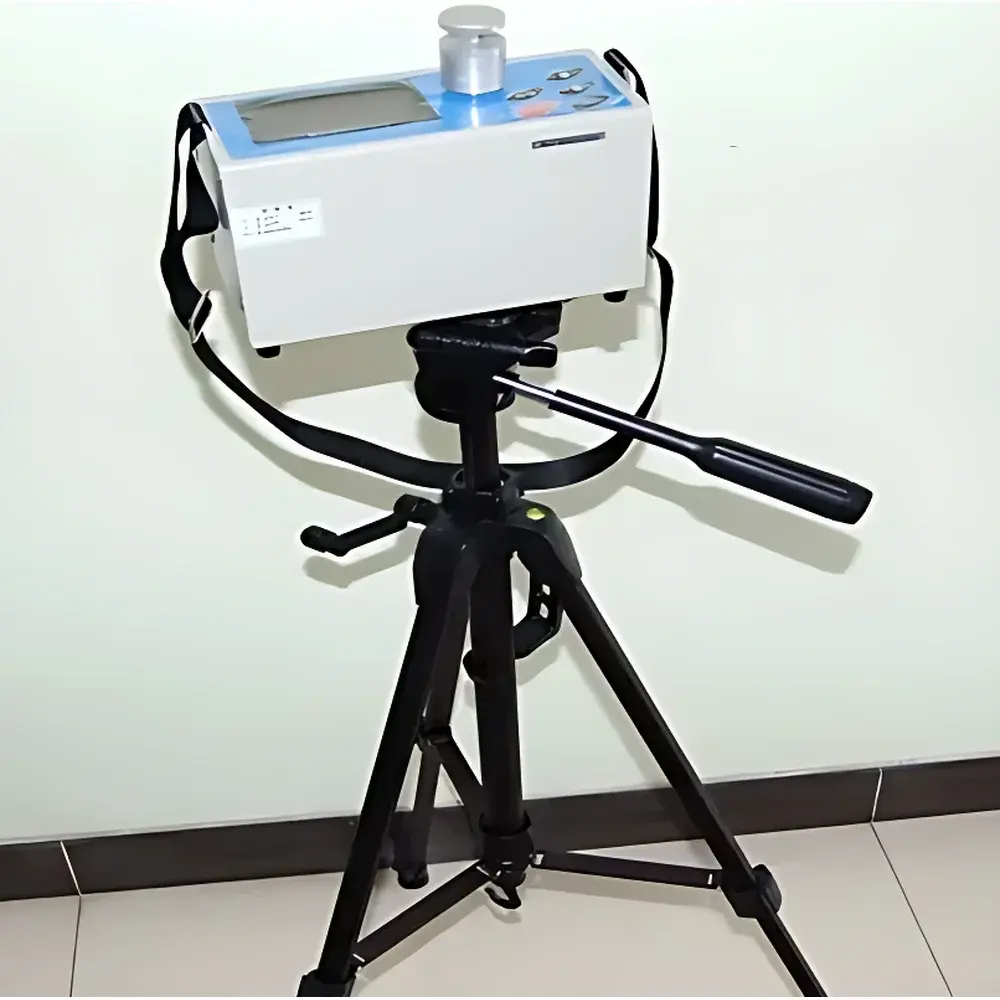
Handheld PM2.5 Particulate Matter Monitor
| Origin | Beijing, China |
|---|---|
| Manufacturer Type | Authorized Distributor |
| Origin Category | Domestic (China) |
| Model | PM2.5 |
| Price Range | USD 14,000 – 21,000 |
| Measurement Principle | Laser Light Scattering |
| Measured Parameters | PM1, PM2.5, PM5, PM10, TSP (optional with certified cyclone cutters) |
| Detection Range | 0.01–10 mg/m³ |
| Minimum Resolution | 0.001 mg/m³ |
| LOD | 2 µg/m³ |
| Sampling Flow Rate | 2.83 L/min |
| Cut-Point Performance | Da₅₀ = 10 ± 0.5 µm, σg = 1.5 ± 0.1 |
| Repeatability | RSD < 7% (n ≥ 6) |
| Total Uncertainty vs. Gravimetric Reference | ≤25% ROU |
| Data Logging Interval | 1–9999 s |
| Display Update Interval | 1–9999 s |
| Calibration Method | NIST-traceable optical membrane standard |
| Humidity Compensation | Real-time digital auto-correction |
| Communication Interfaces | RS232, optional analog output (4–20 mA), USB, Ethernet |
| Software Compatibility | ISO/IEC 17025-aligned air quality data management suite with audit trail, time-stamped records, and real-time trend visualization |
Overview
The Handheld PM2.5 Particulate Matter Monitor is a portable, field-deployable instrument engineered for real-time, quantitative assessment of airborne particulate mass concentration in the respirable size fraction. It operates on the principle of laser light scattering—where a collimated diode laser beam interrogates aerosol-laden air drawn through a precisely defined sampling volume; scattered photons are collected by a high-sensitivity photodetector array and converted into mass concentration via factory-calibrated Mie scattering algorithms. The device complies with the fundamental physical basis outlined in ISO 25500:2015 (Air quality — General aspects — Vocabulary) and aligns with the size-selective performance criteria specified in ISO/CEN TR 19857:2020 for PM2.5 samplers. Designed for operational robustness in variable ambient conditions, it integrates continuous humidity compensation and flow-controlled aspiration to ensure metrological consistency across temperature and relative humidity gradients typical of indoor air quality (IAQ), occupational hygiene, and ambient monitoring applications.
Key Features
- Laser-based optical detection system with 650 nm diode laser source and optimized angular scattering geometry for enhanced sensitivity in the 0.3–10 µm aerodynamic diameter range
- Interchangeable, NIST-traceable impactor/cyclone assemblies—certified by national metrology institutes—for selective measurement of PM1, PM2.5, PM5, PM10, and TSP with Da₅₀ and geometric standard deviation (σg) validated per ISO 13528 and EN 12341
- Dual-channel digital signal processing architecture enabling simultaneous real-time calculation of instantaneous concentration, moving average (1–60 min), and time-weighted average (TWA) exposure metrics
- Integrated thermal mass flow controller maintaining constant 2.83 L/min volumetric flow rate across pressure differentials up to ±15 kPa, meeting ISO 7708:1995 requirements for personal sampling pumps
- On-device data storage (≥32,000 records) with UTC timestamping, battery-backed memory, and automatic power-fail recovery
- RS232 serial interface supporting Modbus RTU protocol; optional USB-C and 10/100BASE-TX Ethernet for integration into centralized environmental monitoring networks
- Embedded firmware compliant with IEC 62443-3-3 for industrial cybersecurity; audit log retains all configuration changes, calibration events, and user actions
Sample Compatibility & Compliance
The instrument is validated for use with ambient air, recirculated HVAC airstreams, vehicle cabin environments, and industrial workspaces where particulate loading remains within its dynamic range (0.01–10 mg/m³). Its inlet design satisfies ISO 7708:1995 inhalability conventions, and all cyclone cutters carry official test reports from CNAS-accredited laboratories confirming Da₅₀ and σg conformity. The system meets the data integrity requirements of GLP (OECD Series No. 1, 2018) and supports 21 CFR Part 11-compliant electronic records when used with validated software modules. It does not require radioactive sources or consumable filters during routine operation, reducing lifecycle maintenance overhead.
Software & Data Management
The optional AirQuality Suite v4.x is a Windows-based application qualified under ISO/IEC 17025:2017 Annex A.3 for data acquisition, validation, and reporting. It provides configurable alarm thresholds, automated report generation (PDF/CSV), spectral trend overlays, and batch export with cryptographic hash verification. All raw scatter signals, environmental metadata (T/RH/pressure), and calibration logs are retained with immutable timestamps. Audit trails include operator ID, action type, and pre-/post-change values—fully traceable for regulatory inspection or third-party accreditation audits.
Applications
- Indoor air quality verification in commercial buildings, schools, and healthcare facilities per ASHRAE Standard 62.1
- OEL (Occupational Exposure Limit) compliance monitoring for respirable dust in mining, construction, and manufacturing settings
- Real-time validation of HEPA filtration efficiency in cleanrooms and isolation wards
- Mobile ambient monitoring campaigns supporting urban airshed modeling and PM source apportionment studies
- Post-remediation verification following asbestos or mold abatement activities
- Calibration transfer reference for fixed-site beta attenuation monitors (BAM) and tapered element oscillating microbalances (TEOM)
FAQ
Does this instrument meet EPA equivalency requirements for PM2.5 monitoring?
It is not designated as a Federal Equivalent Method (FEM) under 40 CFR Part 53, but it is suitable for supplemental monitoring, engineering controls verification, and exposure assessment where regulatory-grade FEM instruments are not required.
Can the device be calibrated in-field without returning to a service center?
Yes—using the supplied NIST-traceable optical membrane standard and guided calibration workflow in the embedded menu, users can perform full optical gain adjustment and zero verification onsite.
Is humidity correction algorithm publicly documented?
The correction model is based on empirical polynomial fitting derived from inter-laboratory round-robin testing per ISO 5725-2; full algorithm documentation is provided under NDA for accredited laboratories.
What is the expected battery life under continuous logging mode?
With lithium-ion battery pack (14.4 V / 4.4 Ah), continuous operation at 10-second update interval yields ≥8 hours of runtime; battery health monitoring and low-power sleep states extend service intervals.
Are firmware updates available, and how are they deployed?
Firmware revisions are released quarterly and delivered via signed .hex packages; installation requires authenticated USB connection and dual-operator confirmation to preserve configuration integrity.
Related Products







