
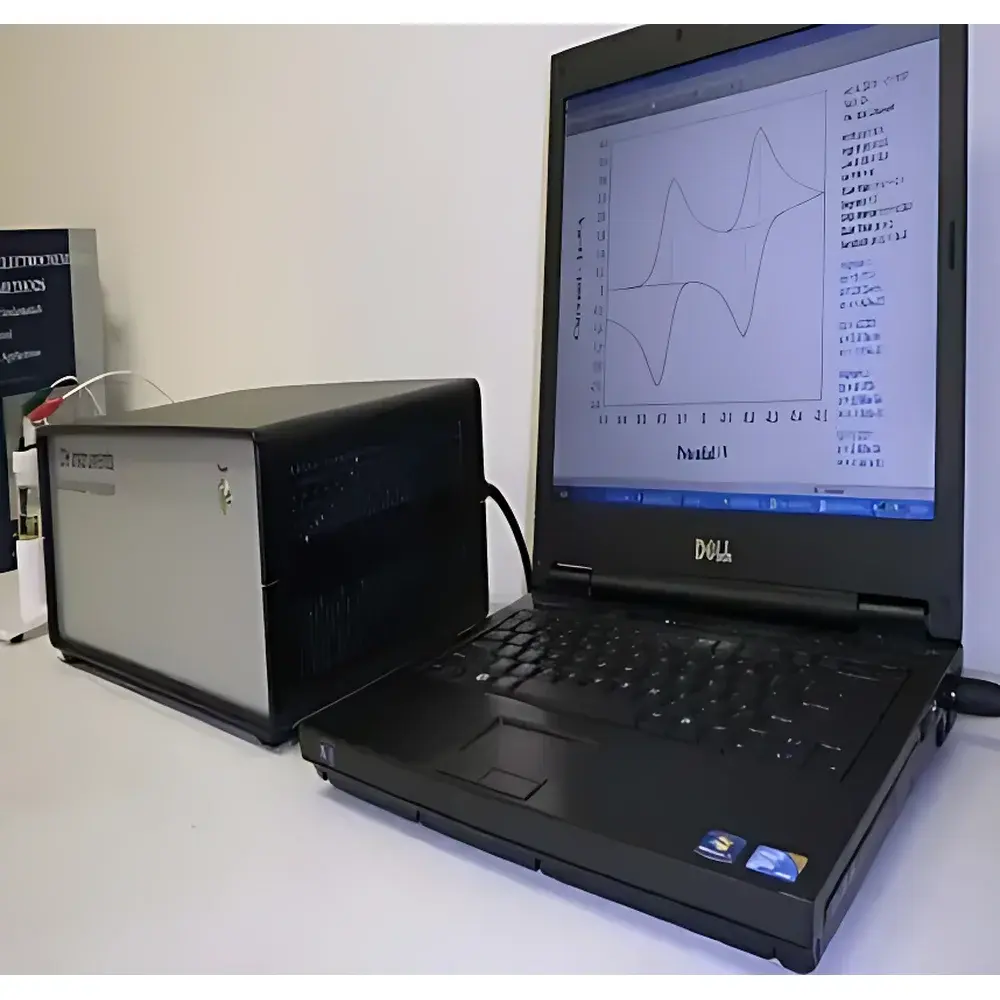
CH Instruments CHI400C Series Electrochemical Quartz Crystal Microbalance (EQCM)
| Origin | Beijing, China |
|---|---|
| Manufacturer Type | Authorized Distributor |
| Origin Category | Domestic (PRC) |
| Model | CHI400C |
| Pricing | Available Upon Request |
Overview
The CH Instruments CHI400C Series Electrochemical Quartz Crystal Microbalance (EQCM) is a fully integrated, time-resolved analytical platform engineered for simultaneous high-precision electrochemical control and nanogram-level mass detection. Based on the piezoelectric resonance principle of AT-cut quartz crystals, the system leverages the Sauerbrey relationship—Δf = −2f₀²Δm / [A·√(ρμ)]—to convert frequency shifts (Δf) into quantitative mass changes (Δm) at the electrode–electrolyte interface. With a fundamental resonant frequency of 7.995 MHz and a gold-coated active area of 0.196 cm², the instrument achieves a mass sensitivity of 1.34 ng/Hz under ideal rigid-film conditions. Unlike conventional frequency-counting EQCM systems limited by integration-time trade-offs, the CHI400C employs heterodyne-based period measurement between the crystal oscillation and a stable reference frequency—enabling sub-millisecond temporal resolution with ≤1 Hz frequency resolution. This architecture supports real-time coupling with fast electrochemical techniques such as cyclic voltammetry (CV) at scan rates up to 0.5 V/s while maintaining synchronous QCM signal acquisition.
Key Features
- Integrated dual-function design: simultaneous operation as a high-performance potentiostat/galvanostat (Model 440C core) and time-resolved QCM analyzer
- Heterodyne frequency measurement engine enabling millisecond-scale sampling with 1 Hz or better frequency resolution
- Potentiostat specifications: ±10 V potential range, ±250 mA current range, <50 pA input bias current, <1 pA current resolution, 16-bit data acquisition at 1 MHz
- Electrochemical method support: CV, LSV, CA, CP, i-t, DPV, NPV, SWV, ACV, SHACV, Tafel, BE, HMV, STEP, PSA, OCPT, and more—fully programmable via CHI software
- Four-electrode capability for accurate high-current or low-impedance measurements (e.g., battery/electrolyzer studies), eliminating lead resistance artifacts
- Real-time monitoring of both resonant frequency shift (Δf) and motional resistance (ΔR) of the QCM crystal network
- Digital signal generation at 10 MHz update rate; CV potential increment as fine as 0.1 mV even at 1000 V/s scan speed
- Configurable low-pass current filtering across eight decades (100 Hz – 1 MHz), automatic/manual iR compensation, and adjustable gain stages
Sample Compatibility & Compliance
The CHI400C accommodates standard 13.7 mm diameter AT-cut quartz crystals with centrally sputtered 5.1 mm gold electrodes (custom electrode materials available upon request). Its purpose-built PTFE three-piece electrochemical cell (Ø35 mm × H37 mm) ensures robust sealing via elastomeric O-rings and modular electrode mounting—compatible with standard Ag/AgCl, SCE, or custom reference electrodes. The system operates in two-, three-, or four-electrode configurations, supporting aqueous and non-aqueous electrolytes, polymer electrolytes, and thin-film solid-state interfaces. While not pre-certified to specific regulatory frameworks, its hardware architecture and software logging capabilities—including timestamped parameter sets, raw data export (ASCII/CSV), and full experimental metadata capture—are compatible with GLP/GMP-aligned laboratory practices. Data integrity features align with principles outlined in FDA 21 CFR Part 11 when used with validated CHI software and controlled IT environments.
Software & Data Management
Control and analysis are performed using CH Instruments’ proprietary Windows-based software, which provides synchronized acquisition of electrochemical waveforms and QCM frequency/resistance transients. All experiments are scriptable via built-in command language or external API (COM/ActiveX). Raw datasets include time-stamped voltage, current, Δf, and ΔR channels with user-defined sampling intervals. Export formats include ASCII tab-delimited, CSV, and binary (.chi) for post-processing in MATLAB, Python (NumPy/Pandas), or Origin. Audit trail functionality records operator ID, method parameters, calibration history, and file modification timestamps—supporting traceability requirements in regulated research settings. No cloud connectivity or remote telemetry is embedded; all data remains local unless explicitly exported by the user.
Applications
The CHI400C serves as a foundational tool in interfacial electrochemistry and dynamic thin-film science. Key use cases include: in situ monitoring of metal electrodeposition/dissolution kinetics (e.g., Cu, Ni, Zn); ion insertion/extraction mass balances in battery electrode materials (LiCoO₂, Si anodes); swelling/deswelling dynamics of conducting polymers (PEDOT, polyaniline) during redox switching; quantification of biomolecular adsorption (DNA, antibodies, enzymes) onto functionalized QCM surfaces; real-time assessment of corrosion inhibitor film formation; and mechanistic validation of coupled charge/mass transport in fuel cell catalyst layers. Its millisecond resolution enables direct correlation between Faradaic current transients and concurrent mass flux—critical for distinguishing diffusion-controlled vs. surface-confined processes per IUPAC definitions.
FAQ
What is the standard QCM crystal specification supported by the CHI400C?
The system is calibrated for 7.995 MHz AT-cut quartz crystals with 5.1 mm diameter gold electrodes on a 13.7 mm substrate. Custom crystals with alternative coatings (Pt, C, ITO) or frequencies are supported with recalibration.
Can the CHI400C operate as a standalone QCM without electrochemical control?
Yes—the QCM oscillator, frequency counter, and data acquisition subsystems function independently of potentiostatic operation, enabling pure gravimetric sensing mode.
Is four-electrode electrochemical measurement supported?
Yes—dedicated working, counter, reference, and sense terminals eliminate uncompensated resistance errors in high-conductivity or high-current systems.
What is the minimum detectable mass change under typical operating conditions?
Based on Sauerbrey theory and 1 Hz frequency resolution, the theoretical limit is ~1.34 ng for rigid, uniformly distributed films; actual resolution depends on noise floor, temperature stability, and film viscoelastic behavior.
Does the system comply with ISO/IEC 17025 or ASTM E2008 standards?
The instrument is not certified to these standards, but its performance characteristics (e.g., current resolution, timing accuracy, linearity) meet or exceed typical requirements for EQCM methods referenced in ASTM E2008-19 (Standard Guide for EQCM Use in Corrosion Studies).




