
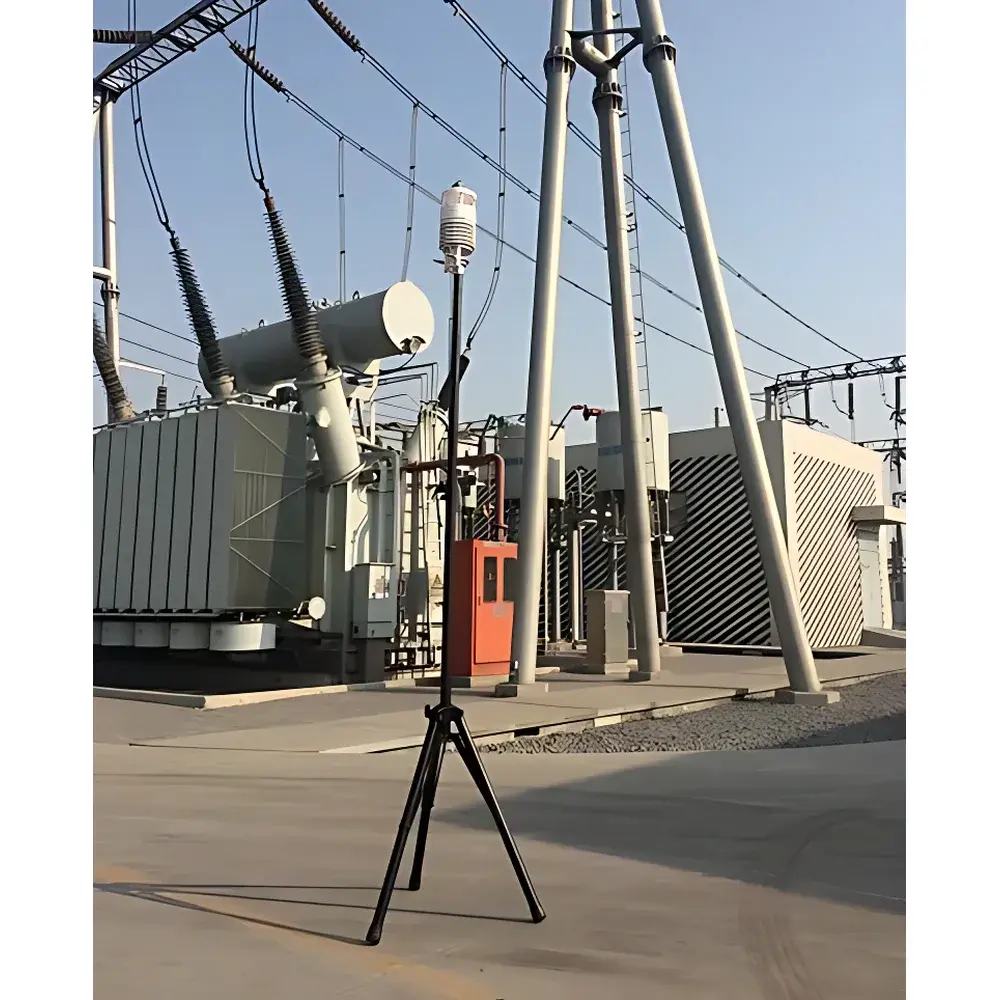
ZYKX-700 True Portable Ultrasonic 7-Parameter Weather Station
| Brand | ZYKX |
|---|---|
| Origin | Beijing, China |
| Model | ZYKX-700 |
| Instrument Type | Handheld Weather Station |
| Temperature Range | −50 °C to +80 °C |
| Temp. Resolution | 0.1 °C |
| Temp. Accuracy | ±0.2 °C |
| RH Range | 0–100% |
| RH Resolution | 1% |
| RH Accuracy | ±2% |
| Barometric Pressure Range | 100–1300 hPa |
| Pressure Resolution | 0.1 hPa |
| Pressure Accuracy | ±0.3 hPa |
| Wind Speed Range | 0–75 m/s |
| Wind Speed Resolution | 0.1 m/s |
| Wind Speed Accuracy | ±(0.3 m/s or 3%) |
| Wind Direction Range | 0–360° |
| Wind Direction Resolution | 1° |
| Wind Direction Accuracy | ±3° |
| Rainfall Measurement Principle | Optical |
| Rainfall Resolution Options | 0.001 mm / 0.01 mm / 0.2 mm |
| Power Input | 12–30 V DC |
| Heating Power | 30 W |
| Communication Interface | RS485 (RS232 optional) |
| MTBF | 8500 h |
| Operating Temperature | −50 °C to +80 °C |
| Storage Temperature | −50 °C to +80 °C |
| Power Supply Options | Mains, Solar, or Hybrid |
Overview
The ZYKX-700 True Portable Ultrasonic 7-Parameter Weather Station is a field-deployable, integrated environmental sensing platform engineered for high-fidelity, real-time acquisition of seven core meteorological variables: ambient temperature, relative humidity, barometric pressure, wind speed, wind direction, rainfall, and solar irradiance (via optional integrated pyranometer support). Unlike conventional anemometer-based stations, the ZYKX-700 employs dual-axis ultrasonic time-of-flight transduction for contactless, moving-part-free wind measurement—eliminating mechanical wear, icing artifacts, and directional dead zones. Atmospheric parameters are acquired via NIST-traceable digital sensors with factory calibration certificates, and all measurements are synchronized to a common internal timestamp with microsecond-level resolution. Designed for rapid deployment in remote terrain, disaster response zones, agricultural field trials, and urban microclimate studies, the system operates autonomously across extreme thermal envelopes (−50 °C to +80 °C) and supports hybrid power architectures—including solar-rechargeable lithium-iron-phosphate battery banks—to ensure continuous operation without grid dependency.
Key Features
- Ultrasonic wind sensor with no moving parts: Enables maintenance-free operation over >8,500 hours MTBF and immunity to ice accumulation, dust clogging, or bearing degradation.
- Multi-sensor fusion architecture: Simultaneous sampling of temperature, humidity, pressure, wind vector, optical rain detection, and irradiance (optional) at configurable intervals from 1 second to 60 minutes.
- Open communication protocol: Fully documented Modbus RTU over RS485 (RS232 available on request), enabling seamless integration with SCADA systems, PLCs, edge gateways, and custom data loggers.
- Ruggedized industrial enclosure: IP66-rated aluminum housing with integrated heating element (30 W, 12–30 V DC input) for low-temperature condensation control and optical rain sensor de-icing.
- Local data resilience: Onboard non-volatile memory stores up to 1 million timestamped records; data retention persists through power loss or network interruption.
- Modular mounting flexibility: Compatible with telescoping masts (3–10 m height), tripod bases, vehicle roof rails, and building façade brackets—no concrete foundation required.
Sample Compatibility & Compliance
The ZYKX-700 meets fundamental performance criteria aligned with international observational standards including WMO Guide to Instruments and Methods of Observation (CIMO Guide, Chapter 12), ISO 16484-5 (Building Automation Systems), and ASTM D5096 (Standard Practice for Calibration of Environmental Sensors). While not certified to IEC 61000-4 electromagnetic immunity suites out-of-box, its RS485 interface complies with EN 50170 Part 1 for industrial fieldbus robustness. Sensor calibrations are traceable to national metrology institutes via manufacturer’s certificate of conformance (CoC), and all firmware revisions adhere to ISO/IEC 17025 documentation requirements for measurement uncertainty reporting. The optical rain gauge conforms to WMO precipitation measurement guidelines for drop-size-insensitive detection, minimizing undercatch during convective events.
Software & Data Management
Data output is natively structured in ASCII-based Modbus registers, supporting direct ingestion into industry-standard platforms including Campbell Scientific LoggerNet, CR1000X firmware, Ignition SCADA, Grafana (with Telegraf plugin), and Python-based analysis pipelines (e.g., Pandas + Xarray). Optional ZYKX Cloud Gateway provides TLS 1.2-encrypted MQTT transmission to AWS IoT Core or Azure IoT Hub, with built-in data buffering during intermittent connectivity. All firmware updates are signed and validated; audit logs record configuration changes, calibration resets, and firmware version transitions—supporting GLP/GMP-aligned data integrity workflows. Remote diagnostics include live sensor health telemetry (e.g., ultrasonic transducer impedance drift, heater duty cycle, voltage sag history), accessible via secure SSH or web-based REST API.
Applications
- Agricultural microclimate monitoring: High-temporal-resolution tracking of dew point depression, vapor pressure deficit (VPD), and wind-driven pesticide drift vectors for precision irrigation and spray scheduling.
- Renewable energy site assessment: Long-term wind shear profiling, turbulence intensity calculation (TI = σV/V̄), and solar irradiance correlation for pre-construction feasibility modeling.
- Wildfire risk forecasting: Real-time FFDI (McArthur Forest Fire Danger Index) inputs via concurrent temperature, RH, wind speed, and drought factor derivation.
- Urban heat island (UHI) studies: Dense-network deployment across heterogeneous land cover types to quantify spatial gradients in air temperature and boundary-layer ventilation rates.
- Disaster response coordination: Rapidly deployable node for post-hurricane wind damage validation, flash flood early warning via optical rain accumulation rate thresholds, and atmospheric stability profiling during HAZMAT incidents.
FAQ
What power sources are compatible with the ZYKX-700?
The station accepts 12–30 V DC input and supports mains adapters, solar charge controllers (with MPPT), and hybrid configurations. A 20 Ah LiFePO₄ battery pack enables >72 h autonomy during extended cloud cover.
Is the ultrasonic wind sensor suitable for icy environments?
Yes—the integrated 30 W heating circuit maintains transducer surface temperature above freezing during operation, and the absence of mechanical cups/vanes prevents ice jamming.
Can rainfall data be correlated with wind-driven horizontal precipitation?
Optical rain detection is inherently insensitive to wind-induced trajectory distortion; however, simultaneous wind vector logging allows post-hoc correction models (e.g., using WMO Annex 8 guidance) to estimate true vertical accumulation.
Does the system support NTP time synchronization?
No—internal RTC is calibrated to ±2 ppm accuracy over the operating range; external NTP sync requires gateway-level integration (e.g., via Raspberry Pi edge node running chrony).
Are calibration certificates provided with each unit?
Yes—each sensor module ships with a factory calibration report listing as-tested values, uncertainties, and reference standards used (e.g., Fluke 9142 for temperature, Rotronic HC2-S for humidity).







