
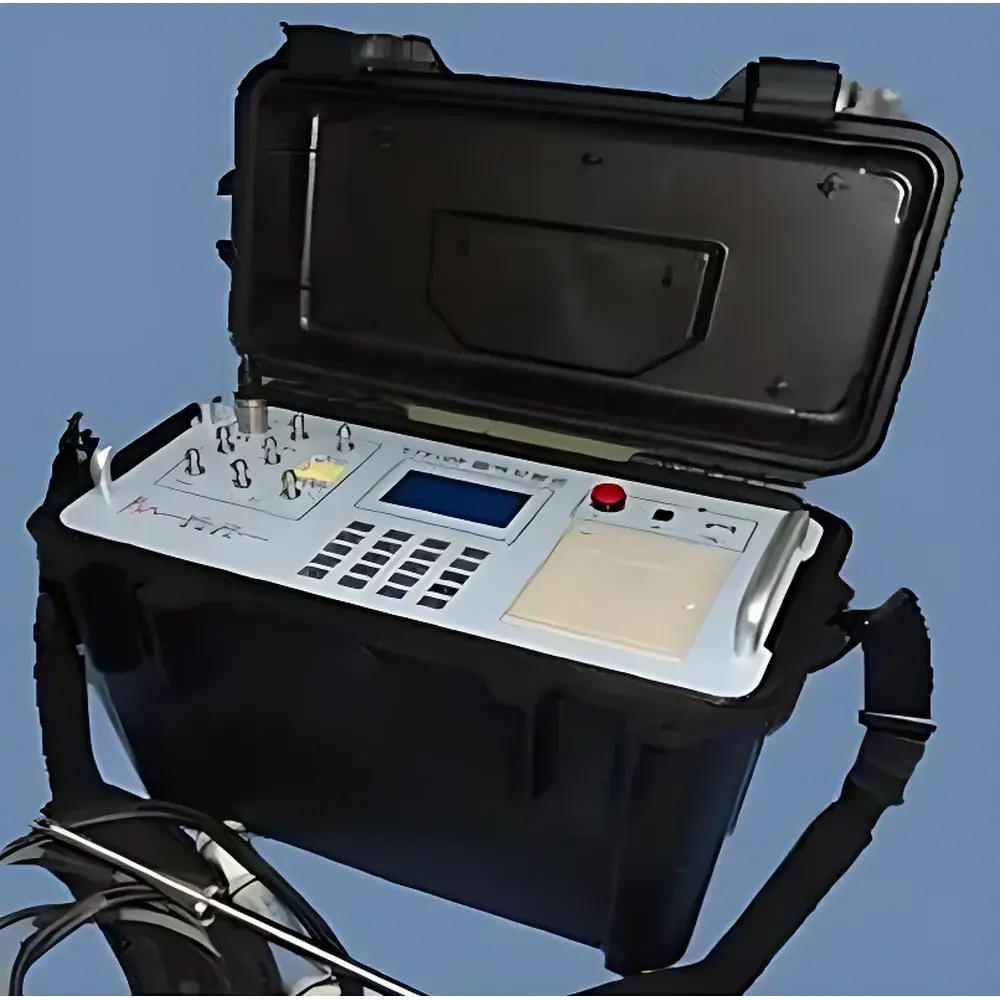
ZYET-5100 Portable Flue Gas Analyzer
| Origin | Beijing, China |
|---|---|
| Manufacturer Type | Authorized Distributor |
| Origin Category | Domestic (PRC) |
| Model | ZYET-5100 |
| Price Range | USD 1,400 – 7,000 |
| Instrument Type | Portable Flue Gas Analyzer |
| Indication Error | ≤ ±5% FS |
| Repeatability | ≤ 2% RSD |
| Response Time | ≤ 90 s (T₉₀) |
| Stability | ≤ ±5% FS/8 h |
| Measurement Principles | Electrochemical (O₂, NO, NO₂, SO₂, CO) |
| O₂ Range | 0–20.9 vol% |
| NO | 0–1000 ppm |
| NO₂ | 0–100 ppm |
| SO₂ | 0–2000 ppm |
| CO | 0–2000 ppm |
| Ambient Temp | 0–200 °C |
| Flue Gas Temp | 0–400 °C |
| Static Pressure | −30 to +30 kPa |
| Differential Pressure | 0–2.5 kPa |
| Resolution | O₂: 0.1 vol% |
| Gases | 1 ppm |
| Temp | 1 °C |
| Pressure | 0.01 kPa (Static), 1 Pa (Differential) |
| Accuracy | O₂: ±0.5% FS |
| Gases | ±5% FS |
| Temp | ±1% (Ambient), ±2% (Flue) |
| Pressure | ±3% FS |
| Data Storage | 500 measurement sets |
| Power | Internal 6 V × 2 rechargeable battery |
| Dimensions (W×D×H) | 417 × 234 × 318 mm |
| Weight | ~10 kg (configuration-dependent) |
| Operating Environment | −0°C to +40°C |
Overview
The ZYET-5100 Portable Flue Gas Analyzer is an engineered field instrument designed for in-situ measurement of combustion exhaust gases in industrial and regulatory environments. It operates on a dual-path sampling architecture: an integrated diaphragm pump draws flue gas through a temperature- and pressure-compensated probe, followed by sequential analysis via electrochemical sensors for O₂, NO, NO₂, SO₂, and CO. CO₂ concentration is derived stoichiometrically from O₂ depletion and fuel-specific excess air ratio (λ). The system incorporates real-time compensation for flue gas temperature (up to 400 °C), ambient temperature (0–200 °C), static pressure (±30 kPa), and differential pressure (0–2.5 kPa), enabling accurate volumetric flow calculation when paired with a Pitot tube. Its core design adheres to the physical and metrological requirements defined in ISO 12039, EN 15267-3, and EPA Method 6C for portable emission monitoring—particularly where rapid deployment, battery autonomy, and multi-parameter correlation are critical.
Key Features
- Modular sensor architecture supporting up to six simultaneously active electrochemical cells, automatically identified by the host firmware upon insertion
- Onboard data logging capacity for 500 complete measurement records—including gas concentrations, temperature gradients, pressure differentials, λ values, and calculated normalized emissions (e.g., mg/m³ @ 5% O₂)
- Integrated thermal printer for immediate hard-copy reporting compliant with field audit requirements
- Self-contained 12 V DC power system with dual 6 V rechargeable batteries, enabling continuous operation >4 hours without AC input
- Standard 300 mm heated probe with embedded Pt100 sensor and particulate pre-filter; compatible with optional ZYET-3901 heated sampling system (190 °C max, Peltier-cooled condensate removal at 5 °C)
- Real-time stoichiometric engine calculating excess air ratio (λ), reference oxygen correction, and mass-based emission rates using user-defined fuel coefficients
- Calibration-friendly interface allowing zero/span verification and sensor-specific gain adjustment without proprietary software or service tools
Sample Compatibility & Compliance
The ZYET-5100 is validated for use across coal-, oil-, gas-, and biomass-fired combustion sources including utility boilers, industrial furnaces, cement kilns, glass melters, and municipal waste incinerators. It meets functional equivalence to EN 14181 (QAL2/QAL3) for periodic performance verification and supports GLP-aligned documentation workflows. Sensor cross-sensitivity profiles are characterized per IEC 62942-2, with built-in algorithms compensating for known interferences (e.g., NO₂ cross-response in NO channels). All pressure and temperature transducers conform to IEC 61298-2 accuracy classes. The instrument’s housing satisfies IP54 ingress protection, and its electrical design complies with IEC 61010-1 for measurement category CAT II 300 V pollution degree 2 environments.
Software & Data Management
Data export is supported via USB 2.0 interface in CSV format, retaining full metadata (timestamp, GPS coordinates if externally tagged, calibration history, sensor serials, and operator ID). Firmware implements secure audit trails per FDA 21 CFR Part 11 Annex 11 principles: all parameter changes, calibration events, and report generations are time-stamped, user-logged, and non-erasable. Optional PC software provides batch normalization against reference O₂ levels, trend visualization of λ vs. load, and automated generation of compliance reports aligned with Chinese HJ/T 76–2017 and EU BREF LCP Annex VIII templates. No cloud dependency or subscription model is required—the system operates fully offline.
Applications
- Regulatory stack testing during CEMS validation and periodic QA/QC audits under national emission standards
- Commissioning and optimization of SCR/SNCR denitrification and wet/dry FGD systems
- Combustion efficiency diagnostics—including air-fuel ratio tuning, heat loss estimation, and unburnt carbon assessment
- Mobile source testing for diesel generator sets and heavy-duty vehicle exhaust characterization
- Research-grade flue gas profiling in academic combustion laboratories requiring trace gas resolution and thermal stability
- Emergency response screening for accidental releases involving SO₂, CO, or nitrogen oxides in confined industrial spaces
FAQ
What standards does the ZYET-5100 comply with for field emission testing?
It fulfills technical equivalency to ISO 12039, EN 15267-3, and HJ/T 76–2017 for portable analyzer performance, including linearity, drift, and interference testing protocols.
Can the ZYET-5100 measure CO₂ directly?
No—it calculates CO₂ concentration indirectly based on O₂ depletion and user-input fuel composition, following standard stoichiometric relationships defined in ISO 14956.
Is the ZYET-3901 heated sampling system mandatory for compliance-grade measurements?
While not mandatory, its use is strongly recommended for high-moisture or low-temperature flue streams (e.g., biomass or waste incineration) to prevent condensate formation and sensor poisoning, thereby ensuring long-term accuracy and sensor longevity.
How often must electrochemical sensors be calibrated?
Zero and span calibration is advised before each daily measurement campaign; full sensor verification against certified gas standards is required every 90 days or after 200 hours of cumulative operation, whichever occurs first.
Does the instrument support differential pressure-based velocity calculation?
Yes—when connected to a Pitot tube and configured with duct geometry parameters, it computes real-time volumetric flow rate (Nm³/h) using ISO 16911-compliant algorithms, including compressibility and moisture correction factors.







